
Sexual Harassment Policies: Smithsonian Has Procedures for Prevention, but Could Improve Guidance and Monitoring
Fast Facts
The Smithsonian Institution—the world’s largest museum, education, and research complex—has thousands of employees and supports or funds thousands of academic appointees such as interns and researchers.
We looked at Smithsonian’s process for responding to sexual harassment complaints and found:
Supervisors lack written guidance on addressing complaints
No process for tracking complaints made to supervisors
Academic appointees are not surveyed on organizational climate, a key predictor of workplace sexual harassment
We made 3 recommendations, including that the Smithsonian include all of its workforce in organizational climate assessments.
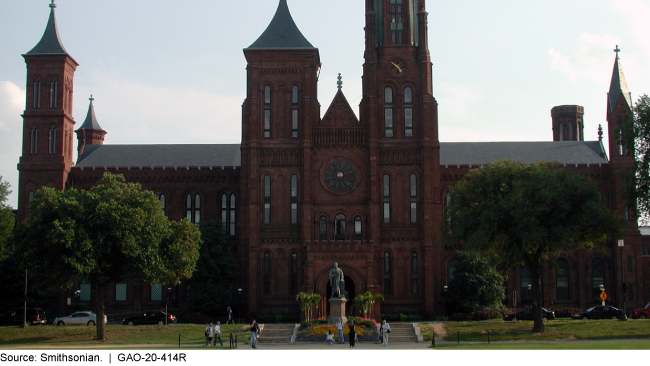
Large brick building with a statue and trees
Highlights
What GAO Found
The Smithsonian Institution is the world's largest museum, education, and research complex. It has several thousand employees and supports or funds thousands of affiliated persons—a term Smithsonian officials use to cover all personnel working with the Smithsonian who are not employees, including contractors and volunteers. The Smithsonian provides two non-mutually exclusive processes for addressing allegations of sexual harassment for both affiliated persons and employees, according to officials (see table). The first process, developed by the Equal Employment Opportunity Commission and implemented by the Smithsonian's Office of Equal Employment and Minority Affairs, addresses formal complaints made to this office. The second, known as the management process, addresses complaints made to unit supervisors. Use of one or both processes for resolving a complaint is up to the preference of the employee or affiliated person filing the complaint. While the federal Equal Employment Opportunity Commission establishes guidance on the first process, the Smithsonian does not provide specific written guidance to supervisors on how to address complaints of sexual harassment under the second process, which is inconsistent with federal internal control standards. Supervisors might be better prepared for addressing and responding to sexual harassment complaints with specific written guidance. Nor are there procedures or processes for tracking complaints raised through that process, inconsistent with the institution's strategic plan. The Smithsonian's 2022 Strategic Plan calls for greater collaboration and coordination between central administration and other parts of the institution, and tracking could help central administration monitor trends and ensure that complaints are addressed.
Smithsonian Processes for Addressing Allegations of Sexual Harassment
|
Equal Employment Opportunity process |
Management process |
|
|
Source: GAO analysis of Smithsonian Institution documentation and interviews. I GAO-20-414R
The Smithsonian has hiring, appointment, and training policies for employees and affiliated persons—specifically, academic appointees such as interns, fellows, and research associates—to help prevent sexual harassment. According to officials, all Smithsonian units are required to follow policies for hiring employees that encourage managers to check references at a candidate's prior workplace. Policies for appointees typically also require reference checks. In addition, academic appointees and employees receive information regarding the Smithsonian's prevention policies primarily through mandatory workplace harassment training, new personnel paperwork, and agency-wide directives.
Why GAO Did This Study
Increasingly, studies and news reports are highlighting the pervasiveness of sexual misconduct in the scientific community, particularly in academic and research settings. Title VII prohibits employment discrimination on the basis of sex—including sexual harassment. The Smithsonian, while not a federal grant-making agency, was established by Congress and supports a wide variety of scientific research and programs across a multitude of museums, research institutes, and research offices. GAO was asked to review how the institution responds to allegations of sexual harassment and the agency's sexual harassment prevention efforts through hiring and training policies.
This report examines: (1) the extent to which the Smithsonian has processes in place to respond to allegations of sexual harassment by employees and affiliated persons, and (2) the extent to which the Smithsonian has hiring, appointment, and training policies in place to prevent sexual harassment for employees and affiliated persons—particularly academic appointees. GAO reviewed agencies' relevant regulations and documentation and interviewed Smithsonian officials.
Recommendations
GAO is making three recommendations to the Smithsonian, including updating guidance for supervisors on how to address sexual harassment complaints and establishing a tracking mechanism for sexual harassment complaints filed with supervisors. The Smithsonian agreed with all three recommendations and created and staffed a position to coordinate its future actions to implement them.
Recommendations for Executive Action
| Agency Affected | Recommendation | Status |
|---|---|---|
| Smithsonian Institution | The Secretary of the Smithsonian should develop written guidance for supervisors specific to how to address complaints of sexual harassment filed under the management process—which may include updating current written guidance for supervisors on handling misconduct, such as the Supervisor's Compass and Smithsonian Directives 212 and 213 (Chapter 752). (Recommendation 1) |
The Smithsonian agreed with the recommendation. As of January 2021, the Smithsonian has launched a new program-SI Civil-to oversee the anti-harassment and workplace violence prevention policies. As a part of this new program, the Smithsonian updated these policies in December 2020 to include additional information on how both employees and affiliated staff may report complaints of sexual harassment to supervisors. Additionally, they developed an associated SI Civil Handbook which includes guidance for supervisors on reporting complaints-including sexual harassment-for immediate action.
|
| Smithsonian Institution | The Secretary of the Smithsonian should establish a tracking mechanism for complaints of sexual harassment filed under the management process—including procedures for supervisors within the units to convey reports of sexual harassment to the central Smithsonian administration and/or OEEMA. (Recommendation 2) |
The Smithsonian agreed with the recommendation. As of January 2021, the Smithsonian updated their anti-harassment policy to now require supervisors to report sexual harassment complaints to the central Smithsonian office via the new SI Civil Program. The SI Civil Handbook includes the specific procedures in order for supervisors to report any incidents. The SI Civil Coordinator will collect and track all data related to the anti-harassment policy and the SI Civil Program via a tracking spreadsheet and provide an annual report to Smithsonian leadership.
|
| Smithsonian Institution | The Secretary of the Smithsonian should include affiliated persons in measures used to assess organizational climate at the Smithsonian—which may include incorporating affiliated persons into current efforts or developing additional measures specific to these persons. (Recommendation 3) |
The Smithsonian agreed with this recommendation. According to a July 2021 response, the Smithsonian updated their Anti-Harassment Policy and Civil Handbook to specifically cover affiliated persons-such as visiting researchers and fellows-and to include onboarding and exit procedures. Given the variance in duration for affiliated persons on the Smithsonian premises, data will be collected independently, rather than included in the annual employee surveys. According to a July 2023 response, fellows are provided with a link to an exit survey to gather feedback and rate their experience. Responses help to improve procedures, fellowship programs, and appointments for future Smithsonian fellows. Individual units obtain feedback from interns using exit surveys, interviews, or other information-gathering methods to better improve their programs.
|