
National Flood Insurance Program: FEMA Can Improve Community Oversight and Data Sharing
Fast Facts
The National Flood Insurance Program can be most effective when participating communities take steps to reduce the risk of flood damage. To do so, communities must adopt the Federal Emergency Management Agency’s (FEMA) floodplain management requirements. For example, participating communities must ensure that property owners rebuild substantially damaged structures to meet current elevation standards.
FEMA visits communities to ensure that they’re following the requirements, but didn’t visit some high-risk communities for over 10 years. We recommended ways to improve oversight, such as assessing additional approaches to ensuring compliance.
Building on piers is one way to meet FEMA elevation standards
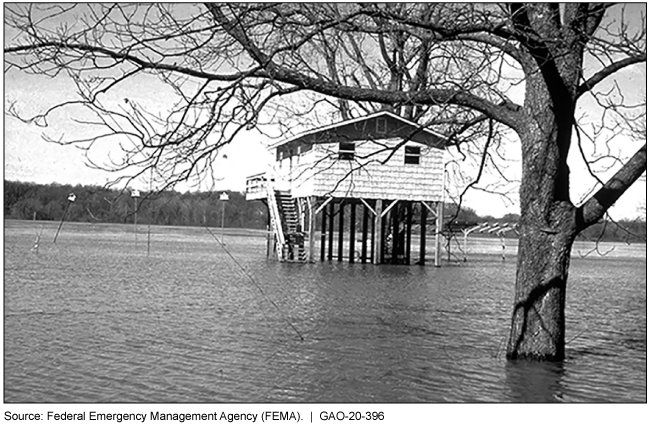
House on piers surrounded by water
Highlights
What GAO Found
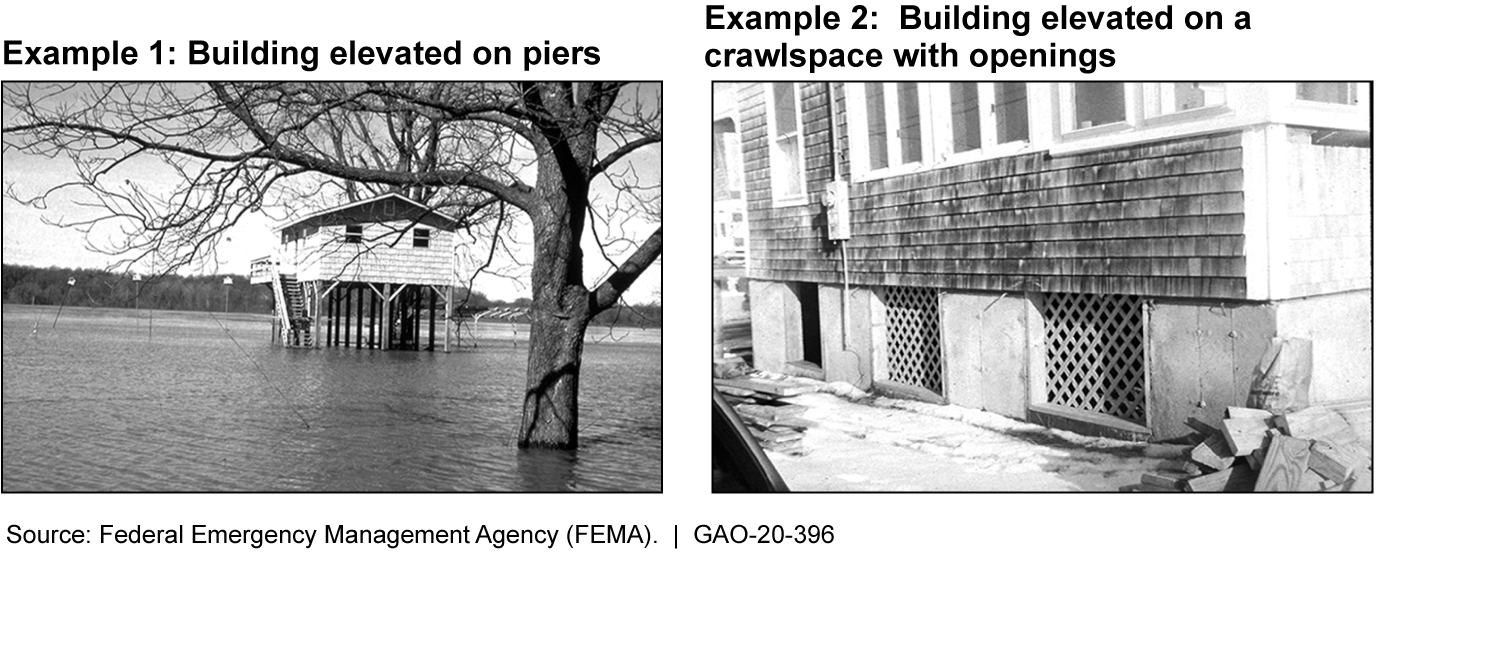
The Federal Emergency Management Agency (FEMA) requires communities participating in the National Flood Insurance Program (NFIP) to adopt FEMA floodplain maps; limit flooding caused by new development; and require that substantially damaged structures meet elevation requirements (see figure). Community floodplain officials cited challenges, including difficulty inspecting buildings after a flood, staff turnover, and adopting new NFIP flood maps.
Examples of How Buildings Can Meet Higher Elevation Requirements
FEMA primarily uses community assistance visits to monitor compliance with NFIP requirements. The visits include evaluations of recent construction. Until 2019, FEMA's goal was to visit all communities considered to be high-risk every 5 years. However, FEMA did not meet this goal in Texas or Florida in 2008–2019 because of a lack of resources. Many high-risk communities received only one visit in this period, and some were not visited at all. Without regular monitoring, FEMA's ability to ensure communities comply with requirements is limited. FEMA and state specialists also are to close out records of these visits in FEMA's tracking system if they find no deficiencies or violations, or when the community has resolved any issues. However, in Florida and Texas GAO found that records for many visits remained open for several years, and FEMA staff were unsure whether this indicated unresolved deficiencies or incomplete recordkeeping. Unreliable recordkeeping hinders FEMA's ability to assess community compliance with NFIP requirements.
After a flood, one key community responsibility is to assess whether flood damage on a property was substantial (50 percent or more of the property's value). In such cases, the community must ensure the properties are rebuilt to current NFIP standards. However, FEMA generally does not collect or analyze the results of these assessments, limiting its ability to ensure the process operates as intended. Furthermore, FEMA has not clarified how communities can access NFIP claims data. Such data would help communities target substantial damage assessments after a flood.
Why GAO Did This Study
NFIP's effectiveness depends in part on communities implementing FEMA requirements on floodplain management and post-disaster rebuilding efforts. GAO was asked to undertake a comprehensive evaluation of federal disaster preparedness, response, and recovery efforts. This report examines (1) requirements NFIP communities must meet and challenges they face, (2) FEMA's use of community visits to ensure compliance, and (3) how FEMA oversees community implementation of NFIP requirements for conducting substantial damage assessments.
GAO analyzed FEMA data on oversight visits and substantial damage assessments from January 2008 through July 2019. GAO also interviewed floodplain managers in 19 communities in Texas, Florida, and Louisiana, and officials from FEMA and floodplain management organizations.
Recommendations
GAO is making four recommendations to FEMA: The agency should (1) assess different approaches for ensuring compliance with NFIP requirements, (2) ensure data on community visits are up-to-date and complete, (3) ensure communities collect data on substantial damage assessments, and (4) clarify policies on data sharing between FEMA and NFIP communities. FEMA concurred with the recommendations.
Recommendations for Executive Action
| Agency Affected | Recommendation | Status |
|---|---|---|
| Federal Emergency Management Agency | The Administrator of FEMA should assess different approaches, in addition to community assistance visits, for using existing resources to ensure communities' compliance with NFIP requirements. This should include analyzing alternatives to community assistance visits. (Recommendation 1) |
In April 2024, FEMA provided GAO with new guidance for its revised Compliance Audit Process as well as its revised audit tool and screenshots to show different phases of the audit process. These documents demonstrate that FEMA considered different approaches to the community assistance visits to ensure communities' compliance with NFIP requirements.
|
| Federal Emergency Management Agency | The Administrator of FEMA should identify appropriate steps to ensure it has complete, up-to-date, and reliable records of community assistance visits, including information on why some visit records remain open for a significant period of time. (Recommendation 2) |
In September 2024, FEMA staff reported that the agency's efforts to modernize its Community Information System were complete and provided documentation of the revised system. FEMA noted that its new system allows for better coordination with NFIP communities to help them maintain compliance with requirements; more consistency and accuracy in tracking violations and deficiencies; and moves communities into the enforcement process of probation or suspension from the NFIP until violations and deficiencies are resolved, rather than leaving records open for a significant period of time without resolution. The new system will ensure that FEMA has complete, up-to-date, and reliable records of community assistance visits, which will enhance the agency's ability to collaborate with communities to reduce flood risk.
|
| Federal Emergency Management Agency | The Administrator of FEMA should ensure that communities are consistently collecting data on their substantial damage assessments and that FEMA has a way to readily access those data to evaluate community compliance with NFIP requirements for rebuilding substantially damaged properties. (Recommendation 3) |
In June 2023, FEMA provided GAO with copies of new tools, including new standard operating procedures, that provide communities with a way to consistently collect data on substantial damage assessment. FEMA officials noted that they tested this new post-disaster substantial damage reporting compliance tool after a recent hurricane and will continue to implement it.
|
| Federal Emergency Management Agency | The Administrator of FEMA should clarify with NFIP communities its policies on sharing data on NFIP claims and provide such information to those communities as needed. (Recommendation 4) |
In June 2023, FEMA provided a copy of its standard operating procedure for communities to share data on substantial damage determinations.
|