
Cost-Type Contracts: Procedures Needed for Sharing Information on Contract Choice among Military Departments
Fast Facts
The 2 main contract types that DOD uses to acquire its major weapon systems are:
Cost-type contracts—DOD pays allowable contractor costs (e.g., labor) and risks paying more if costs increase
Fixed-price-type contracts—DOD pays a fixed price, at which the contractor must deliver the item or service
We analyzed 21 weapon acquisition programs and found that the type of contract DOD used didn’t affect how well programs stuck to cost or schedule estimates.
DOD used to centrally review acquisitions and share what it learned about contract types. Now, the military departments do the reviews; we recommended requiring them to share their findings.
A Component of the Patriot Missile Defense System
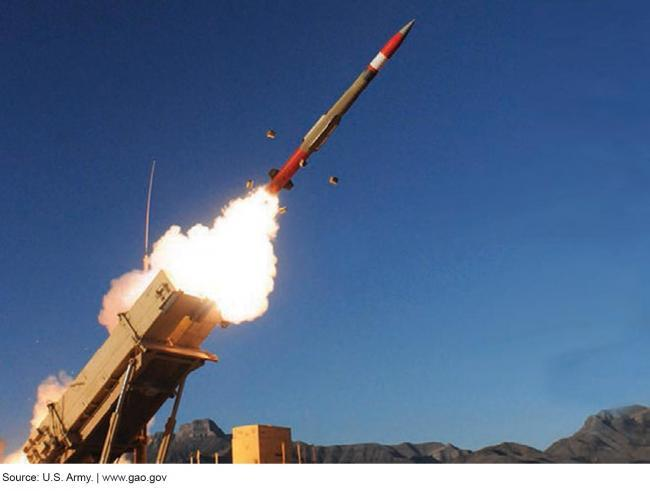
Missile firing
Highlights
What GAO Found
To acquire new major weapon systems, such as aircraft, ships, and satellites, the Department of Defense (DOD) uses a variety of contract types including cost-type contracts, under which the government assumes more risk. DOD is required to document its risk assessment in choosing contract types for major programs. Risks assessed can include use of new technologies and stability of system costs and requirements. Once awarded, cost-type contracts have additional reporting requirements to help monitoring of cost and schedule performance.
GAO analyzed program cost and schedule outcomes for 21 major acquisition programs, and did not find a clear relationship between these outcomes and contract types used. However, programs that completed certain knowledge-based acquisition practices generally had better cost and schedule outcomes than programs that did not implement those practices. These practices include completing preliminary design review before the start of system development and releasing at least 90 percent of design drawings by critical design review.
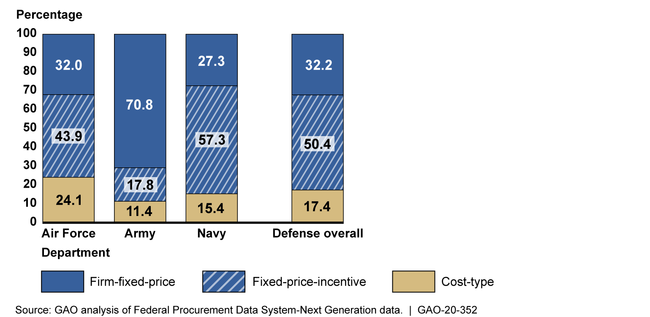
From fiscal years 2011 through 2019, DOD used cost-type contracts for a small proportion—under one-fifth on average—of obligations for its major acquisition programs. This proportion varied across the military departments (see figure).
Proportion of Obligations by Contract Type for Major Defense Acquisition Programs from Fiscal Years 2011 through 2019
A change to DOD's peer review process for its largest contract awards reduced a means for sharing best practices and lessons learned about contract choice across the military departments. In 2019, the Office of the Secretary of Defense announced the end of its peer reviews for most competitive procurements above $1 billion. While these contracts will instead be reviewed through the military departments' own processes, DOD currently does not require the departments to collect and share their findings. DOD has an online compendium of peer review findings; however, this was last updated in 2013. Using an existing centralized resource such as the compendium could help contracting officials learn from the experiences of peers across DOD by exposing them to good practices for structuring contracts.
Why GAO Did This Study
When acquiring major weapon systems, DOD can choose between several different contract types. One of these is cost-type, under which DOD pays allowable costs incurred by the contractor. Historically, DOD has struggled to manage its major acquisition programs. The result has been billions in cost growth and schedule delays in providing systems to the warfighter.
GAO was asked to review DOD's use of cost-type contracts for its major acquisition programs. This report addresses the use of and range of cost and schedule outcomes for cost-type contracts for major weapon system acquisitions, and how military departments share information about contract choice.
GAO analyzed government contracting data on obligations by contract type for fiscal years 2011 through 2019 on contracts in DOD's portfolio of major acquisition programs. GAO compared contract types for 21 major acquisition programs with their cost and schedule outcomes; reviewed seven recently awarded cost-type contracts for major acquisition programs, selected to reflect the different military departments and appropriation types; and interviewed contracting officials.
Recommendations
GAO recommends that DOD establish procedures requiring the military departments to collect and share findings from their reviews of contracting approaches, such as by updating the existing online compendium. DOD agreed with GAO's recommendation.
Recommendations for Executive Action
| Agency Affected | Recommendation | Status |
|---|---|---|
| Department of Defense | The Under Secretary of Defense for Acquisition and Sustainment should establish procedures requiring the military departments to collect and share findings from their peer reviews of MDAP contracting approaches—including choice of contract type—such as by updating the existing online compendium of best practices and lessons learned as they complete their reviews. |
DOD agreed with this recommendation. In June 2021, DOD published a document containing best practices and lessons learned applicable to large dollar, sole source acquisitions, and outlining the process for adding new practices. In May 2023, DOD published revisions to the Defense Federal Acquisition Regulation Supplement Procedures, Guidance, and Information establishing a process for military departments and defense agencies to submit best practices and lessons learned from competitive acquisition peer reviews under MDAPs.
|