
Trade-Based Money Laundering: U.S. Government Has Worked with Partners to Combat the Threat, but Could Strengthen Its Efforts
Fast Facts
Some criminal and terrorist organizations use trade-based money laundering to disguise illicit proceeds and fund their operations. These kinds of schemes can rely on misrepresenting the price, quantity, or type of goods in trade transactions.
To help fight this practice, Immigration and Customs Enforcement’s Trade Transparency Unit has partnered with 17 countries to exchange and analyze trade data. The program has faced challenges. For example, other nations may collect trade data in different formats, making comparisons difficult.
We made 2 recommendations, including that ICE develop a strategy to make these partnerships more effective.
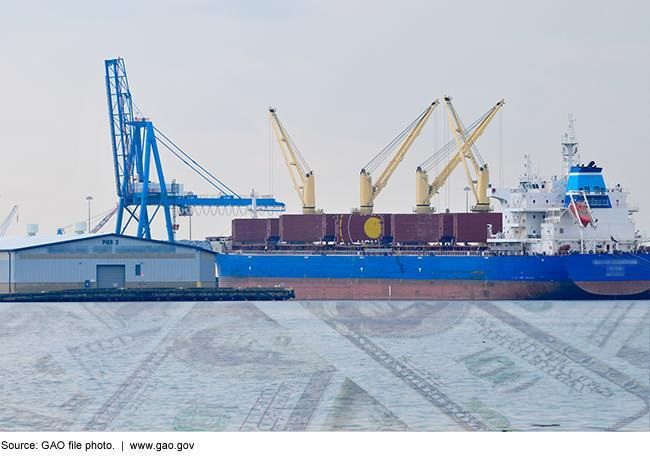
Money superimposed over water and a cargo ship in a port
Highlights
What GAO Found
Different types of criminal and terrorist organizations use trade-based money laundering (TBML) to disguise the origins of their illicit proceeds and fund their operations. TBML schemes can rely on misrepresenting the price, quantity, or type of goods in trade transactions, but other methods are also used. For example, some drug trafficking organizations from Latin America have used a type of TBML scheme known as the Black Market Peso Exchange (BMPE) to launder funds. BMPE schemes involve merchants who—wittingly or not—accept payment in illicitly derived funds, often from third parties to a trade transaction, for exports of goods. In carrying out TBML schemes, criminal and terrorist organizations use various goods, including precious metals and automobiles (see fig.). U.S. officials and other sources have identified a number of countries as being at particular risk for TBML schemes. Available evidence indicates that the amount of TBML occurring globally is likely substantial. However, specific estimates of the amount of TBML occurring around the world are not available.
Examples of Goods Commonly Used in Trade-Based Money Laundering Schemes

Officials and reporting from relevant international bodies and selected partner countries, and knowledgeable sources recommended various practices for countries to consider to combat TBML, which GAO grouped into five categories: (1) partnerships between governments and the private sector, (2) training, (3) sharing information through domestic interagency collaboration, (4) international cooperation, and (5) further research on challenges to combating TBML.
The U.S. government's key international effort to counter TBML is the Trade Transparency Unit (TTU) program under the Department of Homeland Security's (DHS) Immigration and Customs Enforcement (ICE). ICE set up TTUs in 17 partner countries with the goal of exchanging and analyzing trade data to identify potential cases of TBML. While TTUs have played a role in some TBML investigations, the TTU program has experienced various challenges, including lapses in information sharing between ICE and the partner TTUs, differing priorities between ICE and partner TTUs in pursuing TBML investigations, and limitations in the data system that ICE and the TTUs use. However, ICE has not developed a strategy to increase the effectiveness of the TTU program or a performance monitoring framework to assess the results of its work with partner TTUs. As a result, ICE does not have a clear guide on how best to operate the TTU program and cannot make management decisions based on program results. In addition to the TTU program, the U.S. government collaborates with partner countries and international bodies through a range of other activities, such as developing international anti-money laundering standards, providing training and technical assistance, establishing information-sharing methods, and providing ongoing law enforcement cooperation.
Why GAO Did This Study
TBML involves the exploitation of international trade transactions to transfer value and obscure the origins of illicit funds. Various observers have noted that although TBML is a common form of international money laundering, it is one of the most difficult to detect due to the complexities of trade transactions and the sheer volume of international trade, among other things.
This report examines (1) what the available evidence indicates about the types and extent of international TBML activities, (2) the practices international bodies, selected countries, and knowledgeable sources have recommended for detecting and combating TBML, and (3) the extent to which ICE has effectively implemented the TTU program and steps the U.S. government has taken to collaborate with international partners to combat TBML. GAO analyzed U.S. agency and international body data and documentation, conducted a literature review, and interviewed U.S. officials and selected knowledgeable sources.
Recommendations
GAO recommends that DHS develop (1) a strategy to maximize TTU program effectiveness and (2) a performance monitoring framework for the TTU program. DHS concurred with the first, but did not concur with the second recommendation, citing data it already collects and challenges it faces. GAO continues to believe the recommendation is valid, as discussed in the report.
Recommendations for Executive Action
| Agency Affected | Recommendation | Status |
|---|---|---|
| Office of the Secretary for DHS | The Secretary of Homeland Security should direct the Director of ICE to develop a strategy for the TTU program to ensure that ICE has a plan to guide its efforts to effectively partner with existing TTUs, and to expand the program, where appropriate, into additional countries. (Recommendation 1) |
The agency has taken steps to fully implement this recommendation to develop a strategy for the TTU program. In April 2022, ICE provided the "Trade Transparency Unit Strategic Plan for Fiscal Years 2022-2027", which complements Homeland Security Investigation's broader strategic plan. The plan contains four strategic goals: TTU strategic expansion, TBML clearinghouse framework, TTU modernization, and promoting excellence and expertise in TBML. This plan will guide ICE's efforts to combat TBML and assess how best to plan for and address challenges in order to maximize the program's effectiveness.
|
| Office of the Secretary for DHS | The Secretary of Homeland Security should direct the Director of ICE to develop a performance monitoring framework for the TTU program that would enable the agency to systematically track program results and how effectively it is achieving the program's goals. (Recommendation 2) |
Although ICE did not concur with this recommendation at the time of our report, the agency subsequently developed a document outlining key goals for the TTU program and associated performance metrics. It also established baselines for some of the performance measures in fiscal year 2024. In addition, ICE has produced performance reporting outlining key activities it has undertaken in support of these TTU program goals. ICE's actions are consistent with the intent of our recommendation and will help ensure that it has a means of tracking progress toward its goals and identifying any areas that need adjustments to improve program results.
|