
Weapon System Sustainment: DOD Needs a Strategy for Re-Designing the F-35's Central Logistics System
Fast Facts
The F-35 is the Department of Defense’s most ambitious and costly weapon system. It’s also supposed to be one of the smartest—relying on its Autonomic Logistics Information System (ALIS) to manage missions, maintenance, training, and more.
However, after years of development and testing, the system does not work properly—with inaccurate or missing data sometimes leading ALIS to ground flight-ready aircraft, among other problems.
DOD knows the system needs to be re-designed, but has not answered critical questions about the future system. We recommended that DOD clearly identify the associated goals, risks, and costs of re-designing ALIS.
An F-35 Maintainer Using ALIS
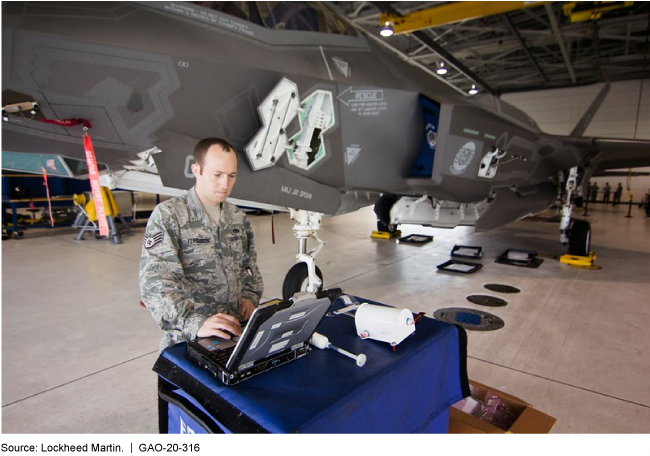
Uniformed servicemember using a laptop with an aircraft behind him
Highlights
What GAO Found
The Autonomic Logistics Information System (ALIS) is integral to supporting the F-35 fighter jet's operations and maintenance. F-35 personnel at 5 locations GAO visited agreed that ALIS is performing better in some aspects, such as faster processing speeds for some tasks. However, problems with ALIS continue to pose significant challenges for F-35 personnel (see figure).
Examples of Challenges Identified by Personnel Who Use the F-35 Autonomic Logistics Information System (ALIS)
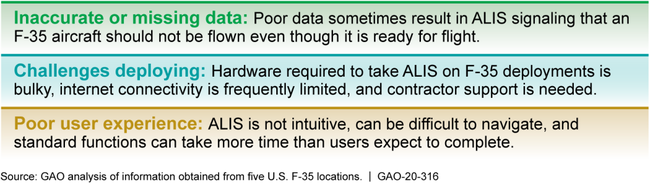
The Department of Defense (DOD) has not (1) developed a performance measurement process for ALIS, which GAO recommended in 2014, or (2) determined how ALIS issues affect F-35 fleet readiness. Without efforts in these areas, DOD will be hindered in addressing ALIS challenges and improving aircraft readiness.
DOD and the prime contractor have a variety of initiatives underway for re-designing ALIS. However, these initiatives involve differing approaches and technical and programmatic uncertainties are hindering the re-design effort (see figure).
Uncertainties about the Future of the F-35 Autonomic Logistics Information System
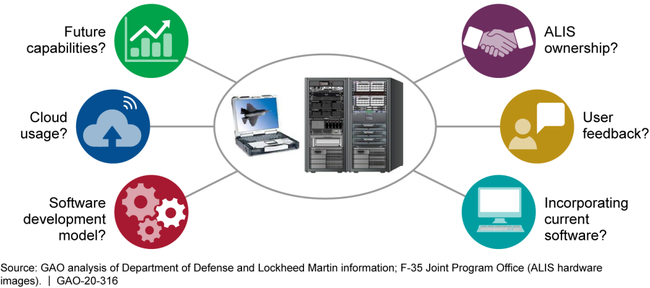
DOD has not developed a strategy for the future of ALIS that includes goals of the re-design, an assessment of key risks, or costs. Without this, DOD may not be able to coordinate various ALIS design-improvement initiatives that are under way or meaningfully enhance the system over the long term.
Why GAO Did This Study
The F-35 is DOD's most ambitious and costly weapon system in history, with U.S. sustainment costs estimated at about $1.2 trillion over a 66-year life cycle. Central to the F-35 is ALIS—a complex system that supports operations, mission planning, supply-chain management, maintenance, and other processes. A fully functional ALIS is critical to the F-35's operational success. However, over the past 5 years GAO has reported on key risks associated with the system, such as challenges deploying the F-35 with ALIS, inaccurate data that reside in ALIS, and ineffective training for personnel who need to use ALIS.
GAO was asked to review DOD's efforts to improve ALIS. This report assesses the extent to which (1) improvements have been made over the past 5 years and challenges remain for ALIS users, and (2) DOD is taking actions to enhance the long-term viability of the system. GAO reviewed F-35 and ALIS program documentation and data, interviewed DOD officials and contractor employees, and visited five U.S. F-35 sites.
Recommendations
GAO is recommending that DOD track how ALIS is affecting readiness of the F-35 fleet and develop a strategy for the ALIS re-design. In addition, GAO believes that Congress should consider requiring DOD to develop a performance measurement process for ALIS. DOD concurred with both of GAO's recommendations.
Matter for Congressional Consideration
| Matter | Status | Comments |
|---|---|---|
| Congress should consider legislation requiring the Department of Defense to establish a performance-measurement process for ALIS that includes, but is not limited to, performance metrics and targets that (1) are based on intended behavior of the system in actual operations and (2) tie system performance to user requirements. (Matter for Consideration 1) | As of February 2026, Congress has not required the Department of Defense to establish a performance-measurement process for the F-35's Autonomic Logistics Information System. |
Recommendations for Executive Action
| Agency Affected | Recommendation | Status |
|---|---|---|
| Office of the Secretary of Defense | The Secretary of Defense should ensure the Under Secretary of Defense for Acquisition and Sustainment, in consultation with the F-35 Program Executive Officer, develops a program-wide process for measuring, collecting, and tracking information on how ALIS is affecting the performance of the F-35 fleet to include, but not be limited to, its effects on mission capability rates. (Recommendation 1) |
DOD concurred with this recommendation. In November 2021, DOD provided a report to Congress entitled, F-35 Autonomic Logistics Information System Redesign Strategy. This report included information on tracking the impact of ALIS on F-35 performance, such as a number of metrics and measures that DOD planned to use to make sure that each version of ALIS is better than the previous version. The report describes improved ALIS software release strategies and more rigorous testing to assure improved performance of the system. However, the report did not provide any specific guidance on how to measure the extent to which ALIS is affecting the performance of the F-35 fleet. The report states, "although some improvements have been made to collecting performance measures, ALIS still lacks the ability to collect performance measures that affect the performance of the F-35 aircraft fleet." As of July 2025, the F-35 Program Office reports that it continues to collect ALIS performance metrics to assess and document impact of ALIS updates, but these metrics continue to not be linked to availability and mission capable rates for the F-35. The F-35 Program Office stated that it would provide documentation on analysis conducted regarding the impact of issues with ALIS on availability and mission capability rates. Once we have been provided and reviewed this documentation, we will update the status of this recommendation.
|
| Office of the Secretary of Defense | The Secretary of Defense should ensure the Under Secretary of Defense for Acquisition and Sustainment, in consultation with the F-35 Program Executive Officer, develops and implements a strategy for the re-design of ALIS. The strategy should be detailed enough to clearly identify and assess the goals, key risks or uncertainties, and costs of re-designing the system. (Recommendation 2) |
DOD concurred with this recommendation. In November 2021, DOD published and subsequently submitted to Congress an F-35 Autonomic Logistics Information System (ALIS) Redesign Strategy. This strategy was completed in response to a congressional requirement that was based on our recommendation. The strategy includes an identification of goals, key risks, and other important aspects of the desired pathway for the redesign. As a result of addressing the recommendation, DOD will be better positioned to effectively plan, coordinate, and implement its efforts to improve ALIS and its performance.
|