
Defense Acquisitions: Senior Leaders Should Emphasize Key Practices to Improve Weapon System Reliability
Fast Facts
DOD invests billions of dollars in its weapons systems and expects them to be reliable.
We spoke with commercial companies known for creating reliable products to find out how they achieve reliability, and found that they often focus on four key practices—such as involving reliability experts early in development. We looked at 7 DOD programs and found that they didn’t consistently follow these practices. Instead, they often prioritized producing systems faster.
We recommended that the Air Force, Army, and Navy emphasize key reliability practices when developing weapons systems.
F-35 Aircraft

Four F-35 aircraft in flight
Highlights
What GAO Found
The commercial companies GAO reviewed proactively address reliability. They strive to identify reliability issues at the component level early in the development process to avoid expensive rework after producing an entire system. GAO found these companies focus on the following key practices:
1. Leveraging reliability engineers early and often
2. Establishing realistic reliability requirements
3. Emphasizing reliability with their suppliers
4. Employing reliability engineering activities to improve a system's design throughout development
GAO found that the seven Department of Defense (DOD) acquisition programs it reviewed did not consistently adhere to these key practices (see figure). These programs often prioritized schedule and cost over incorporating the key reliability practices, and these systems generally were not as reliable as promised.
Key Characteristics of Selected Acquisition Programs' Approach to Reliability
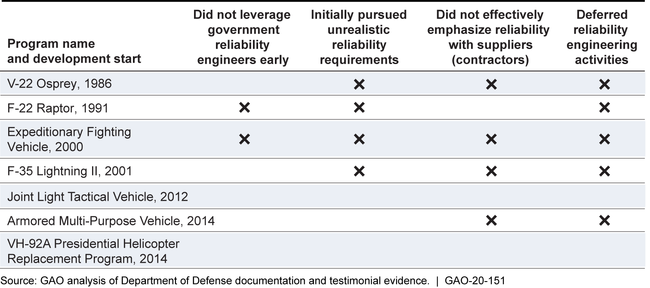
In 2019, DOD highlighted in a policy memorandum the importance of emphasizing reliability with contractors. However, the other three key practices have not been similarly highlighted. DOD has taken steps to accelerate weapon system development, and decision-making authority has been delegated to the military services. In an environment emphasizing speed, without senior leadership focus on a broader range of key reliability practices, DOD runs the risk of delivering less reliable systems than promised to the warfighter and spending more than anticipated on rework and maintenance of major weapon systems.
Why GAO Did This Study
DOD invests tens of billions of dollars each year in major defense acquisition programs, designing and developing technologically advanced weapon systems that warfighters expect will meet specific performance requirements, including reliability requirements. Systems that are not reliable make it more difficult for warfighters to perform their missions.
GAO was asked to examine DOD weapon system reliability. This report addresses (1) how selected companies in the commercial sector address reliability, (2) how selected DOD acquisition programs addressed reliability, and (3) the extent to which DOD leadership has highlighted key reliability practices.
GAO collected information on leading commercial practices at the 2019 Reliability and Maintainability Symposium and from four commercial companies known for delivering reliable products. GAO also assessed how seven DOD acquisition programs—both older and newer, and representing all the military services—addressed reliability; reviewed key documents and interviewed knowledgeable officials; and reviewed reliability-related guidance and policy from senior DOD leaders.
Recommendations
GAO recommends the Secretaries of the Air Force, Army, and Navy highlight the importance of three key reliability practices: leveraging reliability engineers, establishing realistic reliability requirements, and employing reliability engineering activities to improve a system's design throughout development. DOD agreed with GAO's recommendations.
Recommendations for Executive Action
| Agency Affected | Recommendation | Status |
|---|---|---|
| Office of the Secretary of the Air Force | We recommend the Secretary of the Air Force issue policy emphasizing the following three key reliability practices when planning and executing acquisition programs: (1) leveraging reliability engineers early and often, (2) establishing realistic reliability requirements, and (3) employing reliability engineering activities to improve a system's design throughout development. (Recommendation 1) |
The Air Force agreed with this recommendation. In November 2021, the Air Force updated Instruction AFI63-101/20-101 to include the key practices to improve weapon system reliability, including leveraging reliability engineers early and often, establishing realistic reliability requirements, and employing reliability engineering activities to improve a system's design throughout development.
|
| Office of the Secretary of the Army | We recommend the Secretary of the Army issue policy emphasizing the following three key reliability practices when planning and executing acquisition programs: (1) leveraging reliability engineers early and often, (2) establishing realistic reliability requirements, and (3) employing reliability engineering activities to improve a system's design throughout development. (Recommendation 2) |
The Army agreed with this recommendation and in March 2020, the Assistant Secretary of the Army (Acquisition, Logistics, and Technology) (ASA (ALT)) signed a memorandum directing Program Executive Officers to emphasize the three key practices GAO had identified: leveraging reliability engineers early and often, establishing realistic reliability requirements, and employing reliability engineering activities to improve a system's design throughout development.
|
| Office of the Secretary of the Navy | We recommend the Secretary of the Navy issue policy emphasizing the following three key reliability practices when planning and executing acquisition programs: (1) leveraging reliability engineers early and often, (2) establishing realistic reliability requirements, and (3) employing reliability engineering activities to improve a system's design throughout development. (Recommendation 3) |
The Navy agreed with our recommendation and in June 2022, issued a Reliability and Maintainability Engineering Guidebook, in response to this recommendation. The Guidebook emphasizes the three key practices we identified. Specifically, in order to align with best practices of successful commercial companies in reliability and maintainability engineering, the Guidebook instructs program managers to leverage reliability engineers early and often throughout acquisition, include clearly defined and measurable reliability and maintainability requirements in the contract, and employ reliability engineering activities to improve a system's design throughout development. This guidance meets the intent of our recommendation.
|