
Space Command and Control: Comprehensive Planning and Oversight Could Help DOD Acquire Critical Capabilities and Address Challenges
Fast Facts
The Air Force has been working to develop a single modernized computer system to enable more effective operations of military and other government satellites and space systems. Such a system could better respond to threats ranging from jamming attacks to space debris. The past three programs to attempt this have ended up significantly behind schedule and over budget. The programs also deferred more difficult work.
The Air Force’s latest effort takes a new approach to development. We recommended the Air Force ensure that this includes independent software development reviews and other steps to improve its acquisition strategy.
Uniformed man at a computer
Highlights
What GAO Found
Given emerging and evolving threats in the space domain, as well as significant development problems in similar prior efforts, the Air Force is prioritizing the Space Command and Control (C2) program. Early prototype work on the program's software began in 2016. As of mid-2019, the program had delivered some initial capabilities; however, the capabilities delivered so far are not approved for use in operations. Because the program is still early in development, it has not yet established a time frame for certifying these capabilities for operational use. Further, the foundational elements of the program, including the infrastructure and software platform, are still being conceptualized. All Space C2 program capabilities will be significantly more automated than past development efforts and are being designed to allow operators to identify and monitor threats to U.S. space assets, identify courses of action to mitigate or eliminate those threats, communicate these actions to decision makers, and direct actions in response.
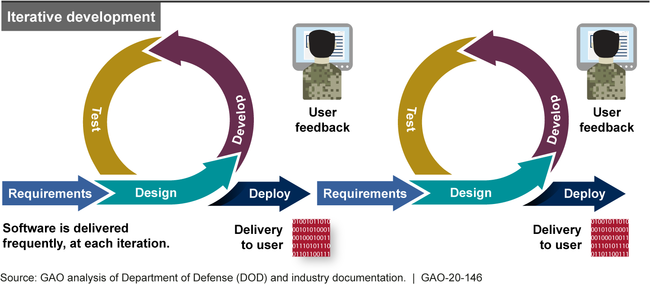
To develop Space C2's technologically complex software, the Air Force is following a modernized, iterative process called Agile development—a relatively new approach for Department of Defense (DOD) programs (see figure).
The Air Force's Iterative Approach to Software Development
The Space C2 program is facing a number of challenges and unknowns, from management issues to technical complexity. Additionally, DOD officials have not yet determined what level of detail is appropriate for acquisition planning documentation for Agile software programs. They are also not certain about the best way to provide oversight of these programs but are considering using assessments by external experts. These knowledge gaps run counter to DOD and industry best practices for acquisition and put the program at risk of not meeting mission objectives. Additionally, software integration and cybersecurity challenges exist, further complicating program development. The Air Force has efforts underway to mitigate some of these challenges in the near term, but until the program develops a comprehensive acquisition strategy to more formally plan the program, it is too early to determine whether these efforts will help to ensure long-term program success.
Why GAO Did This Study
Since the early 1980s, the Air Force has been working to modernize and consolidate its space command and control systems into a single comprehensive platform. The past three programs to attempt this have ended up significantly behind schedule and over budget. They also left key capabilities undelivered, meeting the easier requirements first and deferring more difficult work to subsequent programs. At the same time, the need for a consolidated space command and control capability has been growing.
The House Armed Services Committee report accompanying a bill for the National Defense Authorization Act for Fiscal Year 2018 contained a provision for GAO to review DOD's newest efforts to develop space command and control capabilities. This report describes the status of these efforts and identifies challenges the Air Force faces in bringing them to fruition.
To conduct this work, GAO analyzed acquisition and strategy documentation, management directives, and lessons learned; and compared Air Force development plans with leading industry practices for software development, DOD guidelines, and best practices included in a draft GAO guide for assessing Agile software development programs.
Recommendations
GAO is making two recommendations, including that DOD should ensure the Air Force develops a comprehensive acquisition strategy for the Space C2 program. DOD concurred with the recommendations.
Recommendations for Executive Action
| Agency Affected | Recommendation | Status |
|---|---|---|
| Department of Defense | The Under Secretary of Defense for Acquisition and Sustainment should ensure that the Air Force's finalized Space C2 program's acquisition strategy includes, at a minimum, the following elements:
|
DOD concurred with the recommendation. In July 2024, the Under Secretary of Defense for Acquisition and Sustainment signed the Space C2 Program Acquisition Strategy, which contains each of the elements in GAO's recommendation.
|
| Department of Defense | The Under Secretary of Defense for Acquisition and Sustainment should ensure that the Air Force's Space C2 program conducts periodic independent reviews to assess the program's approach to developing software and provide, as needed, advice to the program and recommendations for improving the program's development and progress. Participants could include, but are not limited to, officials from the Defense Innovation Board, the Defense Digital Service, the office of the Air Force Chief Software Advisor, and the Under Secretary of Defense for Acquisition and Sustainment's Special Assistant for Software Acquisition. (Recommendation 2) |
DOD concurred with this recommendation. and stated that the Under Secretary of Defense for Acquisition and Sustainment will assess the need for future periodic and independent reviews of the program. In a May 2021 memorandum, the Office of the Under Secretary of Defense for Acquisition and Sustainment directed the Space C2 program to provide a plan for implementing this recommendation within 90 days. Space Systems Command restructured the Space C2 program to define and prioritize activities necessary to decommission the Space Defense Operations Center and deliver needed enterprise Space C2 capabilities by 2026. The program completed an FY22 review (an FFRDC assessment of the Advanced Tracking and Launch Analysis System (ATLAS) development platform) and a FY23 review (a cybersecurity assessment). The Air Force will be required to conduct periodic reviews per the FY24 NDAA Conference Report (118-301) to Accompany H.R. 2670, Section 1607.
|