
Tax Administration: Opportunities Exist to Improve IRS's Management of International Tax Dispute Resolution
Fast Facts
U.S. firms that earn income from foreign activities or foreign subsidiaries are subject to taxes at home and abroad. Double taxation may occur when two or more countries with different tax approaches levy taxes on the same income.
The IRS' U.S. Competent Authority (USCA) helps U.S. multinationals resolve disputes over double taxation with foreign authorities and the IRS. However, taxpayers may have a hard time understanding the process. USCA's website, for example, provides highly technical guidance and lacks clear explanations.
We made 8 recommendations, including that USCA provide better procedure guidance.
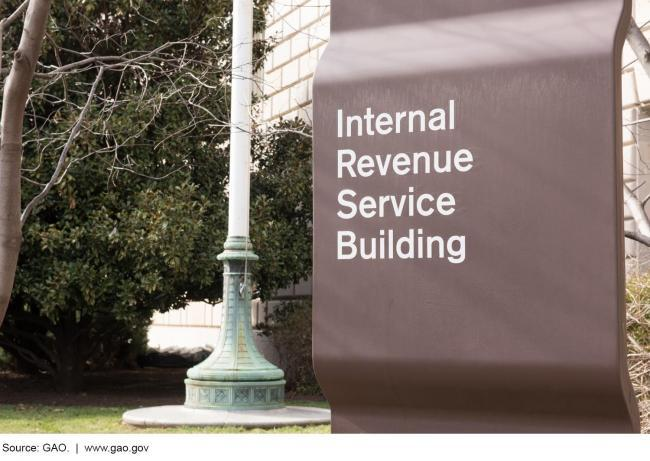
Photo of the Internal Revenue Service Building.
Highlights
What GAO Found
A U.S. multinational corporation (MNC) operating in a foreign country is subject to taxes in that country as well as in the United States. The U.S. MNC's tax return may be audited by the United States or the other country. Such audits can result in an adjustment to the U.S. MNC's taxable income that may result in income being subject to tax in both countries. If the U.S. MNC disagrees with the adjustment, it can ask the United States Competent Authority (USCA) within the Internal Revenue Service (IRS) to help resolve the dispute through the mutual agreement procedure (MAP). Generally, disputes are resolved by one country withdrawing some or all of the adjustment and the other country providing other relief to the MNC to address double taxation of income. The following figure provides an overview of the dispute resolution process.
IRS U.S. Competent Authority Mutual Agreement (USCA) Procedure (MAP) Process

Dispute resolution assistance is available to U.S.MNCs that need it and USCA provides comprehensive technical information on its website on how to request assistance. However, because USCA's website does not provide an overview or plain language guidance on the MAP process U.S. MNCs may not have clear information on how to navigate the process.
USCA has taken a number of steps to ensure efficient management of MAP cases including assigning staff with requisite background and skills to cases according to their complexity and organizing staff into teams that specialize by countries. However, GAO identified a number of weaknesses that impact USCA's management of MAP cases. These include the following
key data are not tracked and existing data are not used to assess the effective allocation of resources for the program,
few controls have been established to monitor and ensure the reliability of the data in the case management database, and
lack of trend analyses on dispute case characteristics that could help inform management decision making and the more efficient operation of the program.
Why GAO Did This Study
With increasing globalization, multinational corporations can take advantage of differences in countries' corporate tax systems to reduce their overall tax liabilities. However, globalization can also lead to disputes about the correct tax liability for U.S. MNCs in different countries. GAO was asked to review how the United States administers the process for resolving international tax disputes when a U.S. MNC disagrees with a tax determination of another country.
This report (1) describes IRS's dispute resolution process, (2) assesses the information IRS provides to taxpayers about the process, and (3) assesses the extent to which IRS evaluates its management of dispute resolutions cases. GAO reviewed IRS guidance on the MAP process, interviewed IRS officials and compared IRS actions to federal standards for internal control and GAO's criteria for a good tax system. GAO analyzed MAP data for cases closed from 2013 to 2017 as well as a stratified random sample of MAP case files.
Recommendations
GAO is making a total of eight recommendations, including that IRS improve the clarity of information on the dispute resolution process, track and use dispute resolution case data, ensure the quality of case data, and analyze trends in dispute case characteristics. IRS agreed with GAO's recommendations and said it will provide detailed corrective action plans.
Recommendations for Executive Action
| Agency Affected | Recommendation | Status |
|---|---|---|
| Internal Revenue Service | The Commissioner of Internal Revenue should direct USCA to provide an overview of the MAP process that is more accessible and transparent than the Revenue Procedure. (Recommendation 1) |
IRS has updated their website to provide an overview of the MAP process, including a clear description and graphic.
|
| Internal Revenue Service | The Commissioner of Internal Revenue should direct USCA to ensure that APMA staff record and track contact with taxpayers. (Recommendation 2) |
IRS agreed with GAO's recommendation. As of November 2020, IRS has implemented an integrated case inventory and management system that contains a case log where staff will be required to record and track contact with taxpayers.
|
| Internal Revenue Service | The Commissioner of Internal Revenue should direct USCA to ensure that APMA staff record and track the hours they spend on MAP cases. (Recommendation 3) |
IRS agreed with GAO's recommendation. As of December 2021, IRS has implemented an integrated case inventory and management system. In July 2023, IRS implemented additional capability to track actual time worked on cases.
|
| Internal Revenue Service | The Commissioner of Internal Revenue should direct USCA to ensure that Advance Pricing and Mutual Agreement Program (APMA) identify and record the dates of key milestones throughout MAP case resolutions. (Recommendation 4) |
IRS agreed with GAO's recommendation. As of November 2020, IRS has implemented an integrated case inventory and management system that allows dates of key milestones to be recorded throughout the case history.
|
| Internal Revenue Service | The Commissioner of Internal Revenue should direct USCA to ensure that APMA puts procedures in place to review the quality of inventory data. (Recommendation 5) |
IRS agreed with GAO's recommendation. As of December 2021, we verified that IRS implemented an integrated case inventory and time management system. The new system appears to be able to support policies and procedures including review by management to ensure the quality of data in the system. Key to addressing this recommendation is the policies and procedures that system users follow to ensure proper reviews are undertaken. In August 2023, IRS provided detailed training and guidance materials directing users to include relevant case memo notes to ensure quality.
|
| Internal Revenue Service | The Commissioner of Internal Revenue should direct USCA to ensure that APMA records the dollar amounts of MAP case outcomes in its database. (Recommendation 6) |
IRS agreed with GAO's recommendation. As of November 2020, IRS has implemented an integrated case inventory and management system capable of recording the dollar amounts of MAP case outcomes.
|
| Internal Revenue Service | The Commissioner of Internal Revenue should direct USCA to ensure that APMA analyzes trends in case characteristics as part of routine program management activities. (Recommendation 7) |
IRS agreed with GAO's recommendation. In November 2020, IRS stated they report case trends quarterly in a memo that is shared with LB&I leadership. GAO reviewed examples of the quarterly memos that contained analysis of trends, and agree that IRS is considering the trends in case characteristics to manage the program.
|
| Internal Revenue Service | The Commissioner of Internal Revenue should direct USCA to ensure that APMA identify and record categories of the tax issue relevant in the dispute. (Recommendation 8) |
IRS agreed with GAO's recommendation. As of November 2020, IRS has implemented an integrated case inventory and management system that allows the user to select from a group of tax issue categories.
|