
Future Warfare: Army Is Preparing for Cyber and Electronic Warfare Threats, but Needs to Fully Assess the Staffing, Equipping, and Training of New Organizations
Fast Facts
Great powers—particularly China and Russia—and other adversaries pose current and future threats to the nation. The Defense Department is preparing to meet those threats where they arise, including the cyber domain.
The Army’s preparations include new cyber and electronic warfare units. Some of these units are being created on an accelerated schedule, and in some cases, activated before cyber training and equipment have been updated. Those units are short of people and the Army faces competition finding people with in-demand cyber skills.
We recommended that the Army comprehensively assess the risk of accelerating the creation of the new units.
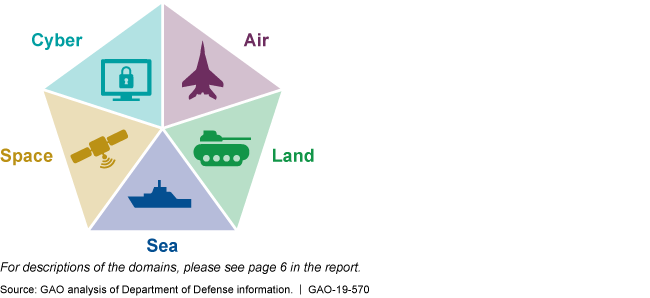
Pentagon with five icons designating Air, Land, Sea, Space, and Cyber domains
Highlights
What GAO Found
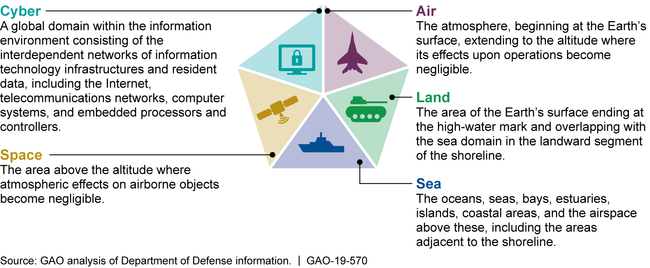
The Army is changing aspects of its doctrine, organizations, and training to develop a force that can effectively engage great-power competitors—Russia and China—through multi-domain operations by 2028. Multi-domain operations present adversaries with multiple challenges across multiple domains (land, air, sea, cyber, and space) in contested environments. To this end, the Army is revising its doctrine to guide how the force and specific units will function. The Army is also reorganizing its force by creating new units to conduct missions in multiple domains and by updating the responsibilities of key Army formations, such as Army divisions. Also, the Army is training its combat forces for multi-domain operations in part by increasing the focus on cyber operations.
The Five Warfighting Domains Envisioned by the Army Operating Concept
The Army is establishing new cyber and electronic warfare units for multi-domain operations, but did not fully assess the risk of activating some units at an accelerated pace and is experiencing staffing, equipping, and training challenges. For example, the Army activated a cyber battalion in December 2018, and as of March 2019, this unit was understaffed by more than 80 percent. Army guidance directs the Army staff to conduct assessments on new units to determine whether the Army can staff, equip, and train these organizations. However, Army leadership believed the threats justify developing these units at an accelerated pace. Consequently, the Army did not assess the staffing, equipping, and training risk before activating one unit, and only conducted an initial risk assessment before activating a second unit. As a result, senior Army leaders may not know what other challenges could arise, such as sustainment, as the units grow in capabililty. Army officials told GAO that as these units evolve, it is uncertain when more comprehensive risk assessments would take place. The Army has previously accelerated the activations of other units when it saw fit to do so, and is considering creating other new units for multi-domain operations. If the Army does not assess risks for units activated at an accelerated pace, those units may be unable to effectively conduct multi-domain operations.
Why GAO Did This Study
The rise of great-power competitors, such as China and Russia, prompted the Army to transform the way it plans to fight. The Army is developing a new warfighting concept to guide how its forces will engage jointly with other services in multiple domains, especially in cyber and space.
The House Armed Services Committee included a provision in House Report 115-200 accompanying a bill for the National Defense Authorization Act for Fiscal Year 2018 for GAO to review the Army's implementation of the concept. Among its objectives, this report addresses (1) how the Army is changing its doctrine, organizations, and training in order to execute multi-domain operations; and (2) the extent to which the Army has established new cyber and electronic warfare units, including any challenges faced by these units, and whether the Army assessed risks associated with its plan to establish these units.
GAO reviewed Army concepts, doctrine, force design, and training documents concerning multi-domain operations. GAO also interviewed Army and Department of Defense officials.
Recommendations
GAO is making three recommendations, including that the Army comprehensively assess the risk of staffing, equipping, and training the cyber and electronic warfare units that it has activated at an accelerated pace, and to do so for new organizations it plans to activate in an accelerated manner for multi-domain operations. The Army concurred with one recommendation and partially concurred with two recommendations. GAO clarified the recommendations, as discussed in the report.
Recommendations for Executive Action
| Agency Affected | Recommendation | Status |
|---|---|---|
| Department of the Army | The Secretary of the Army should ensure that the Deputy Chief of Staff, G-3/5/7 assess the risk associated with staffing, equipping, and training the existing Intelligence, Cyber, Electronic Warfare, and Space (ICEWS) unit prior to its incorporation into the first Multi-Domain Task Force in fiscal year 2020. (Recommendation 1) |
The Army partially concurred with this recommendation. Officials stated that the Army does not conduct risk assessments for pilot units, but that they would if and when the Army decided to establish such a unit. In reviewing the Army's actions, we found that in August 2019, the Army completed a Force Integration Functional Analysis risk assessment on the first Multi-Domain Task Force that it plans to field, including the Intelligence, Cyber, Electronic Warfare, and Space detachment. As a result, the Army's actions are consistent with our recommendations and we are closing it as implemented.
|
| Department of the Army | The Secretary of the Army should ensure that the Deputy Chief of Staff, G-3/5/7 conduct a comprehensive risk assessment associated with staffing, equipping, and training the 915th Cyber Warfare Support Battalion prior to approving the expansion of the unit to its full operational capability. (Recommendation 2) |
The Army partially concurred with this recommendation. The Army indicated that it does not conduct risk assessments for force generating units such as the 915th Cyber Warfare Support Battalion, but that it does develop concept plans, which apply rigor and analysis in the same way as a risk assessment. In reviewing the Army's actions, we found that in November 2019 the Army concluded a risk assessment of the 915th Cyber Warfare Support Battalion and is in the process of officially creating the unit. As a result, the Army's actions are consistent with our recommendation and we are closing it as implemented.
|
| Department of the Army | The Secretary of the Army should ensure that the Deputy Chief of Staff, G-3/5/7 assess the risk associated with staffing, equipping, and training of new units that it plans to activate in an accelerated manner for the purposes of conducting multi-domain operations, taking into consideration the assessments performed on the first activated ICEWS battalion and the 915th Cyber Warfare Support Battalion. (Recommendation 3) |
The Army concurred with this recommendation. In its February 2020 corrective action plan, the Army indicated that it will conduct a FIFA or similar risk assessment in accordance with its policy and procedures before activating any new units for MDO employment. In April 2021, the Army provided documentation stating that it would conduct risk assessments for capabilities with planned activations within the year of execution or budget year, similar to risk assessments conducted for capabilities within the future years defense plan. In support of its statement, the Army documentation included the results of a completed force integration functional area analysis risk assessment on the full design of its Multi-Domain Task Force, as well as its Offensive Cyberspace Operations Signal Battalion. As a result, the Army's actions are consistent with our recommendation and we are closing it as implemented.
|