
Elder Justice: Goals and Outcome Measures Would Provide DOJ with Clear Direction and a Means to Assess Its Efforts
Fast Facts
Researchers estimate that as many as 1 in 10 older U.S. adults are abused each year. This includes physical, sexual, or emotional abuse, financial scams, and neglect. It can occur at the hands of family, guardians, caregivers, or others.
The Department of Justice has investigated and prosecuted cases of elder abuse, provided training and grants, and taken other actions to combat it. However, DOJ has not developed goals that could help guide these efforts.
We recommended that DOJ develop and document elder justice goals and outcome measures to better guide its elder justice efforts.
Examples of Scams Commonly Committed Against Older Adults in the U.S.
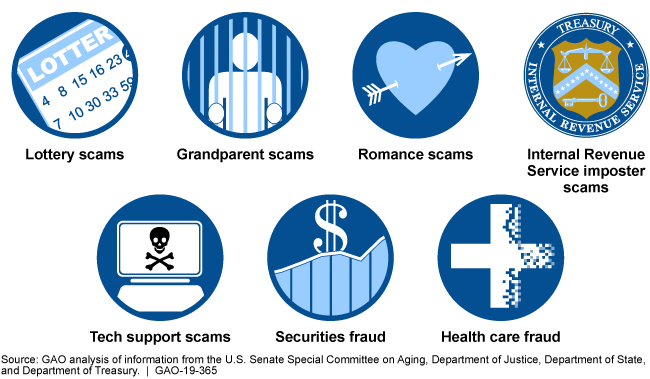
A graphic showing different types of scams and fraud
Highlights
What GAO Found
The Department of Justice (DOJ) has established several efforts to address elder abuse, including neglect and exploitation, but its planning and assessment of its elder justice efforts are limited. For example, DOJ has established several working groups and in accordance with the Elder Abuse Prevention and Prosecution Act (EAPPA)—enacted in October 2017—designated an elder justice coordinator in each of its 94 U.S. Attorneys' Offices. In addition, DOJ provides training and educational materials on elder justice topics for its own staff, as well as state and local officials, and also offers grants to state and local entities that can be used to address elder abuse.
Despite these efforts, DOJ has not developed and documented goals (e.g., enhancing coordination with state and local officials) that articulate the common outcomes it seeks to achieve through its elder justice work. DOJ also has not developed outcome measures that track the agency's progress on its overall elder justice efforts, for example, a means to measure if its coordination practices have been useful and relevant over time to state and local officials. DOJ officials stated that they do have goals, and noted that one of them is to comply with EAPPA. However, implementing the requirements outlined in EAPPA is not a goal that articulates a common outcome that the agency is seeking to achieve through its efforts. Developing and documenting goals and outcome measures, which is consistent with both leading practices and internal control standards, would assist with DOJ's planning—providing direction for what it seeks to achieve—and its assessment of overall effectiveness.
The Department of State has a number of policies and procedures to assist all U.S. citizens arrested abroad, including older U.S. citizens, and the Department of Homeland Security conducts some arrest investigations abroad. For example, trained Department of State staff at overseas posts and in Washington, D.C. provide emergency and non-emergency services to U.S. citizens arrested abroad, such as visits to the place of detention and medical assistance. They also take actions to ensure that U.S. citizens arrested abroad are treated humanely and fairly. In December 2018, the Department of State revised its policies by adding “elderly prisoners” to the list of special arrest cases, or cases that may require additional attention. The Department of Homeland Security investigates arrests in foreign countries of U.S. citizens, including older U.S. citizens, who were tricked into smuggling drugs by international criminal enterprises.
Why GAO Did This Study
Researchers estimate that as many as 1 in 10 older adults in the United States—age 60 or older—experience abuse each year. Elder abuse may involve physical, sexual, emotional, or financial abuse or neglect. It can occur by family, guardians, or caregivers as well as by strangers and international criminal enterprises, which operate schemes for monetary gain or to facilitate other criminal activities. According to media reports and congressional testimony, some older U.S. citizens who have traveled abroad have unwittingly participated in illicit activities, and in some cases, have been arrested in foreign countries.
EAPPA included a provision for GAO to review elder justice efforts in the federal criminal justice system. This report examines (1) the ways DOJ works to address crimes against older adults, and to what extent DOJ is planning for and assessing its efforts; and (2) how the Departments of State and Homeland Security address the arrest of older U.S. citizens abroad, including arrests involving international criminal enterprises. GAO reviewed agency policy documents, and interviewed agency officials, as well as a nongeneralizable sample of elder abuse stakeholders and state and local officials selected for their experience in this area.
Recommendations
GAO made two recommendations related to developing and documenting goals and outcome measures for DOJ's elder justice work. In its response, the agency outlined steps to address the recommendations.
Recommendations for Executive Action
| Agency Affected | Recommendation | Status |
|---|---|---|
| Department of Justice | The Attorney General should develop and document goals that explain the common outcomes DOJ seeks to achieve through its elder justice efforts. (Recommendation 1) |
We found that DOJ did not have documented goals that explain the common outcomes it seeks to achieve through its elder justice efforts. As a result, we recommended that the Attorney General develop and document such goals. In October 2022, officials shared with us the Department's FY2022-2026 Strategic Plan. Within this plan, Goal 2 concerns the protection of vulnerable populations, and within this goal, the Department set forth a specific strategy to "Fight Elder Fraud, Abuse, and Exploitation." The Department's Strategic Plan articulates-and Department officials told us-that as part of this strategy, the Department will "collaborate with state and local governments, private businesses and other external stakeholders to engage in concerted outreach to vulnerable Americans, including older adults to offer information that may prevent harm or allow victims to obtain assistance." By developing and documenting this strategy-embedded within its larger goal of protecting the vulnerable-DOJ explains the common outcomes it seeks to achieve though its elder justice efforts, and its efforts are consistent with our recommendation.
|
| Department of Justice | The Attorney General should develop and document outcome measures to track the progress the agency is making toward achieving its elder justice goals. (Recommendation 2) |
We found that DOJ did not have outcome measures to track the progress the agency was making toward achieving its elder justice goals. As a result, we recommended that the Attorney General develop and document such outcome measures. In November 2022, officials provided us the Department's Fiscal Year 2021 Annual Performance Report, which includes an outcome measure that is linked to a strategy cited in the Department's FY2022-2026 Strategic Plan. Specifically, the strategy is to "collaborate with state and local governments, private businesses and other external stakeholders to engage in concerted outreach to vulnerable Americans, including older adults to offer information that may prevent harm or allow victims to obtain assistance." The corresponding outcome measure is "the number of formal relationships established with state, county, and local law enforcement...to communicate elder justice best practices." By developing and documenting this outcome measure, which is linked to its specific elder justice strategy, DOJ is positioned to track the progress it is making to advance its elder justice efforts, and its efforts are consistent with our recommendation.
|