
Federal Retirement: OPM Actions Needed to Improve Application Processing Times
Fast Facts
The Office of Personnel Management receives over 100,000 federal retirement applications each year. Between 2014 and 2017, OPM did not meet its goal of processing most applications within 60 days.
OPM identified 3 main reasons for delays:
Continued reliance on paper applications and manual processing
Insufficient staffing, particularly during peak season
Incomplete applications
OPM has taken steps toward modernizing the process, such as planning for an electronic application, but it lacks a timetable and cost estimates for IT modernization.
We made 6 recommendations, including that OPM develop an IT modernization plan.
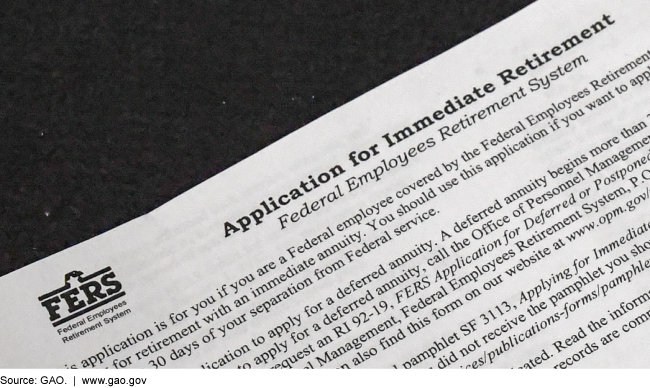
Application for immediate retirement, federal employees retirement system
Highlights
What GAO Found
The Office of Personnel Management (OPM), which administers the federal retirement program, identified three root causes for retirement processing delays:
1. the continuing reliance on paper-based applications and manual processing;
2. insufficient staffing capacity, particularly during peak workload season; and
3. incomplete applications.
OPM has taken various actions to address these root causes and thereby reduce delays.
Vision for modernizing retirement processing. OPM's strategic vision consists of five key initiatives for modernizing the application process, including developing an electronic application form and an electronic system to store retirement information. However, OPM was unable to provide estimated time frames or costs for the initiatives. OPM officials said that additional information technology (IT) modernization work is dependent on sufficient funding, among other factors. These factors are important but do not preclude OPM from establishing estimated cost ranges and time frames—practices consistent with industry best practices and IT project management principles.
Actions to increase staffing capacity. OPM's actions have included using overtime pay and hiring additional staff. However, OPM generally does not assess the effectiveness of these actions or whether they reduce delays. For example, OPM does not measure overtime productivity or correlate overtime data with application processing data. Federal internal control standards state that management should review its performance compared to its goals. OPM officials stated that they have limited resources for assessments. However, without assessments, OPM is less able to make informed decisions on how to best use staffing practices to improve processing times.
Actions to reduce missing information in applications. OPM provides assistance to agencies through guidance, training, communication through liaisons and email, and error reports. OPM's monthly error reports to agencies include information on the type of error found and the volume of applications with the same error, according to OPM. The four agencies GAO interviewed—Department of Defense (DOD), Department of Health and Human Services (HHS), National Aeronautics and Space Administration (NASA), and U.S. Postal Service (USPS)—reported that aspects of the error reports were not user-friendly. OPM stated that its assistance is intended to help agencies submit complete and accurate retirement packages for quicker processing. Federal internal control standards state that management should communicate quality information externally and periodically reevaluate its communication methods. OPM officials stated that the error report is intended to capture the overarching errors many agencies face and that revising the error report would not be cost-effective. However, the current format of the error report may limit its usefulness to agencies in improving their retirement applications.
Why GAO Did This Study
According to OPM, it receives more than 100,000 retirement applications each fiscal year. Between 2014 to 2017, OPM did not meet its goal of processing most retirement applications within 60 days. GAO was asked to review potential improvements in federal retirement processing at OPM. This report (1) describes the root causes of retirement application processing delays, as determined by OPM; and (2) examines what strategies, if any, OPM has taken to address those root causes, and how OPM has evaluated the effectiveness of the strategies.
GAO reviewed OPM data and documents, and interviewed OPM officials. GAO also interviewed officials from DOD, HHS, NASA, and USPS about their experiences with processing retirement applications. GAO selected these agencies because they represent a variety of application error rates and relatively high application volume.
Recommendations
GAO is making 6 recommendations. These recommendations include that OPM should develop a retirement services IT modernization plan for initial project phases; develop and implement policies for assessing staffing strategies intended to improve processing times; and determine if there are cost-effective ways to make the retirement application error report more user-friendly. OPM concurred with 1 recommendation and partially concurred with 5 recommendations. GAO continues to believe all aspects of the recommendations are valid, as discussed in the report. GAO also incorporated technical comments.
Recommendations for Executive Action
| Agency Affected | Recommendation | Status |
|---|---|---|
| Office of Personnel Management |
Priority Rec.
The Associate Director of OPM's Retirement Services, working in coordination with the Chief Information Officer, should develop, document, and implement a Retirement Services IT modernization plan for initial project phases that is consistent with key aspects of IT project management, such as determining objectives, costs, and time frames for each initial phase. (Recommendation 1) |
OPM partially agreed with this recommendation. As of March 2025, OPM stated that it has made significant progress toward implementing its Retirement Services IT Modernization Plan. OPM described actions that it has taken to digitize its paper-based retirement application process, such as a pilot of a web-based system that enables agencies and payroll providers to submit retirement applications online. OPM also stated that it has developed a Retirement Services Transformation Strategy and a Modernization Roadmap. However, OPM did not provide these documents. To fully implement our recommendation, OPM needs to develop, document, and implement a Retirement Services IT modernization plan that is consistent with key aspects of IT project management, such as determining objectives, costs, and time frames. As of March 2025, OPM described its accomplishments to date, but has not provided supporting documentary evidence for our review. Having such a plan is especially important since OPM anticipates that implementing the plan will be an iterative, multiyear effort. In September 2025, OPM provided a status update and supporting documentation demonstrating its actions taken to implement this recommendation. For example, OPM's modernization effort includes multiple projects such as an Online Retirement Application (ORA) that enables agencies and payroll providers to submit retirement applications online rather than having to apply via a mailed paper application; the Digital File System (DFS) that allows for the storage and management of digital retirement applications; and an annuity calculator that replaces its current outdated retirement calculator. OPM provided documentation for each of these projects that included specific objectives, project milestones and deliverables, target dates for completion, and related status. These actions meet the spirit of GAO's recommendation.
|
| Office of Personnel Management | The Associate Director of OPM's Retirement Services should adopt management practices to enhance the use of performance information on processing timeliness to inform how OPM manages operations, identifies problem areas, and allocates resources. For example, OPM could enhance use of performance measures at the operational level or establish a timeliness performance goal for reviewing disability retirement eligibility. (Recommendation 2) |
OPM partially concurred with this recommendation. In April 2021, OPM provided documentation showing that it established a timeliness performance goal in fiscal year 2020 for reviewing disability retirement eligibility in an average of 45 days or less. In August 2002 and May 2024, OPM provided examples from fiscal years 2020-2023 that show how it tracked the average processing days from when a disability retirement application is received to when a determination is made. In May 2024, OPM stated that this performance information continues to be used to track processing times and inventory as a measure of productivity. OPM also stated that this information is used by management to reallocate staff as needed and project future fiscal year totals for inventory and production.
|
| Office of Personnel Management | The Associate Director of OPM's Retirement Services should provide explanatory information, such as the range of processing times and the exclusion of disability retirement eligibility determinations, as part of the performance measure on processing timeliness. (Recommendation 3) |
OPM included explanatory information in its retirement processing timeliness status for October 2019 through February 2021. The explanatory information included the range of processing times with both average number of days for completing retirement cases that were completed in less than 60 days and also more than 60 days. In addition, the explanatory information also stated that disability determinations are included after approval.
|
| Office of Personnel Management | The Associate Director of OPM's Retirement Services should develop and implement policies and procedures for assessing strategies intended to improve processing times, including collecting and improving data needed to support those strategies, such as collecting better productivity data or staffing data and linking them to processing outcomes. (Recommendation 4) |
OPM partially concurred with the recommendation. In August 2022, OPM provided a list of strategies it uses to improve claim processing times, such as using overtime and special project teams. OPM also provided documentation of a new weekly production report. In May 2024, OPM stated the weekly production report is used to prioritize specific workloads and monitor workload levels to shift resources as needed. In January 2025, OPM stated that it does not have procedures to assess the strategies employed to improve operational performance. These efforts may improve processing outcomes. However, to fully implement this recommendation, OPM needs to develop both policies to guide, and plans to evaluate, its strategies and newly implemented procedures or reports.
|
| Office of Personnel Management | The Associate Director of OPM's Retirement Services should examine its process for assessing its assistance to agencies on retirement applications. For example, OPM could incorporate into its assessment process more agency feedback or documentation of assessment results, which could improve its partnership with agencies to strengthen the assistance provided. (Recommendation 5) |
OPM concurred with the recommendation. In September 2024, OPM stated that in August 2024, it had the first meeting of a new working group of agency officials who administer retirement benefits programs, the United States Postal Office, and payroll offices. The purpose of the working group includes gathering information and feedback from federal agencies and to address OPM's Office of Inspector General recommendations on handling initial retirement applications, according to OPM. In January 2025, OPM provided the agenda for the first meeting in August 2024, that included reviewing an agency audit survey and updates on a checklist used to determine errors in retirement packages. The survey included agency responses to questions asking for input on the retirement application error report that it sends to agencies, such as frequency, what information would be useful to include, and any additional feedback. OPM stated that the feedback from the working group is assisting it in creating an action plan to address agencies concerns about the error report. In September 2024, OPM stated that at the working group meeting it reviewed the checklist that had been revised based on agency feedback and that the agencies were satisfied with the changes made. OPM also stated that the next meeting was scheduled for February 2025. OPM incorporating feedback from the working group into its assessment process, such as asking for input on the error report and on the revised checklist, will help increase the effectiveness of its assistance to agencies which also contributes to decreasing errors in retirement applications.
|
| Office of Personnel Management | The Associate Director of OPM's Retirement Services should work with agencies to determine if there are cost-effective ways to make the retirement application error report that it sends to agencies more user-friendly. For example, explore whether there are cost-effective ways to provide the error report in a format that could be manipulated (e.g., Excel spreadsheet), or to include additional information, such as incorporating disability retirement applications or providing clearer descriptions of errors or trend data, some of which OPM already collects. (Recommendation 6) |
OPM partially concurred with the recommendation. In September 2024, OPM stated that in February 2023, it asked the contractor who produces the error reports to generate them in Excel. OPM stated that the first error reports in Excel were sent to agencies in October 2023. In January 2025, OPM provided an example of an error report in Excel format. We were able to manipulate the error report by resorting the error codes and adding a formula to add up some of the error codes. OPM also stated that it plans to continue to provide the error report in Excel format.
|