
Southwest Border Security: CBP Is Evaluating Designs and Locations for Border Barriers but Is Proceeding Without Key Information
Fast Facts
U.S. Customs and Border Protection (CBP) evaluated barrier design prototypes for the southwest border. CBP also determined how it would prioritize locations for future barriers, but didn't analyze the costs of putting barriers in each potential location. These costs can vary depending on topography, land ownership, and other factors.
Without assessing costs, CBP doesn't have complete information for prioritizing barrier deployments in the most cost-effective manner.
We recommended, among other things, further analysis of the costs to build future barriers.
U.S. Customs and Border Protection tested eight prototypes when considering designs for southwest border barriers.
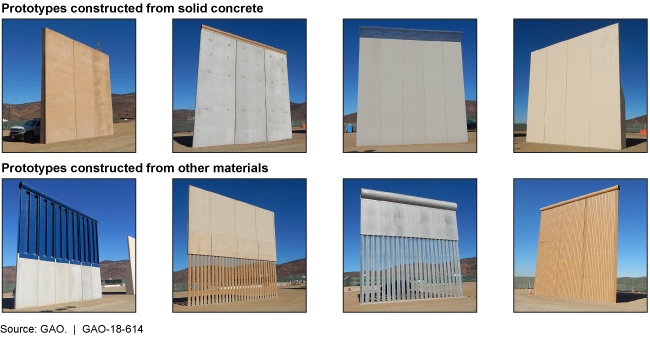
Eight pictures of barrier prototypes near the southwest border. Some are concrete; some are constructed of other materials.
On December 10, 2018, GAO posted an HTML version of this report.
Highlights
What GAO Found
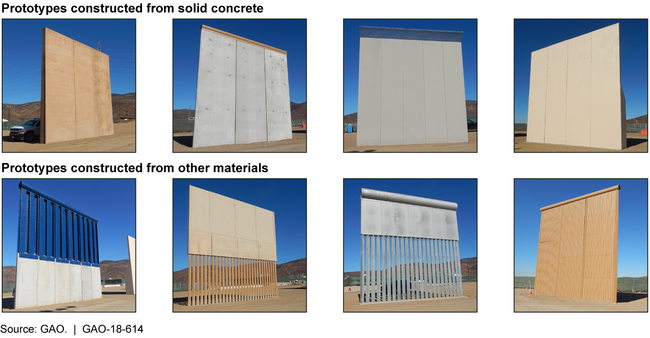
In March 2017, U.S. Customs and Border Protection (CBP), within the Department of Homeland Security (DHS), issued two requests for proposals (RFP) for physical barrier prototype designs for the southwest border. One RFP was for prototypes made of reinforced concrete, the other was for prototypes made of other materials. CBP subsequently issued task orders, under contracts awarded to six companies, to design and construct eight prototypes, pictured below. From October to December 2017, CBP tested the prototypes, using a range of methods to attempt to climb and breach them. Based on the results, CBP identified design attributes it can use to customize future barrier designs for specific locations, depending on the terrain and other factors.
U.S. Customs and Border Protection's Barrier Prototype Designs
CBP and U.S. Border Patrol developed a methodology for prioritizing future barrier deployments along the entire southwest border, which included input from Border Patrol officials, data on illegal entry traffic, and analysis of operational and engineering feasibility for each potential location. However, the strategy did not include analysis of the costs associated with deploying barriers in each location or segment, which can vary depending on topography, land ownership, and other factors. Without assessing costs, consistent with leading practices for capital decision making, CBP does not have complete information for prioritizing locations to use its resources in the most cost-effective manner.
Acquisitions for the Border Wall System Program—DHS's program to deploy barriers and other assets along the southwest border—are required to follow the department's acquisition process. However, GAO found that for one of the two approved segments, DHS has not documented its plans as required. Specifically, GAO found that for the Rio Grande Valley segment, DHS leadership approved and documented plans in December 2017. In contrast, for the San Diego secondary barrier segment, CBP's plans have not yet been documented, which could hinder DHS's ability to monitor progress for the segment.
Why GAO Did This Study
In January 2017, the President issued Executive Order 13767, which directs the Secretary of Homeland Security to immediately plan, design, and construct a wall or other physical barriers along the southwest border. CBP's fiscal year 2018 appropriation provided funding for barrier planning and design, but limited use of funds for primary barrier construction to previously deployed fencing designs.
GAO was asked to review DHS's efforts to deploy barriers along the southwest border. This report examines (1) how CBP evaluated potential designs for barriers, (2) DHS's process for identifying and assessing locations for future deployments of barriers, and (3) how DHS is managing the acquisition of the Border Wall System Program, among other things.
GAO analyzed planning documents; interviewed DHS, CBP, and Border Patrol officials; and conducted a site visit to San Diego to observe CBP's testing of barrier prototypes. This is a public version of a sensitive report that GAO issued in June 2018. Information that DHS deemed sensitive has been omitted.
Recommendations
GAO recommends that DHS analyze the costs associated with future barrier segments and include that analysis in future planning, and document plans for the planned secondary barrier replacement in the San Diego sector. DHS concurred with GAO's recommendations.
Recommendations for Executive Action
| Agency Affected | Recommendation | Status |
|---|---|---|
| Department of Homeland Security |
Priority Rec.
The Commissioner of CBP should analyze the costs associated with future barrier segments and include cost as a factor in the Impedance and Denial Prioritization Strategy. (Recommendation 1) |
In July 2018, we reported on U.S. Customs and Border Protection's (CBP) efforts to construct new physical barriers along the southwest border. We found that the Impedance and Denial Prioritization Strategy--CBP's decision support tool for prioritizing locations for barrier construction projects--did not include analysis of the costs of deploying barriers in each location, which can vary depending on topography, land ownership, and other factors. We recommended that CBP analyze the costs associated with future barrier segments and include cost as a factor in the Impedance and Denial Prioritization Strategy. CBP agreed with this recommendation. However, CBP officials stated that, after prioritizing locations, CBP conducts detailed cost estimates as part of the acquisitions process. As of September 2020, CBP officials stated that this cost information may affect how the construction projects are executed, but that it would not influence how CBP prioritizes barrier construction projects across various locations. Most recently, in August 2021, CBP officials stated that given the Presidential proclamation that ended the border wall program, they were only completing certain previously approved projects. Given the recommendation has been overcome by events, we are closing this recommendation as not implemented.
|
| Department of Homeland Security | The Under Secretary for Management should document plans to require CBP to follow the DHS acquisition life cycle, including the completion of all acquisition documentation requirements, for the planned secondary barrier deployment in the San Diego sector. (Recommendation 2) |
In July 2018, we reported on U.S. Customs and Border Protection's (CBP) efforts to deploy new physical barriers along the southwest border. We found that the Department of Homeland Security (DHS) had not documented its plans to follow the department's acquisition process for a planned barrier segment in San Diego. We recommended that the Under Secretary for Management document plans to require CBP to follow the DHS acquisition life cycle, including the completion of all acquisition documentation requirements, for the planned secondary barrier deployment in the San Diego sector. DHS agreed with this recommendation. In September 2018, the Under Secretary for Management approved the San Diego secondary barrier segment for Acquisition Decision Event (ADE) 2A/2B. In accordance with the DHS acquisition process, ADE-2A approves the program and ADE-2B approves the supporting projects and contracts. This action should serve to document the department's plans to follow the acquisition process for the planned segment. Therefore, this recommendation is closed as implemented.
|