
Managing for Results: Government-wide Actions Needed to Improve Agencies' Use of Performance Information in Decision Making
Fast Facts
Information about whether and how well agencies are reaching their goals is essential to making the federal government more effective. This only works, however, when federal managers use that data to make decisions.
Despite various efforts aimed at increasing managers’ use of data in decision making, our work has found little change over the past 20 years. The Office of Management and Budget has begun taking steps to address this issue, and our work identified additional practices—such as data-driven reviews—that can lead to increased use of data.
We recommended that OMB do more to further improve managers' use of performance information.

Photo of two men in suits looking over papers on a desk
Highlights
What GAO Found
Agencies' reported use of performance information to make decisions, and leading practices that can promote such use, generally has not improved since GAO's last survey of federal managers in 2013. However, GAO's survey results continue to point to certain practices that could help agencies improve managers' use of performance information. For example, as shown in the table below, GAO's survey found that managers whose programs were subject to data-driven reviews (regular reviews used to assess progress on select agency goals) to a greater extent reported statistically significantly greater use of performance information to make decisions.
Agency Reviews Associated with Increased Use of Performance Information in 2017
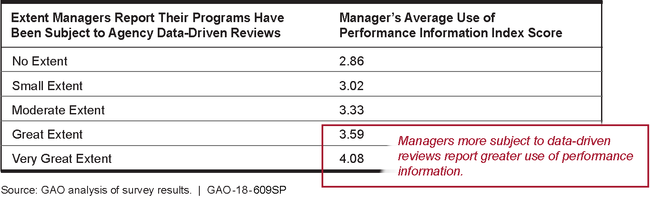
Note: GAO's index score is an average of responses to 11 related survey questions that approximates the reported use of performance information in decision making. The index runs from 1 to 5, where 1 reflects managers reported they and others use performance information to “no extent,” and 5 reflects to a “very great extent.”
The Executive Branch has begun taking steps to improve the use of performance information within agencies and across the government. For example,
In the President's Management Agenda and government-wide reform plan, released in March and June 2018 respectively, the administration acknowledged the need to do more, and announced a goal, among other actions, to improve the use of data in federal decision making. However, the Office of Management and Budget (OMB) and others responsible for this goal have yet to fully develop action plans to hold agencies accountable for achieving it.
The Performance Improvement Council (PIC), which is chaired by OMB, has undertaken efforts to improve the use of performance information by, for example, creating a working group on agency performance reviews. But it has not yet taken a systematic approach to identify and share proven practices that led to, or challenges that may be hampering, increased use of performance information by managers. GAO's survey results identified agencies that may have insights into such practices and challenges.
More fully developing action plans for the new goal, and identifying and sharing proven practices and challenges, could help ensure the Executive Branch takes further steps to improve the use of performance information by managers within agencies and across the federal government.
Why GAO Did This Study
To reform the federal government and make it more efficient and effective, agencies need to use data about program performance. The benefit of collecting performance information is only fully realized when it is used by managers to make decisions aimed at improving results.
GAO was asked to review agencies' use of performance information. This report assesses, among other things, the extent to which: (1) 24 agencies' reported use of performance information and related leading practices has changed since 2013 and (2) the Executive Branch has taken actions to enhance the use of performance information.
To address the first objective, GAO analyzed results from its 2017 survey of federal managers, and compared them to 2013 results. The survey covered a stratified random sample of 4,395 managers from the 24 Chief Financial Officers Act agencies. The survey had a 67 percent response rate and results can be generalized to the population of managers government-wide and at each agency. For the second objective, GAO reviewed agency documents and interviewed staff from OMB and the PIC.
Recommendations
To improve the use of performance information within agencies and across the federal government, GAO recommends that OMB work with (1) fellow goal leaders to more fully develop action plans for the new goal to improve the use of data and (2) the PIC to prioritize efforts to identify and share proven practices and challenges. OMB had no comments on this report.
Recommendations for Executive Action
| Agency Affected | Recommendation | Status |
|---|---|---|
| Office of Management and Budget | The Director of OMB should direct the leaders of the Leveraging Data as a Strategic Asset CAP Goal to ensure future updates to the action plan, and the resulting federal data strategy, provide additional details on improving the use of data, including performance information, more extensively within federal agencies. The action plan should identify performance goals; contributing agencies, organizations, programs, and other activities; those responsible for leading implementation within these contributors; planned actions; time frames; and means to assess progress. (Recommendation 1) |
As of January 2021, OMB and the leaders of the Leveraging Data as a Strategic Asset cross-agency priority (CAP) goal have taken actions that addressed this recommendation. For example, the July 2020 CAP goal action plan identified three underlying goals (i.e., performance goals) the federal government seeks to achieve by 2030, including one to "promote efficient and appropriate data use." It further identified 20 different actions agencies were to take in 2020 to show progress towards those goals. The Federal Data Strategy 2020 Action Plan provided further details for each of those 20 actions, including related performance measures and targets, milestones, and responsible parties. Finally, as of January 2021, agencies' progress towards implementing each of the actions and related targets and milestones was publicly reported on a web-based dashboard. Taken together, these details provide greater assurance that the Executive Branch's plans to improve data-driven decision making can be achieved.
|
| Office of Management and Budget | The Director of OMB, in coordination with the PIC, should prioritize efforts to identify and share among agencies proven practices for increasing, and challenges that hamper, the use of performance information in decision making more extensively within agencies. At a minimum, this effort should involve the agencies that our survey suggests may offer such insights. (Recommendation 2) |
As of July 2025, the Office of Management and Budget (OMB) and the Performance Improvement Council (PIC) have taken some actions to address this recommendation. For example, in 2018 and 2019, the PIC hosted a series of workshops focused on relevant topics, such as how agency staff can develop performance measures and analyze data, and how data-driven reviews are used across the federal government. However, they have not engaged the agencies highlighted by our survey results to identify proven practices that would increase, or challenges that are hampering, data-driven decision making within agencies. In September 2025, OMB informed us that in March 2025 it and the PIC had developed and shared with agencies leading practices for increasing the use of performance information in decision-making. We plan to request a copy of this resource to assess the extent to which it addresses this recommendation, and will update the status accordingly.
|