
VA Health Care: Improved Monitoring Needed for Effective Oversight of Care for Women Veterans
Fast Facts
Are women veterans getting the medical care they need?
The Department of Veterans Affairs has policies in place to help ensure the privacy, safety, and dignity of women veterans when they receive care at its medical facilities. For example, exam rooms must have privacy curtains and exam tables must face away from doors.
However, we found many instances of noncompliance with these policies. We also found that 27 percent of VA medical facilities lacked an onsite gynecologist.
We recommended that VA improve its oversight of care for women veterans, including monitoring access to services such as gynecology and maternity care.
Examples of VA Medical Center Examination Rooms for Women Veterans GAO Inspected, December 2015-March 2016
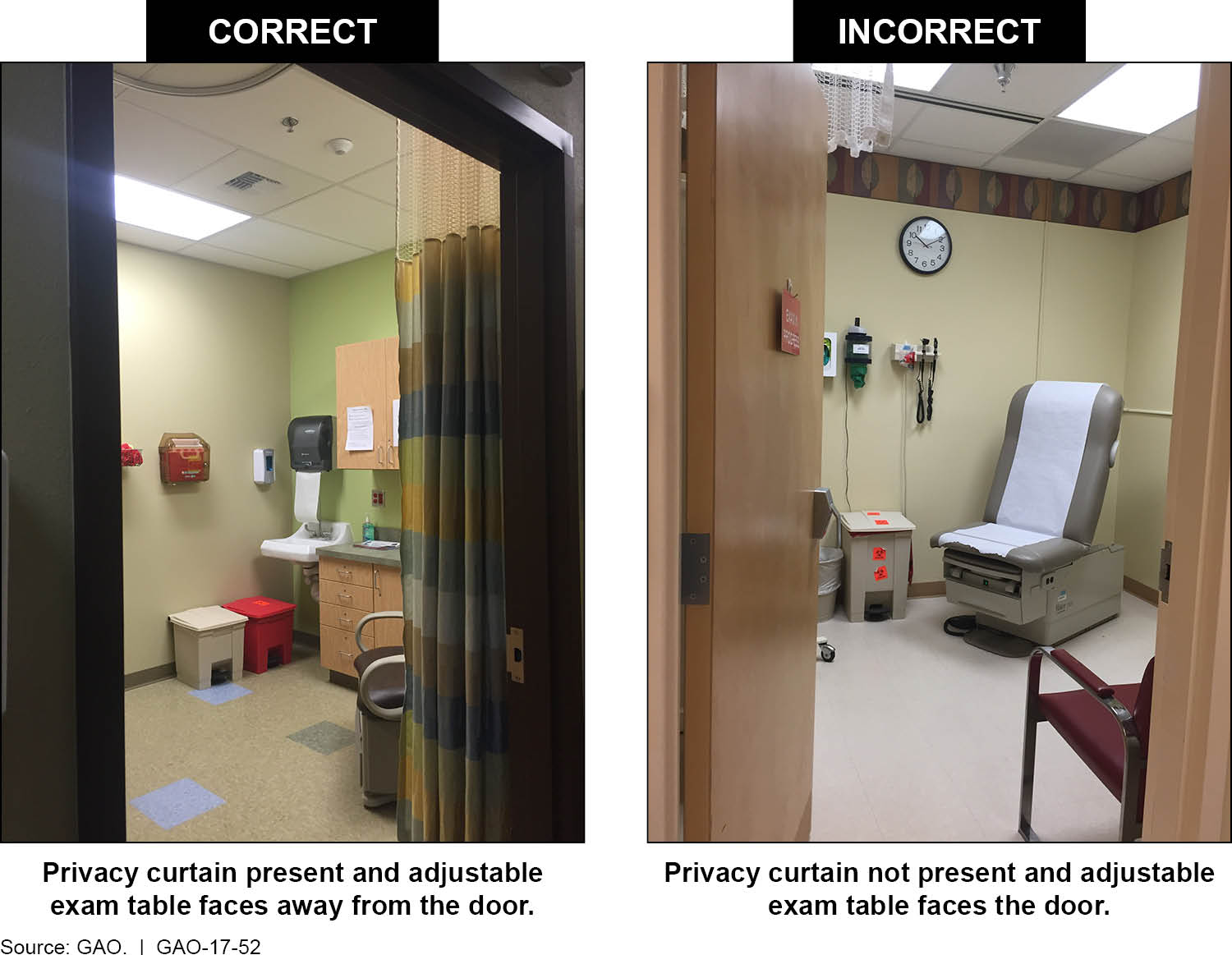
2 photos showing correct & incorrect use of privacy curtains and placement of exam table.
Highlights
What GAO Found
The Department of Veterans Affairs' (VA) Veterans Health Administration (VHA) does not have accurate and complete data on the extent to which its medical centers comply with environment of care standards for women veterans. VHA policy requires its medical facilities, including VA medical centers, to meet environment of care standards related to the privacy, safety, and dignity of women veterans. VHA Central Office relies on medical centers to conduct regular inspections and to report instances of noncompliance, which are compiled in a VHA database. However, almost all the noncompliance GAO identified through inspections at six VA medical centers it visited had not been reported or recorded in the VHA database, and compliance rates ranged from 65 percent to 81 percent. For example, GAO found a lack of auditory privacy at check-in clerk stations and a lack of privacy curtains in examination rooms, as required by VHA policy. GAO also found weaknesses in VHA's oversight of the environment of care for women, including a lack of thorough inspections and limited verification of facility-reported data which results in inaccurate and incomplete data. As a result, the privacy, safety, and dignity of women veterans may not be guaranteed when they receive care at VA facilities. Federal internal control standards for monitoring call for management to establish activities to monitor the quality of performance over time and promptly resolve any identified issues.
GAO's analysis of VHA data shows that nationally the number of VHA full-time-employee equivalent gynecologists and the number of women's health primary care providers—VHA primary care providers specially trained in women's health care services, such as breast exams—increased by 3 percent and 15 percent respectively, from fiscal year 2014 through fiscal year 2015, and those percentages exceeded the 1 percent growth in women veteran enrollment during the same period. However, about 27 percent of VA medical centers and health care systems lacked an onsite gynecologist and about 18 percent of VA facilities providing primary care lacked a women's health primary care provider, according to VHA data. VHA officials said not all facilities require onsite gynecologists and facilities may authorize gynecological services from non-VA providers. They acknowledged a shortage of at least 675 women's health primary care providers and have a plan to train at least 535 providers by the end of fiscal year 2016.
The Veterans Choice Program (Choice) is a primary option for veterans to receive care from non-VA providers in the community if care cannot be provided at VA facilities. While the number of obstetricians and gynecologists under Choice has increased, some areas lack these providers, according to a VHA analysis. While VHA monitors access-related Choice performance measures (such as timely appointment scheduling) for all veterans, it does not have such measures for women veterans' sex-specific care, such as mammography, maternity care, or gynecology. VHA's data show poor performance on access-related performance measures for all veterans, and GAO found cases where women veterans' maternity care was significantly delayed, suggesting that veterans, including women, face challenges receiving timely access to care. Federal internal control standards for monitoring call for management to establish activities to monitor the quality of performance over time and promptly resolve any identified issues.
Why GAO Did This Study
In 2010, GAO found a number of weaknesses related to care for women veterans at VA medical facilities. GAO was asked to update that study. This report examines (1) the extent that VA medical centers complied with requirements related to the environment of care for women veterans and VHA's oversight of that compliance; (2) what is known about the availability of VHA medical providers who can provide sex-specific care for women veterans at VA facilities; and (3) VHA's efforts to provide and monitor access to sex-specific care for women veterans through Choice. To do this work, GAO reviewed VHA data on environment of care deficiencies; the number, location, and availability of VHA and Choice medical providers; women veteran enrollment; and Choice access-related performance measures. In addition, GAO inspected the environment of care for compliance with VHA policy at a nongeneralizable sample of six VA medical centers, which were selected to achieve variation in different care models, the size of the women veterans' population, and geographical locations. GAO also interviewed VHA Central Office and VA medical center officials.
Recommendations
GAO recommends that VA (1) strengthen the policies and guidance for its environment of care inspection process and (2) monitor women veterans' access to sex-specific care under current and future community care contracts. VA concurred with GAO's recommendations.
Recommendations for Executive Action
| Agency Affected | Recommendation | Status |
|---|---|---|
| Department of Veterans Affairs | To improve care for women veterans, the Secretary of Veterans Affairs should direct the Under Secretary for Health to strengthen the environment of care inspections process and VHA's oversight of this process by expanding the list of requirements that facility staff inspect for compliance to align with VHA's women's health handbook, ensuring that all patient care areas of the medical facility are inspected as required, clarifying the roles and responsibilities of VA medical facility staff responsible for identifying and addressing compliance, and establishing a process to verify that noncompliance information reported by facilities to VHA Central Office is accurate and complete. |
VA concurred with our recommendation. In November 2021, the Veterans Health Administration (VHA) provided GAO with documentation strengthening its environment of care inspections process and oversight. This documentation included (1) an updated list of inspection requirements related to the privacy, safety, and dignity of women veterans in VHA health care facilities; (2) an updated agency directive and process guide governing the environment of care inspections process, including clear roles and responsibilities for staff responsible for identifying and addressing compliance; and (3) recent environment of care inspection reports showing facility examples of compliance.
|
| Department of Veterans Affairs |
Priority Rec.
To improve care for women veterans, the Secretary of Veterans Affairs should direct the Under Secretary for Health to monitor women veterans' access to key sex-specific care services--mammography, maternity care, and gynecology--under current and future community care contracts. For those key services, monitoring should include an examination of appointment scheduling and completion times, driving times to appointments, and reasons appointments could not be scheduled with community providers. |
VA completed the development of an electronic dashboard tool in 2023 which can monitor women veterans' access to care for key services under the community care program, as we recommended in December 2016.
|