
K-12 Education: Certain Groups of Students Attend Alternative Schools in Greater Proportions Than They Do Other Schools
Fast Facts
Students may attend alternative K-12 public schools due to issues like poor grades and disruptive behavior. Some students attend for a few days to a few years, while others cycle in and out.
Among other things, we found:
Enrollment at these schools dropped between school years 2013-14 and 2015-16. Declines in White and Hispanic enrollment accounted for most of the drop
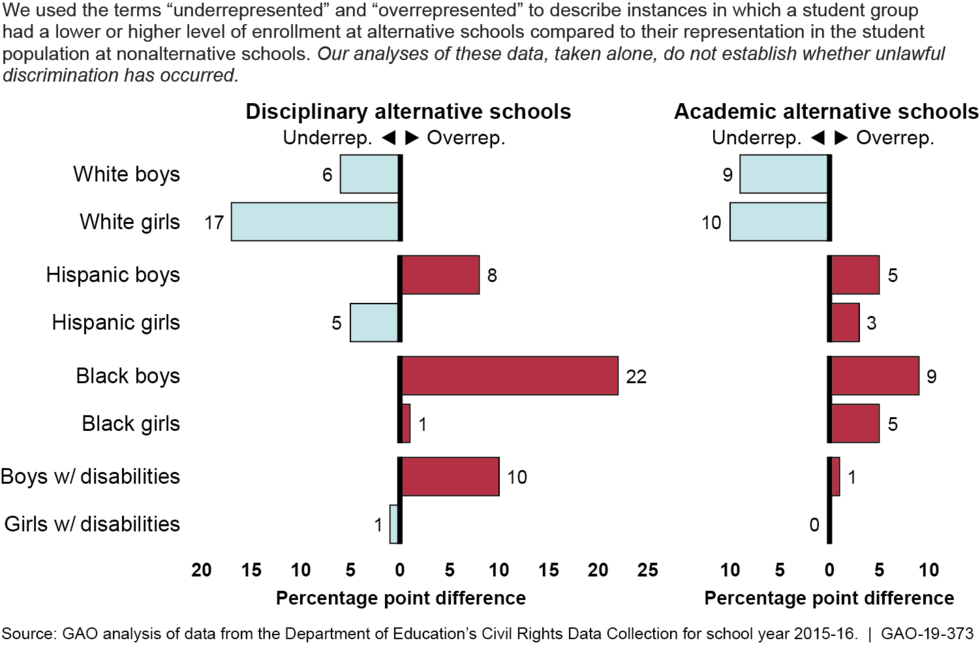
Some groups, such as Black boys and boys with disabilities, were overrepresented—particularly in schools with a discipline focus
A lower percentage of alternative schools had support staff (such as counselors and social workers) than nonalternative schools
Percentage of Public Schools that Are Alternative by District, School Year 2015-16
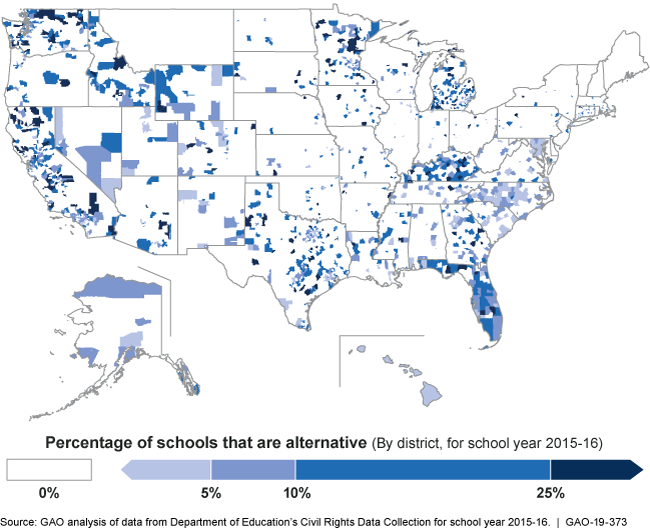
Map of United States showing concentrations of alternative schools in Florida, California, Kentucky, Washington and other states
Highlights
What GAO Found
Certain groups of students are overrepresented at alternative schools—public schools with a disciplinary or academic focus that serve students who have been expelled or suspended from school, or are at risk of educational failure—compared to their enrollment at nonalternative schools. Overall enrollment and discipline of students at these schools dropped between school years 2013-14 and 2015-16, according to GAO’s analysis of Department of Education (Education) data. Declines in White and Hispanic student enrollment accounted for most of the drop. Some groups, such as Black boys and boys with disabilities, were overrepresented in alternative schools, particularly those with a discipline focus, compared to their enrollment at nonalternative schools (see figure). While overall discipline dropped for students at alternative schools, school arrests and referrals to law enforcement went up by 33 and 15 percent, respectively, for Black boys and girls between school years 2013-14 and 2015-16.
Under/Overrepresentation at Alternative Schools, School Year 2015-16
Alternative schools have some of the most vulnerable students, but lower percentages of alternative schools have various types of support staff than nonalternative schools. Compared to nonalternative schools in 2015-16, a lower percentage of alternative schools had social workers, nurses, and counselors—support staff who serve different roles in addressing the health, behavioral, and emotional needs of students. For example, 47 percent of nonalternative schools had at least one social worker, compared to 26 percent of alternative schools. In every district GAO visited, officials said students had experienced multiple types of trauma, such as gang violence, death of schoolmates or parents, poverty, or homelessness—consistent with research linking trauma with educational and behavioral challenges—and described various strategies they used to meet student needs despite their staffing challenges.
Why GAO Did This Study
Students who attend public K-12 alternative schools may be at risk of educational failure for many reasons, including poor grades, disruptive behavior, mental health issues, and other life circumstances. Movement of students in and out of alternative schools can be fluid, with some students attending for a few days to a few years, and some cycling in and out of these schools repeatedly. Support staff, such as school psychologists and social workers, can play a role in supporting students’ health, behavioral, and emotional needs.
GAO was asked to review alternative schools. This report examines what is known about enrollment, discipline, and support staff in alternative schools, among other objectives. GAO analyzed data on alternative schools for school years 2013-14 and 2015-16 from Education’s Civil Rights Data Collection (most recent years available); visited selected school districts and alternative schools in Florida, Illinois, and Texas, selected for a mix of types (regular alternative, charter, and juvenile justice) and focuses (disciplinary or academic) of alternative schools; and interviewed federal officials.
In commenting on this report, Education expressed concern that GAO's analysis could confuse readers about whether race/ethnicity and other demographic variables are the cause of disproportionality or are simply correlated. GAO believes this concern is misplaced because the report clearly states that GAO's analysis is descriptive and does not imply causation or make inferences about disproportionality.
For more information, contact Jacqueline M. Nowicki at (617) 788-0580 or nowickij@gao.gov.