
What Are The Lowest-Performing Schools Doing to Improve?
No public school wants to be known as low performing or failing. Across the nation, the states place their lowest-performing schools on improvement plans and give additional resources to help them succeed. Improving these schools’ performance is important because of what it means for their students’ futures.
Decades of educational reforms have demonstrated just how hard it is to turn things around. Even so, there are some success stories too.
Today’s WatchBlog post looks at our new report on the obstacles some schools face when it comes to performance and what some have done to find success.
Image

What does it mean to be a low-performing school?
Measuring student performance in schools is done at the state level. This usually includes looking at students’ standardized tests scores and other metrics like graduation rates. Schools with low-performing students are identified so that changes can be made to help them instructionally (and their students academically) improve.
The lowest-performing schools are designated as “Comprehensive Support and Improvement” (CSI) schools. This means they are among the lowest performing 5% of Title I schools statewide—schools that receive federal Title I funds to serve low-income families statewide—or have high schools with graduation rates below 67%. CSI schools also include those with low-performing student groups that didn’t improve within a specific time frame determined by their state. For example, schools in Maryland need to show improvements after 3 years. These schools receive targeted federal funding, additional resources, and help with implementing improvement plans.
Lowest-performing schools have some characteristics in common. Some factors increased the odds of a school being labeled CSI. These include higher percentages of students living in poverty, more students with disabilities, and higher student-teacher ratios. But there were also some factors associated with decreasing the odds of a school being identified as lowest performing, including:
- Suburban location
- Higher percentage of Asian students
- Charter schools
- Large schools (more than 1,000 students)
The number of lowest-performing schools has increased slightly. The number of public schools needing comprehensive support increased from 6.5% to 7.3% between school years 2019-20 and 2022-23. And for many of these schools, the factors that lead them to become a low-performing school are just getting worse. For example,
- More students experienced deep poverty in school year 2022-23 than in school year 2019-20.
- And more of the lowest-performing schools had multiple reasons for being identified, such as low performance AND low graduation rate in school year 2022-23.
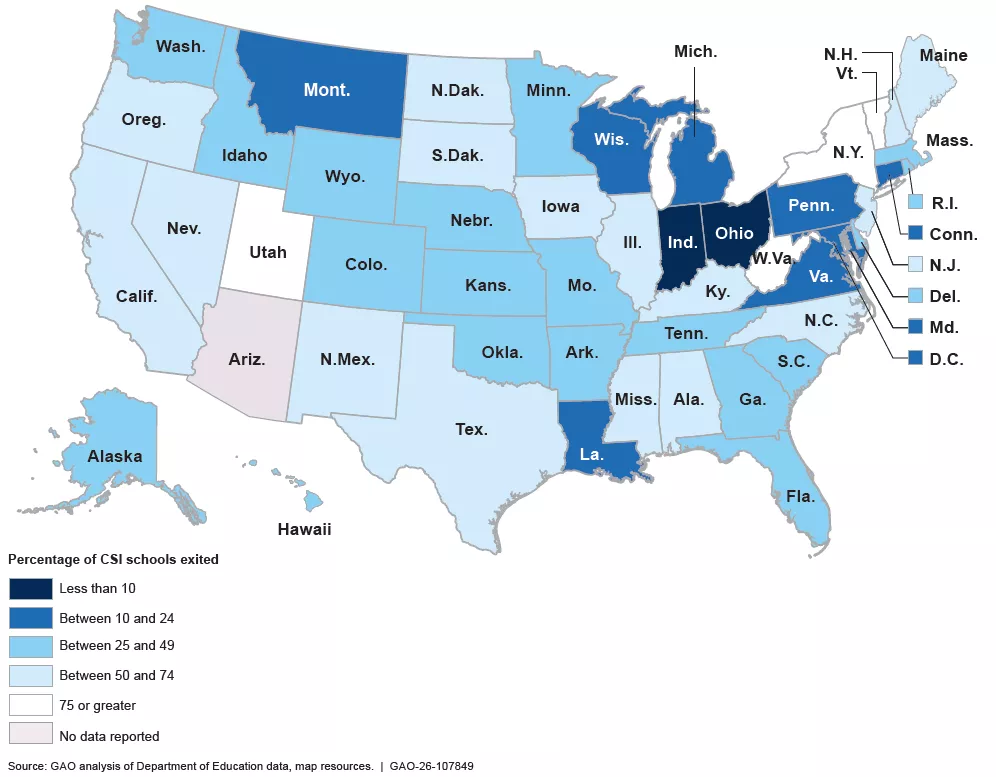
Some good news. Many schools are progressing. We found that, overall, 46% of the lowest-performing schools identified in school year 2019-20 had improved student performance enough to exit CSI by school year 2022-23. But knowing whether this is a true improvement is difficult because federal law allows each state to make its own exit criteria. For example, schools in Vermont exit CSI once they show significant improvement according to state-designed criteria. But in Ohio, schools must meet exit criteria for 2 consecutive years.
Percentage of Schools That Were Identified for CSI in School Year 2019-20 But Exited That Status by 2022-23
Image
Tools for success—how were some schools able to improve performance
While it can be an uphill battle to exit CSI status, some schools were able to successfully do it. We went straight to the source and interviewed educators in three state education offices, eight districts, and 14 schools to find out how they did it.
These educators identified key strategies for exiting CSI status. Effective leadership was central to them all. And buy-in from the top down was critical.
One elementary school principal said, “I think the success and momentum builder was getting everybody to understand their stake and role. We had some honest and tough conversations around ‘all means all.’ All students can learn, regardless of who they are or where they come from.”
Key Strategies Educators Identified to Improve Lowest-Performing Schools
Image
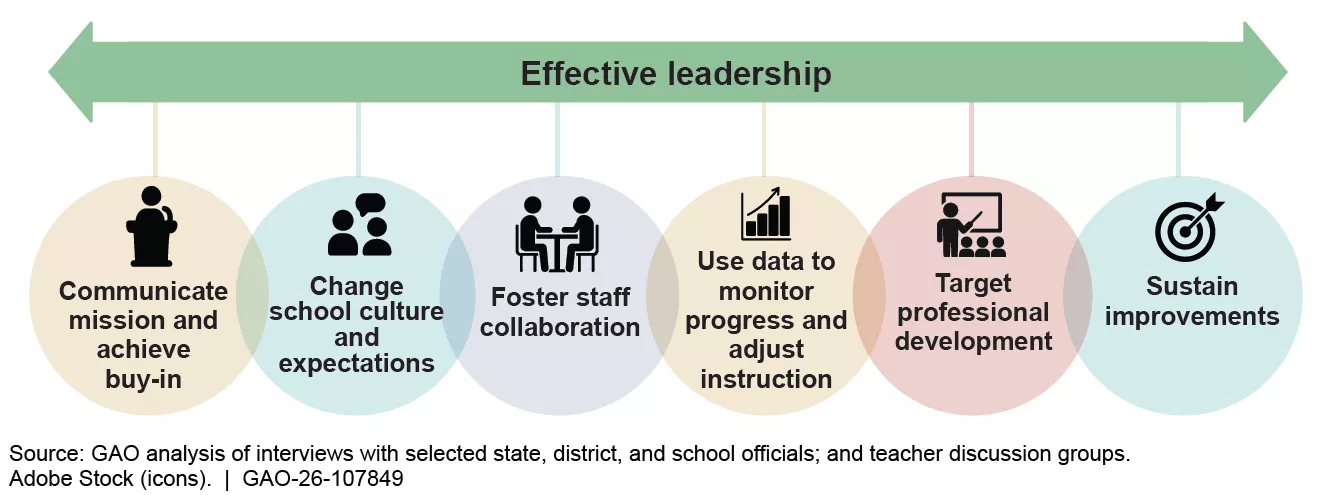
We also learned that combining multiple strategies aided schools’ success. For example, using data to measure changes in school culture and expectations for student behavior and attendance is important. But paring that with continuous monitoring of improvements over time increased the likelihood of success.
What are some of the key challenges to improving school performance? Educators also told us there are still challenges to exiting CSI status, such as student attendance, teacher shortages, and staff turnover.
For example, one school district official said as many as a third of its students were chronically absent. Two high school teachers told us that when students are habitually absent or late, it significantly impacts their ability to plan lessons and assess student knowledge.
For these schools, addressing chronic absenteeism was an important step for improving performance. They did so in a couple ways, such as providing quarterly attendance incentives. For example, one middle school took its students with fewer than five unexcused absences ice skating.
Learn more about these success stories and the challenges schools face by reading our full report.
- GAO’s fact-based, nonpartisan information helps Congress and federal agencies improve government. The WatchBlog lets us contextualize GAO’s work a little more for the public. Check out more of our posts at GAO.gov/blog.
- Got a comment, question? Email us at blog@gao.gov.
GAO Contacts
Image



Related Products
GAO's mission is to provide Congress with fact-based, nonpartisan information that can help improve federal government performance and ensure accountability for the benefit of the American people. GAO launched its WatchBlog in January, 2014, as part of its continuing effort to reach its audiences—Congress and the American people—where they are currently looking for information.
The blog format allows GAO to provide a little more context about its work than it can offer on its other social media platforms. Posts will tie GAO work to current events and the news; show how GAO’s work is affecting agencies or legislation; highlight reports, testimonies, and issue areas where GAO does work; and provide information about GAO itself, among other things.
Please send any feedback on GAO's WatchBlog to blog@gao.gov.