
Repeated Blast Exposures May Risk Military Service Members' Brain Health
Some military service members' brain health may be at risk due to blast exposures from weapons used in training or combat. Machine gunners, artillery and infantry troops, snipers, and others are frequently exposed to blasts in the course of their everyday jobs. And many have experienced symptoms ranging from headaches and slowed reaction time to memory loss or even traumatic brain injury.
Today’s WatchBlog post looks at our new report on these injuries and what the Department of Defense (DOD) is doing to protect service members.
Image
The dangers of repeated blast exposures
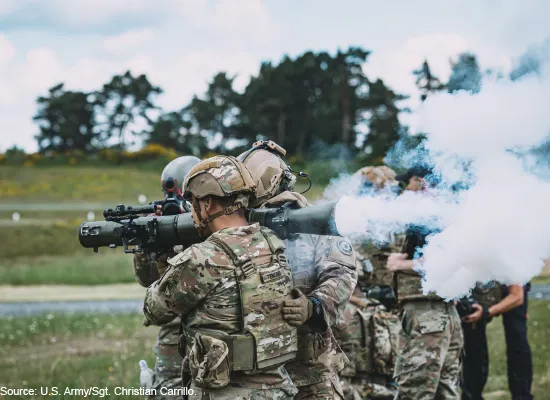
Service members may experience blast exposures outside of combat. And they do not need to receive a physical blow to be injured. Simply firing or detonating a weapon releases energy, causing a sudden pressure wave. These pressure waves—also known as “blast overpressure”—are above normal atmospheric pressure. And they can travel through the skull and cause micro-injuries in the brain.
Service members who are close to the weapon during discharge are at higher risk of impact. And certain weapon systems—such as shoulder-fired weapons and .50 caliber weapons like a sniper rifle—are known to generate higher levels of blast overpressure.
One exposure to this wave may not result in injury. But repeated exposure may cause neurological symptoms and damage. For most service members, repeated exposure happens during military training and combat involving heavy weaponry.
Some studies have shown that exposure to blast overpressure is associated with chronic health issues, including tinnitus, irritability, sleep disturbances, and difficulties with memory and concentration. In some cases, traumatic brain injuries have occurred.
One service member we interviewed said that shooting a rocket launcher feels like “taking a hit from a [football player] going 150 miles per hour.” Another reported that, after conducting consecutive exercises with breaching weapons (such as explosives), they felt “rattled, dizzy, and were throwing up.”
What is DOD doing to address this health concern?
As research on the health impacts of blast exposure continues, DOD has identified steps to prevent, mitigate, and treat brain health effects, including:
- Designing weapons to reduce the amount of blast overpressure
- Identifying safer positioning and distance from firing weapons
- Providing personal protective equipment like helmets and ear protection
- Tracking blast exposures to identify who needs care
- Treating short- and long-term brain health effects
DOD has also updated some safety policies in response to health concerns. For example, DOD has outlined appropriate stand-off distances when firing a weapon and the appropriate use of personal protective equipment. DOD has also set requirements for the military to complete baseline cognitive assessments for new service members and current service members at high risk because of their jobs.
Cognitive assessments are computer-based tests that detect service members’ speed and accuracy of attention, memory, and thinking ability. Having an initial assessment can be important later if a service member begins experiencing symptoms of blast exposure. It provides a baseline that can be used to detect a service member’s cognitive changes and guide proper treatment to avoid long-term effects of blast exposure.
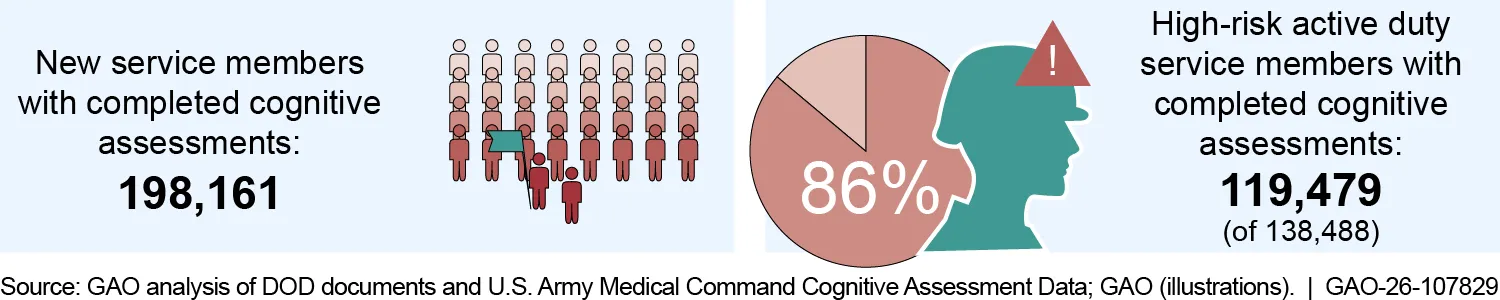
By the end of fiscal year 2025, most service members who had to be tested under the DOD policy had been assessed. Completed assessments totaled nearly 200,000 for new service members and more than 119,000 for high-risk active duty personnel.
Cognitive Assessments Completed in Fiscal Year 2025
Image
In addition, DOD has implemented tracking requirements, including updating a centralized data system that tracks exposures for service members. DOD has a process in place to track information about what kinds of weapons were used and how service members were exposed. This will help create a record of the hazards that a service member has experienced over the course of their military service.
DOD’s efforts to address blast exposure face challenges
DOD officials reported that resource constraints have hampered their ability to fully implement new safety efforts. These include not having enough staff or the needed technology to conduct cognitive assessments.
Exposure tracking efforts, too, have been hampered by a shortage in occupational safety and health staff.
How can DOD address these challenges? We recommended DOD complete a thorough assessment of its resource needs. This would better position the department to fully implement cognitive monitoring and exposure tracking requirements. It would also yield vital records with the potential to give service members and health care providers documented insight into cumulative blast exposures over service members’ careers.
We will continue to look into DOD’s efforts to improve service members’ safety from blast exposure. Learn more about our current work, read our full report.
Need help or more information on blast exposure? Service members and health care providers can look to the military health system and services branches for more information and available resources, including resources like fact sheets, videos, and publications. Check out its website for resources like this fact sheet.
- GAO’s fact-based, nonpartisan information helps Congress and federal agencies improve government. The WatchBlog lets us contextualize GAO’s work a little more for the public. Check out more of our posts at GAO.gov/blog.
- Got a comment, question? Email us at blog@gao.gov.
GAO Contacts
Image



Related Products

GAO's mission is to provide Congress with fact-based, nonpartisan information that can help improve federal government performance and ensure accountability for the benefit of the American people. GAO launched its WatchBlog in January, 2014, as part of its continuing effort to reach its audiences—Congress and the American people—where they are currently looking for information.
The blog format allows GAO to provide a little more context about its work than it can offer on its other social media platforms. Posts will tie GAO work to current events and the news; show how GAO’s work is affecting agencies or legislation; highlight reports, testimonies, and issue areas where GAO does work; and provide information about GAO itself, among other things.
Please send any feedback on GAO's WatchBlog to blog@gao.gov.