
Protecting Children from Lead Exposure and Other Toxins in Toys and Children’s Products
Hundreds of millions of children’s products—including toys, cribs, and clothing—enter the United States each year. This large volume can make it difficult to ensure these products are safe, including from toxic substances like lead.
The Consumer Product Safety Commission (CPSC) sets safety standards to protect children from hazardous products. But could it do more?
Today’s WatchBlog post looks at our new report on this.
Image

What does CPSC do to ensure children’s products are safe?
For decades, CPSC has helped consumers assess health and safety risks associated with children’s products. The agency sets safety standards to protect children from hazardous products. For example, products containing lead and other toxic substances can pose serious health risks to children, who may put them in their mouths. Specifically, exposure to lead can result in slowed growth, learning and behavioral problems, and even brain damage.
CPSC requires manufacturers and importers to have certain toys and other products tested for lead and other toxic substances. This is done by accredited third-party labs before products are sold in the U.S. Importers must also provide certificates showing that their products comply with CPSC’s safety regulations.
Due to the large volume of products arriving at U.S. ports, CPSC works with Customs and Border Protection (CBP) to identify high-risk shipments. For example, CPSC port investigators can use CBP entry information and other shipment documentation to identify packages containing children’s products within a shipment that may need to be screened.
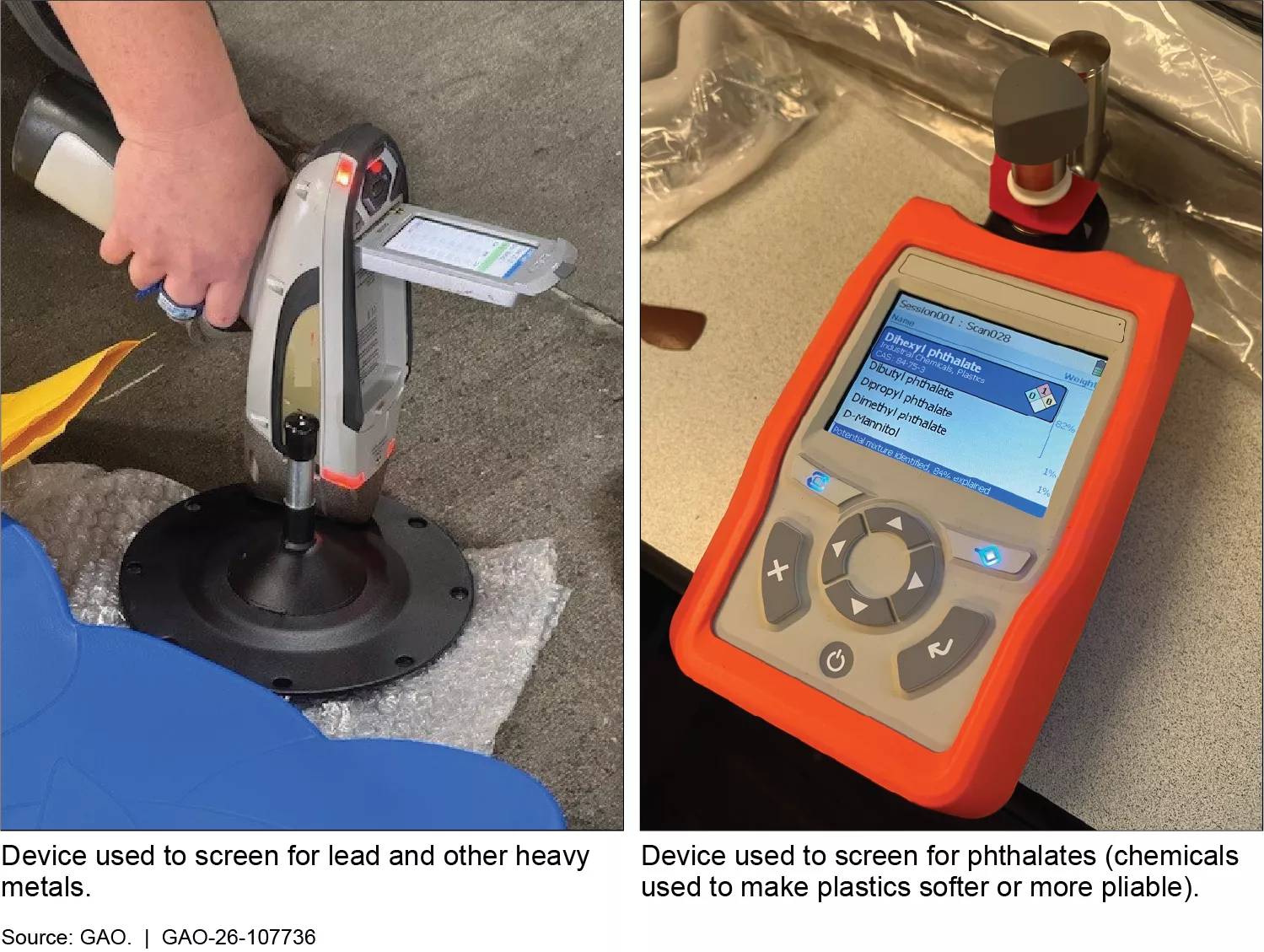
CPSC port inspectors screen products selected for examination for lead and other toxic substances with handheld devices. They also review importer documentation to verify products were lab-tested and certified to meet safety standards. Once inspectors are satisfied that the products meet these standards, the shipment is released into the market.
Inspectors may collect samples of products for further CPSC lab testing if the products fail the initial screening or do not have a certificate and test report. If the products fail, they could be destroyed or returned to the importer.
Devices the Consumer Product Safety Commission Uses to Screen Children’s Products for Toxic Substances at U.S. Ports
Image
How well are these efforts working and what more is needed?
CPSC’s standards and processes are important for ensuring the safety of children’s products. But more needs to be done to ensure that these standards are met and processes are followed. For example:
Lab oversight. CPSC has requirements for third-party labs to ensure they are accredited, have technical expertise, and are free of undue influence from a manufacturer or other interested party. For labs owned or controlled by a manufacturer, the agency looks at data on prior violations to identify associations between the labs and non-compliant products. This helps CPSC better evaluate the labs’ safeguards against undue influence. But it does not analyze this data for independent and government-owned labs. Doing so could help it better identify and address potential problems.
New e-filing system. This July, CPSC will begin requiring importers to electronically file certain testing information at U.S. entry ports. This includes the dates and places of manufacturing and of third-party testing. The new process aims to help the agency better target inspections for shipments containing children’s products. But we found that CPSC still needs to come up with a plan to ensure that importers are complying with the new e-filing requirements and are providing accurate information.
Updated testing for toxic substances. CPSC has also updated some testing requirements for children’s products, but not its requirements for lead or phthalates (toxic substances used to make plastics more pliable). The law requires the agency to review its lead requirements at least every 5 years. Yet it hasn’t done so. And it does not have written procedures for how staff should monitor changes related to phthalates and other toxic substances in products.
Addressing these areas could improve CPSC’s oversight and its efforts to prevent unsafe children’s products from entering the U.S. market. For more information on CPSC oversight of children’s products and our recommendations to improve it, check out our full report.
- GAO’s fact-based, nonpartisan information helps Congress and federal agencies improve government. The WatchBlog lets us contextualize GAO’s work a little more for the public. Check out more of our posts at GAO.gov/blog.
- Got a question or comment? Email us at blog@gao.gov.
GAO Contacts
Image


Related Products

GAO's mission is to provide Congress with fact-based, nonpartisan information that can help improve federal government performance and ensure accountability for the benefit of the American people. GAO launched its WatchBlog in January, 2014, as part of its continuing effort to reach its audiences—Congress and the American people—where they are currently looking for information.
The blog format allows GAO to provide a little more context about its work than it can offer on its other social media platforms. Posts will tie GAO work to current events and the news; show how GAO’s work is affecting agencies or legislation; highlight reports, testimonies, and issue areas where GAO does work; and provide information about GAO itself, among other things.
Please send any feedback on GAO's WatchBlog to blog@gao.gov.