
More Than Ramps—Accessibility Issues Remain Prevalent in Health Care
Annual medical check-ups, wellness exams, visits to specialists or, in some cases, emergency rooms. Most of us interact with health care providers at least once a year. For people with disabilities, accessing this care can be difficult.
Today’s WatchBlog post looks at our report on physical and other barriers people with disabilities face when trying to get health care.
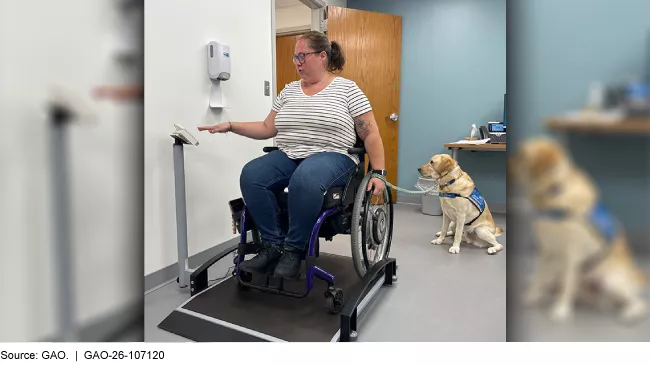
Medical Scale for People Who Use Wheelchairs
Image
Why accessing health care is harder for many people with disabilities
As many as one in four adults living in the U.S. have a disability. Some are physical, affecting a person’s vision, hearing, or movement. Others include a range of intellectual or developmental disabilities such as autism, which could limit someone’s ability to access health care without assistance.
To understand the barriers that people with disabilities face when trying to access the health care they need, we asked them. We also talked with organizations that represent people with disabilities. Here’s what they told us:
Physical barriers. You may be thinking of barriers to access health care in terms of physical ones—like wheelchair access ramps. There are lots of physical obstacles that people with disabilities face beyond just getting into a building.
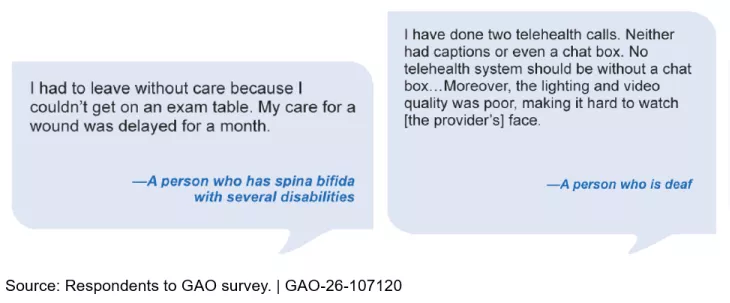
People with disabilities told us they had challenges:
- In exam rooms—for example, not being able to get onto the exam table
- Using medical equipment—such those used for mammograms
- Using check-in kiosks or phone apps to get medical information
Image
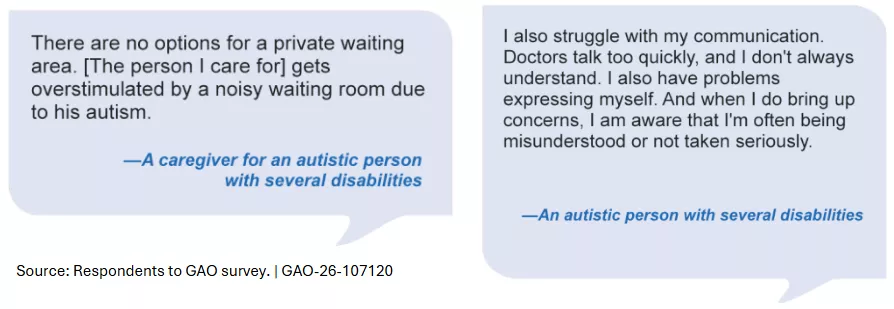
Other Barriers. Sometimes, it’s easier to see or understand the physical barriers. But people with disabilities also told us about other barriers you might not think or know about. For example, people with autism may become overwhelmed by bright lighting, strong smells (like medical cleaning products), or the noises of a busy waiting room or emergency room.
People with hearing and vision disabilities said communicating when in the exam room can also be difficult. People who are blind or have low vision may need verbal cues to let them know the medical staff are in the room. Some people may need a sign language interpreter, or a longer appointment to have enough time to get and share medical information.
Image
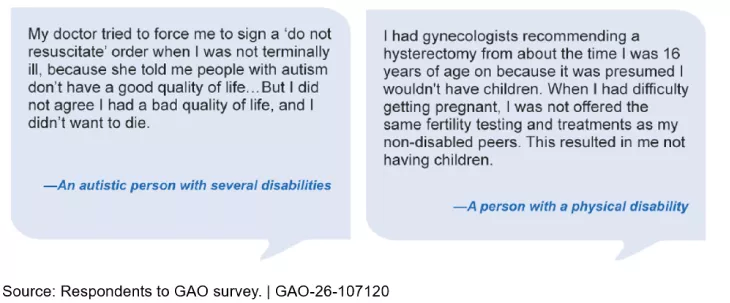
How bias impacts health care access. We were also told about how preconceived notions about disabilities or discrimination impacted patients’ access to the care they need. People told us about being denied services by providers because of their disability. They also spoke about medical practitioners making assumptions about what was best for them because of their disability—for example, not having or wanting children.
Image
More work needed to understand and address barriers to health care accessibility
Accessibility issues are broad, prevalent, and pervasive. They don’t just impact people in smaller communities or small practices. Large hospitals, specialists, and more can have obstacles that can affect health care access for those with disabilities.
There are several federally funded programs, including Medicare (the nation’s largest health care program), that pay for health services for people with disabilities. And federal law prohibits programs that receive federal funds or those who serve patients covered by Medicare from discriminating based on disability. This means the government has a duty to ensure accessibility.
But when we looked at efforts by the government to understand accessibility issues, we found that much more needs to be done.
The Department of Health and Human Services (HHS) collects information on health, including 12 national surveys that ask whether a respondent has disabilities. But none of the surveys collect national-level data on accessibility issues, and HHS does not have a plan to collect this data in the future. We think it should and recommended steps for it to do so.
Learn more about our work on health care accessibility issues and our recommendations for HHS by reading our full report. We also published an “easy read” version of this report to make it more accessible to people with certain disabilities.
- GAO’s fact-based, nonpartisan information helps Congress and federal agencies improve government. The WatchBlog lets us contextualize GAO’s work a little more for the public. Check out more of our posts at GAO.gov/blog.
- Got a comment, question? Email us at blog@gao.gov.
GAO Contacts
Image




Related Products
GAO's mission is to provide Congress with fact-based, nonpartisan information that can help improve federal government performance and ensure accountability for the benefit of the American people. GAO launched its WatchBlog in January, 2014, as part of its continuing effort to reach its audiences—Congress and the American people—where they are currently looking for information.
The blog format allows GAO to provide a little more context about its work than it can offer on its other social media platforms. Posts will tie GAO work to current events and the news; show how GAO’s work is affecting agencies or legislation; highlight reports, testimonies, and issue areas where GAO does work; and provide information about GAO itself, among other things.
Please send any feedback on GAO's WatchBlog to blog@gao.gov.