
Interest in Geothermal Development on Federal Lands Heats Up
Interest in geothermal energy has heated up during the last several years—particularly on federal lands. Why is there so much interest in geothermal now and how is the federal government handling this demand?
Today’s WatchBlog post looks at our new report on this issue.
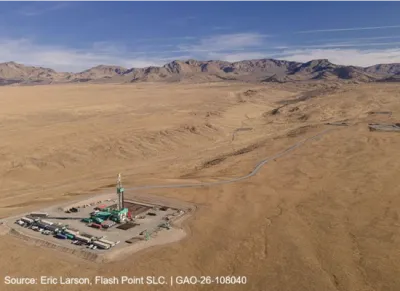
Utah Frontier Observatory for Research in Geothermal Energy (FORGE)
Image
Why is interest in geothermal growing?
Geothermal is attractive because it can provide a renewable, consistent, and domestic supply of electricity. And it can’t be disrupted by weather, which is nice.
It wasn’t always so attractive to developers. Drilling for geothermal often involves uncertainties, high upfront costs, and long development timelines before generating power and seeing any return on investment. More recent advancements in geothermal technology have helped to lower costs and made development of utility-scale power plants more attractive.
Developers are looking to lease federal lands and build utility-scale geothermal power plants to address future energy needs, including to power data centers.
Why federal lands? Traditionally, the best places to drill for geothermal are areas where the land closest to the earth’s surface is hot—think volcanoes, hot springs, and geysers. A lot of these hot rock features are on federal lands.
How much has interest in geothermal on federal lands grown?
The federal Bureau of Land Management (bureau) is tasked with managing geothermal interest and activity on federal lands, which has grown in recent years. We looked at how the bureau has responded to changes in 1) land nominations submitted by developers, 2) lease sales, and 3) drilling permits on federal lands.
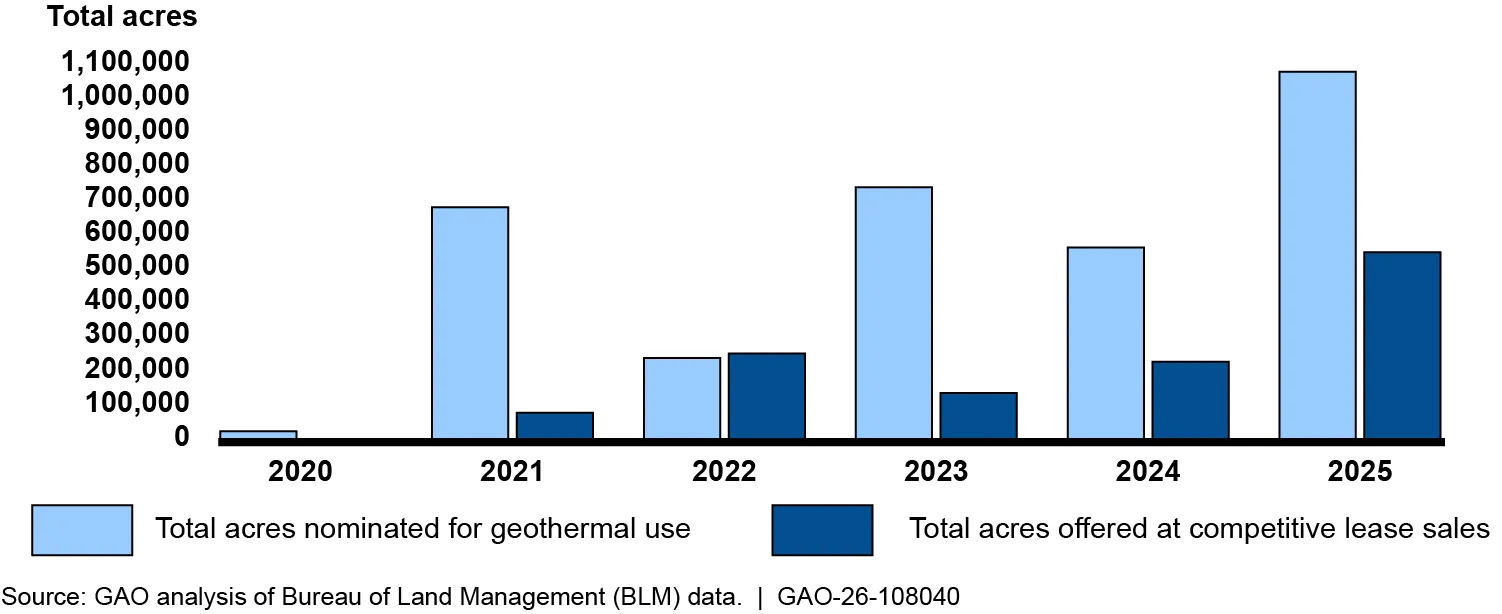
Land nominations. Geothermal developers can nominate specific federal lands they are interested in leasing. The bureau then reviews these nominations and offers eligible land at lease sales. Land nominations grew more than fortyfold—from about 26,000 to more than a million acres annually between 2020 and 2025.
- In New Mexico alone, there has been a significant increase from about 4,500 acres nominated in 2024 to more than 400,000 in 2025.
- Idaho has also seen significant interest with just 280 acres nominated in 2020 to more than 180,000 in 2025.
Lease sales. Federal land leases for geothermal development are auctioned to the highest bidder. In recent years, revenue from lease sales has grown significantly and developers have paid more per acre. In 2025, one lease was auctioned at $412 per acre—the highest winning bid in our review. From 2020 through 2025, the average winning bid went from $5.57 per acre to over $50. In total, geothermal lease sales generated over $24 million in 2025 alone.
Drilling Permits. The bureau has also increased the number of drilling permits it approves each year. In 2019, there were just seven. In 2024, there were 68 approved.
Total Acreage Nominated for Geothermal Use and Offered for Lease, 2020–2025
Image
How is the federal government handling this increase?
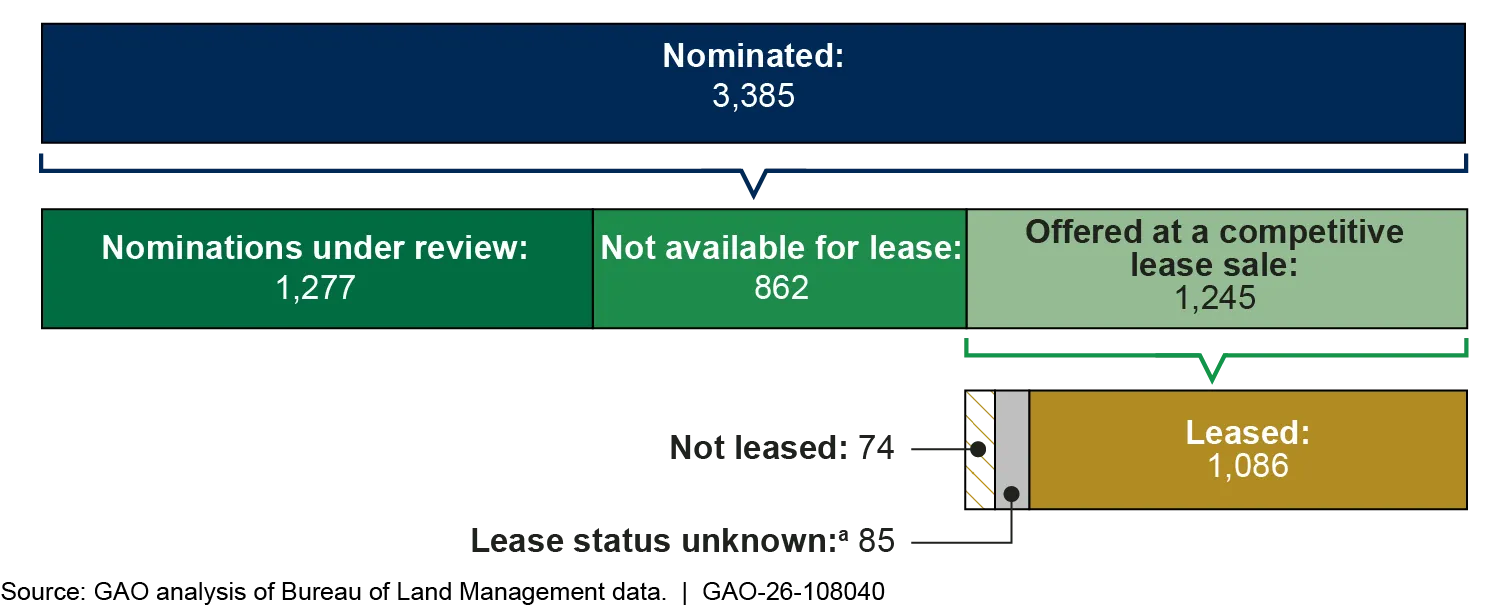
So far, the bureau has processed more than 60% of land nominations over the last several years. But it has also faced some challenges in managing this demand.
Status of 2019-2025 Geothermal Land Nominations, as of February (thousands of acres)
Image
Staffing and workload issues. Bureau officials across states reported recent staffing constraints that created backlogs in geothermal programs. For example, some bureau geologists already manage larger oil and gas mining workloads. And some state offices reported recent staff losses and high vacancies, which delayed permit processing.
To help with these workloads, the bureau is sharing staff resources across states. But this has raised other concerns.
Limited visibility of permit data. The bureau has limited visibility into the status of permits because geothermal developers submit applications to local offices for review. Since permit information is managed locally, bureau leadership doesn’t know how many permits are currently under review or fully processed (meaning approved, denied or withdrawn). As a result, it doesn’t know where backlogs are occurring and where staffing is needed most.
Inconsistency in permit process. Both the developers and bureau officials we spoke with described inconsistencies in permitting across federal offices in different states. These differences included, for example, whether a permit is required to collect soil samples and whether permit applications can be filed online or by mail.
Some of this confusion stems from draft handbooks provided to bureau staff. We think the bureau should review these handbooks to make sure they are up to date, finalize, and publish them. We also think it should establish a unified mechanism to track permitting activities. These two actions would help with some of the staffing challenges we saw.
Learn more about geothermal on federal lands by reading our full report.
- GAO’s fact-based, nonpartisan information helps Congress and federal agencies improve government. The WatchBlog lets us contextualize GAO’s work a little more for the public. Check out more of our posts at GAO.gov/blog.
- Got a comment, question? Email us at blog@gao.gov.
GAO Contacts
Image


Related Products

GAO's mission is to provide Congress with fact-based, nonpartisan information that can help improve federal government performance and ensure accountability for the benefit of the American people. GAO launched its WatchBlog in January, 2014, as part of its continuing effort to reach its audiences—Congress and the American people—where they are currently looking for information.
The blog format allows GAO to provide a little more context about its work than it can offer on its other social media platforms. Posts will tie GAO work to current events and the news; show how GAO’s work is affecting agencies or legislation; highlight reports, testimonies, and issue areas where GAO does work; and provide information about GAO itself, among other things.
Please send any feedback on GAO's WatchBlog to blog@gao.gov.