
Mortgage Lending: Newly Enacted Restrictions May Help Curb Unwanted Solicitations While Preserving Comparison Shopping
Fast Facts
Over the last several years, applying for a mortgage meant homebuyers would be bombarded with marketing calls and texts. That's because credit reporting agencies sold their information to lenders and brokers who used it to send competing offers.
Although these offers could help homebuyers shop for a mortgage, many were overwhelmed and annoyed by their high volume and at times confused over who was sending them.
New restrictions went into effect in March 2026 limiting who can buy this information. This could reduce unwanted solicitations while still allowing buyers to comparison shop for mortgages, e.g., by using online tools or referrals.

Hand holding a smartphone with incoming call from spam caller on the screen.
Highlights
What GAO Found
When homebuyers apply for a mortgage, lenders request their credit reports from credit reporting agencies. These agencies may then sell the homebuyers’ contact and credit information to other lenders and brokers, which use it to send competing loan offers. Before recent legislation, credit reporting agencies could, without the homebuyer’s consent, provide this information to those that did not have an existing relationship with the homebuyer (see figure). Thus, homebuyers could receive dozens of mortgage solicitations by phone or text in a short period.
Example of the Mortgage Trigger Lead Marketing Process
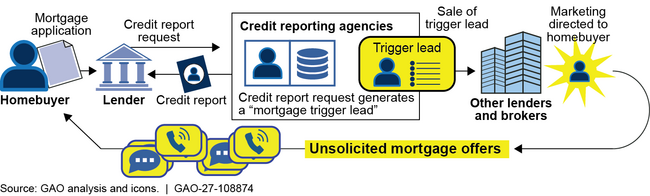
According to industry stakeholders, the primary benefit of trigger leads is that they can encourage homebuyers to comparison shop for loans and potentially save money. But this benefit may be limited: Recent federal survey results suggest that no more than 3.5 percent of homebuyers may have obtained a loan through competing offers based on trigger leads. One lender said homebuyers have ways to compare lenders before applying for a mortgage, so offers based on trigger leads generated later in the homebuying process may be less useful.
Trigger leads resulted in a high volume of unwanted marketing solicitations and posed other drawbacks for some homebuyers, according to consumer advocates and industry stakeholders:
- A high volume of solicitations can overwhelm and confuse homebuyers, and aggressive tactics can annoy them.
- Broad dissemination of homebuyers’ information could expose them to misleading or deceptive practices.
- Homebuyers may view the sale of their personal information and resulting marketing solicitations as an invasion of privacy.
In 2025, the Homebuyers Privacy Protection Act restricted credit reporting agencies’ ability to provide residential mortgage trigger leads to parties that have an existing relationship with or consent from the homebuyer. Because these restrictions took effect in March 2026, not enough time has passed to determine their effects on homebuyers. If effectively implemented, these restrictions could limit access to trigger leads and reduce the volume of solicitations homebuyers receive while preserving opportunities to comparison shop.
Why GAO Did This Study
Each year, millions of homebuyers apply for a mortgage, and some receive marketing calls and texts from other lenders and brokers with competing offers based on trigger leads. The volume of these mortgage solicitations prompted the enactment of the Homebuyers Privacy Protection Act in 2025.
The act includes a provision for GAO to assess the value of trigger leads for homebuyers. This report examines (1) the potential benefits of trigger leads, (2) drawbacks associated with them, and (3) how the act’s restrictions may affect those benefits and drawbacks.
GAO reviewed federal and state laws, searched for and reviewed relevant literature, and analyzed 2022–2024 responses to the National Survey of Mortgage Originations. In addition, GAO obtained information from or interviewed officials of credit reporting agencies, consumer groups, mortgage lenders (banks, credit unions, and nonbanks), industry associations, the association for state banking regulators, and a state regulatory agency. GAO also analyzed the Consumer Financial Protection Bureau’s (CFPB) consumer complaints database and used artificial intelligence to identify complaints related to mortgage solicitations, and interviewed officials from CFPB and the Federal Trade Commission.
For more information, contact William W. Colvin at colvinw@gao.gov.