
Rural Health Transformation Program: Early Implementation Actions and Monitoring Plans
Fast Facts
It can be hard for people living in rural areas to get the health care they need. In 2025, a federal law established the Rural Health Transformation Program to fund state activities—like recruiting clinicians to rural areas.
The Centers for Medicare & Medicaid Services administers the program, which will provide up to $50 billion to states over 5 years. In its first year, CMS gave $10 billion to 50 states.
This Q&A report looked at what CMS did to implement the program and its plans to monitor states’ activities. For example, CMS plans to communicate with states to discuss progress and conduct audits and site visits.

Person using a stethoscope on an elderly person
Highlights
What GAO Found
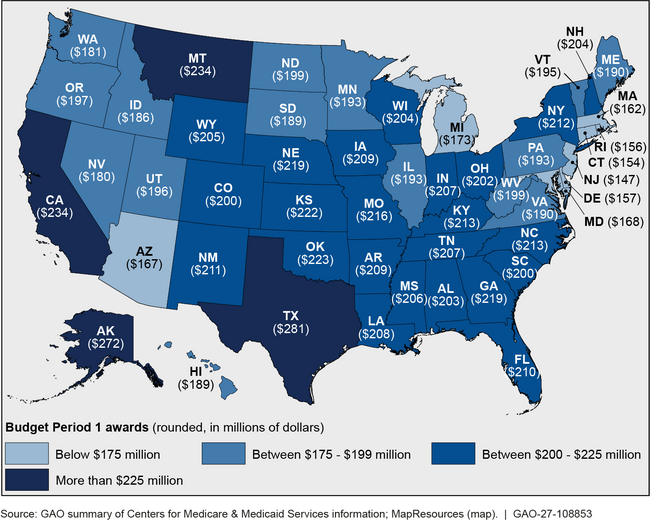
The Rural Health Transformation program provides funding for states to conduct rural health activities, such as recruiting clinicians to rural areas and providing training and technology to improve care delivery in rural hospitals. In the latter half of 2025, the Centers for Medicare & Medicaid Services (CMS) completed a number of early key actions to implement the Rural Health Transformation program. These actions included the release of the notice of funding opportunity—which provided details on program goals and requirements—and initial funding awards to all 50 states totaling $10 billion. The initial allotment of state funding ranged from $147 million for New Jersey to $281 million for Texas. CMS and merit reviewers assessed state applications based on a variety of factors—such as rural characteristics (e.g., total area in square miles and percent of population in rural areas) and the strength of states’ proposed initiatives. As a result, funding amounts variedacross states.
Rural Health Transformation Program Funding, by State, Budget Period 1 (December 29, 2025, Through October 30, 2026)
CMS plans on conducting a range of activities to monitor states’ activities and use of program funding. These monitoring activities include communicating with states to discuss progress and challenges, reviewing information states submit, and conducting audits and site visits. GAO found that its planned activities are generally consistent with selected requirements related to monitoring of federal awards. For example, CMS plans to measure awardee performance to show achievement of program goals and objectives, and hold webinars to share lessons learned, improve program outcomes, and foster the adoption of promising practices.
CMS plans to allot up to $40 billion of the remaining program funds to states over the next 4 years based on their demonstration of satisfactory progress toward approved initiatives (e.g., progress toward planned milestones), among other activities. If states do not comply with the terms and conditions of their notices of award, CMS may withhold, reduce, or recover a portion of states’ program funding. The authorizing legislation of the Rural Health Transformation program limits states’ ability to appeal or challenge any funding changes made by CMS. However, officials said issues related to appeals or challenges of funding changes may depend on the specific facts and circumstances, and they are in the process of determining how the agency will handle any such disputes or challenges.
Why GAO Did This Study
In July 2025, the One Big Beautiful Bill Act established the Rural Health Transformation program to provide funding allotments to states for specified rural health activities. It will fund up to $50 billion to states over 5 years. The program is administered by CMS as cooperative agreements with states. Federal law provided CMS with broad discretion to determine funding allotments to states.
Among other topics, this report describes CMS’s initial steps to establish the program, examines CMS’s plans to monitor states’ activities, and describes CMS’s approach for determining states’ future funding allotments.
To conduct this work, GAO reviewed CMS documentation on Rural Health Transformation program implementation and monitoring. GAO also interviewed CMS officials and representatives from two rural health stakeholder groups and one state government stakeholder group selected among those with national membership.
For more information, contact Leslie V. Gordon at GordonLV@gao.gov.