
Multilateral Banks: Treasury Should Improve Consistency and Transparency of Decisions on Projects Affecting U.S. Producers
Fast Facts
The U.S. funds and participates in multilateral development banks that support overseas projects in industries like farming and manufacturing.
By law, Treasury must instruct U.S. participants to vote against assistance for projects that could harm American producers of the same or similar products. But we found gaps in Treasury's process for determining whether to vote "no" on projects. Those gaps could lead to decisions that harm U.S. producers.
Also, Treasury doesn't publicize when it considered this law in votes on these projects—limiting transparency.
Our recommendations address these issues.
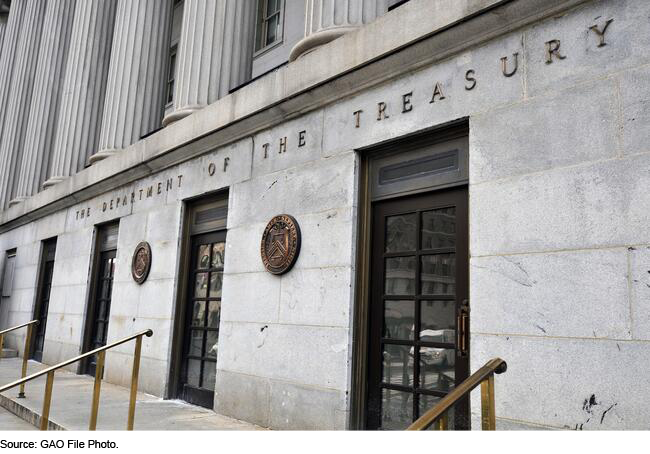
Entrance exterior to the Department of the Treasury building
Highlights
What GAO Found
The U.S. provides funds and participates in multilateral development banks (MDBs), which support overseas projects that may compete with U.S. producers. GAO found that Treasury’s project review process has gaps in defining and applying criteria for assessing three key provisions in the statute, all of which must be met to trigger the requirement that Treasury oppose an MDB project. For example, Treasury has criteria for assessing whether a commodity or mineral is in surplus on world markets, but it rarely applies it, according to Treasury officials. Also, Treasury does not have criteria for assessing “substantial injury” to U.S. producers. Developing and applying such criteria would better position Treasury to ensure the consistency of its voting decisions and, as a result, its implementation of the statute. Without criteria, Treasury could take different positions on project proposals with similar circumstances because assessments rely on subjective judgment rather than consistent standards. This could put Treasury at risk of unintentionally affecting U.S. producers.
Treasury supported most of the projects that GAO determined were related to commodities or minerals for export relevant to the statute from January 2015 - August 2025. Treasury made more than 11,000 votes on MDB projects during this period and supported 83 percent of the 340 projects that were likely covered by the statute. However, Treasury does not include information in the public voting records about which projects it considered as relevant to the statute. Doing so would enhance transparency for industries that may be adversely affected by MDB projects.
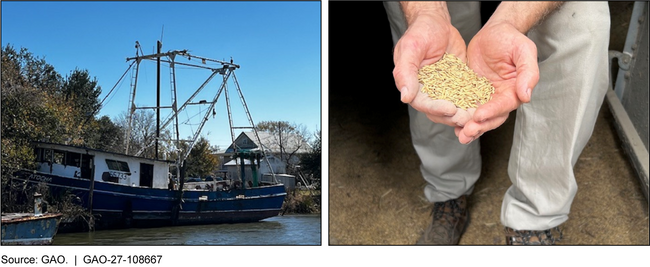
GAO found evidence that MDB-financed projects may be one of several factors that contributed to injury to U.S. producers in the shrimp industry, one of GAO’s two case studies. Specifically, MDB-supported aquaculture projects in Ecuador led to more shrimp imports and may have contributed to lower prices in the U.S., which adversely affected U.S. producers. GAO did not identify evidence linking MDB projects to challenges affecting U.S. rice producers. Shrimp and rice industry stakeholders and available data suggest that both industries have faced a range of other challenges unrelated to MDB-supported projects, such as market competition, regulatory requirements, and environmental conditions.
Abandoned Shrimp Boat in Louisiana and Rice Grower Displaying Rice in Arkansas
Why GAO Did This Study
Congress enacted 22 U.S.C. § 262h directing Treasury to instruct U.S. Executive Directors at international finance institutions to oppose any assistance that supports production or extraction of commodities or minerals in surplus on world markets and whose export would cause substantial injury to U.S. producers of the same, similar, or competing product.
GAO was asked to review Treasury’s implementation of this statute. This report examines 1) Treasury’s oversight process to help ensure adherence to the statute, 2) U.S. voting records on MDB-financed projects, and 3) the extent to which relevant MDB projects may have contributed to injury to U.S. producers in selected industries.
GAO reviewed laws and agency documents, analyzed trade data and voting records, interviewed agency officials, and conducted field work in four states to meet with stakeholders from the U.S. shrimp and rice industries.
Recommendations
GAO is making four recommendations to Treasury, including that it develop and apply criteria to assess the statute’s key provisions and include information in public voting records on projects for commodities or minerals for export relevant to the statute. Treasury concurred with all four recommendations.
Recommendations for Executive Action
| Agency Affected | Recommendation | Status |
|---|---|---|
| Department of the Treasury | The Secretary of the Treasury should ensure the Undersecretary for International Affairs updates its guidance to include specific criteria for identifying "commodities and minerals" to consider under 22 U.S.C. § 262h. (Recommendation 1) |
When we confirm what actions the agency has taken in response to this recommendation, we will provide updated information.
|
| Department of the Treasury | The Secretary of the Treasury should ensure the Undersecretary for International Affairs reviews the existing criteria in its guidance for assessing "surplus on world markets" under 22 U.S.C. § 262h and, if necessary, updates its guidance. (Recommendation 2) |
When we confirm what actions the agency has taken in response to this recommendation, we will provide updated information.
|
| Department of the Treasury | The Secretary of the Treasury should ensure the Undersecretary for International Affairs updates its guidance to include specific criteria for assessing "substantial injury to U.S. producers" under 22 U.S.C. § 262h. (Recommendation 3) |
When we confirm what actions the agency has taken in response to this recommendation, we will provide updated information.
|
| Department of the Treasury | The Secretary of the Treasury should ensure the Undersecretary for International Affairs includes in the public voting record when Treasury determined a project was relevant to 22 U.S.C. § 262h. (Recommendation 4) |
When we confirm what actions the agency has taken in response to this recommendation, we will provide updated information.
|