
Army Corps of Engineers: Determinations That Projects Do Not Need Environmental Mitigation Should Be Clarified
Fast Facts
The Army Corps of Engineers manages water infrastructure projects, such as levees to control flooding. But some projects can harm the environment, including fish and wildlife.
The Corps must report to Congress on its plans to mitigate environmental harms—or its determinations that mitigation isn't needed.
This Q&A reviews the Corps' plans and determinations that mitigation wasn't needed. For 2020-2025, the Corps submitted plans for 30% of its projects. But the Corps didn't clearly document why mitigation wasn't needed for the other projects.
We recommended it do so to keep Congress informed about projects' environmental impacts.
Army Corps Flood Control Project in New Orleans
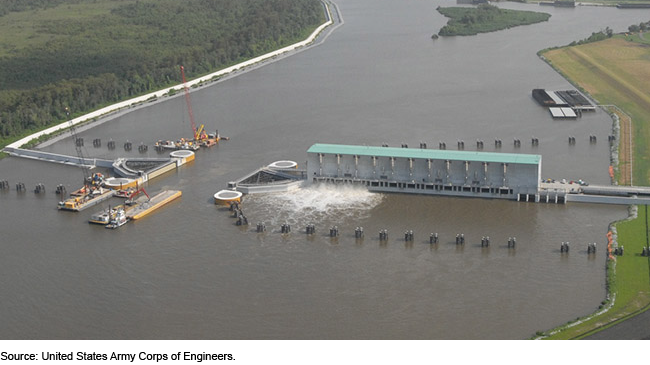
Aerial view of a levee spanning a waterway, with an opening in the center.
Highlights
What GAO Found
Through its Civil Works program, the U.S. Army Corps of Engineers plans, constructs, and maintains water resources projects around the country. For any Civil Works projects submitted to Congress for authorization, federal statute requires the Corps to report its plans for environmental mitigation—that is, actions to avoid, minimize, or compensate for any expected losses to fish and wildlife and damage to ecological resources resulting from its projects. If the Corps determines no mitigation is necessary, it is required to report that determination.
Of the 74 Civil Works projects submitted to Congress for authorization during calendar years 2020–2025, the Corps determined that mitigation plans were needed for 22 projects and not needed for 52 projects. For the 22 projects with mitigation plans, GAO found that the plans generally included selected components from the 2008 Rule, “Compensatory Mitigation for Losses of Aquatic Resources.” For the 52 projects that the Corps determined did not need mitigation plans, GAO found that reports submitted to Congress for project authorization, and supporting feasibility reports, generally did not clearly document the Corps’s determination that no mitigation was needed and why.
Civil Works Projects Submitted for Authorization During Calendar Years 2020–2025 and the Need for Mitigation Plans, as Determined by U.S. Army Corps of Engineers
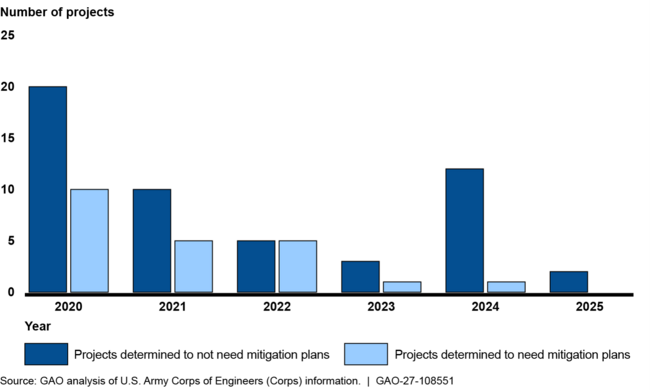
Corps officials said that they have not consistently focused on documenting that no mitigation is needed in a clear, summary format and agree that doing so could be beneficial for Congress and the public. By clearly documenting its determinations that no mitigation is needed, and the basis for those determinations, the Corps could better assure Congress that authorization of projects without mitigation will not result in undue impacts on fish and wildlife and ecological resources.
Why GAO Did This Study
Corps water resources projects aim to improve navigation channels, reduce flood and storm damage, and restore aquatic ecosystems. As some projects can have an adverse impact on the environment, the Corps is required to identify measures to mitigate unavoidable impacts.
The Water Resources Development Act of 2022 includes provisions for GAO to review Corps plans to mitigate fish and wildlife losses resulting from Civil Works projects. This report provides information on the Corps’s mitigation determinations for Civil Works projects, including the extent to which the Corps’s mitigation plans, or determinations that mitigation is not necessary, are included in reports submitted to Congress for project authorization.
GAO analyzed and reviewed laws, regulations, and guidance relevant to Civil Works mitigation activities. GAO also met with Corps officials who oversee mitigation planning for the Civil Works program and gathered information on Civil Works projects submitted for authorization in calendar years 2020–2025. For projects determined to need a mitigation plan, GAO reviewed the mitigation plans. For projects determined not to need a mitigation plan, GAO reviewed the Chief’s Reports and supporting feasibility reports.
Recommendations
GAO recommends that the Corps develop guidance on documenting and justifying its determinations that no mitigation is needed in reports submitted to Congress for project authorization. The Office of the Assistant Secretary of the Army for Civil Works did not concur, noting that the reports have sufficient technical information. As noted in the report, GAO maintains the recommendation is warranted.
Recommendations for Executive Action
| Agency Affected | Recommendation | Status |
|---|---|---|
| Corps of Engineers | The Assistant Secretary of the Army for Civil Works should ensure that the Chief of Engineers and Commanding General of the U.S. Army Corps of Engineers develop guidance for the Corps on documenting and justifying its determinations that no mitigation is needed for Civil Works projects in reports submitted to Congress for authorization. (Recommendation 1) |
When we confirm what actions the agency has taken in response to this recommendation, we will provide updated information.
|