
Critical Minerals: BLM Should Ensure Individuals and Businesses Meet Citizenship Requirements for Hardrock Mining Claims
Fast Facts
Critical minerals–like copper and lithium–are vital to the U.S. economy and national security. The U.S. relies on imported critical minerals to meet its needs, raising concerns that have prompted the President to call for expanding mining on federal lands.
To extract minerals from federal lands, individuals must generally be U.S. citizens and companies must be incorporated in the U.S. However, the Bureau of Land Management, which oversees mines on federal lands, rarely collects information to know if these requirements are being met.
We recommended that BLM do so to help ensure that only those qualified can extract minerals from federal lands.
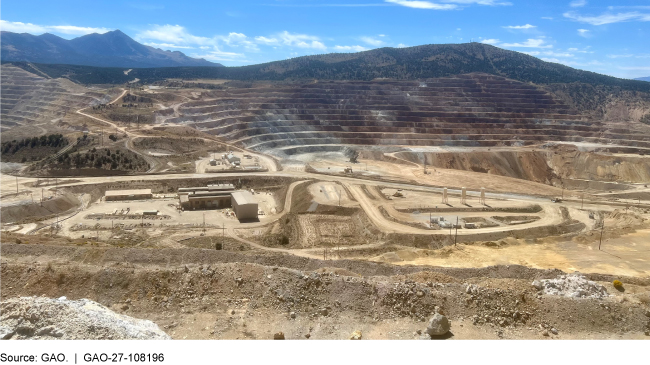
Photo of a copper mine on federal lands.
Highlights
What GAO Found
The Department of the Interior’s Bureau of Land Management (BLM) administers mining claims that grant the exclusive right to extract critical and other hardrock minerals from most federal lands. U.S. mining laws include citizenship requirements for individuals and business entities holding such claims, known as mining claimants. Under these laws, mining claimants generally must be U.S. citizens, which can include individuals as well as business entities incorporated in a U.S. state or territory. Foreign entities are not qualified to be claimants, but their subsidiaries can hold claims if they are incorporated in the U.S. Mining claimants are not required to disclose to BLM if they are a subsidiary of another entity, foreign or domestic, and they do not have to provide information on any foreign investment they may receive.
Under BLM’s regulations and guidance, the agency collects basic identifying information from individuals and business entities holding mining claims. However, BLM generally does not collect citizenship information and does not document if mining claimants meet the U.S. citizenship requirements. In addition, BLM officials said the agency rarely verifies the citizenship of mining claimants. As a result, BLM generally does not know whether mining claimants are qualified to hold mining claims.
Information the Bureau of Land Management (BLM) Collects from Mining Claimants

GAO analyzed a nongeneralizable sample of 15 mining claimants that appeared to be business entities and could not find evidence that seven of the claimants were incorporated in the U.S., as required. BLM was unable to help determine if these entities met the requirement to be incorporated in the U.S. because it did not have the necessary information to do so. Until BLM directs staff to collect citizenship information and document that mining claimants meet the U.S. citizenship requirements, BLM lacks reasonable assurance that only qualified individuals and business entities hold mining claims that allow them to extract and profit from the minerals produced on federal lands.
Australia and Canada—examples of top mineral-producing countries—collect detailed information on foreign investors in businesses in their countries. They can use this information to restrict foreign investments in mining and other sectors by prohibiting certain investments or imposing conditions, as each country has done in some cases in recent years. In addition, both countries limit the ability of foreign state-owned enterprises and other foreign investors to acquire control of businesses involving critical minerals.
Why GAO Did This Study
Critical minerals are vital to the U.S. economy and national security. Federal lands are a significant source of hardrock minerals and include some mining operations supported by foreign investments, according to BLM officials. The administration and Congress have expressed concern about U.S. reliance on foreign sources for critical minerals, and the President has called for expanding mineral production from federal lands.
GAO was asked to review issues related to foreign entities’ involvement in mining on federal lands. This report examines (1) the extent to which BLM collects, documents, and reviews mining claimants’ citizenship information and (2) how selected mineral-producing countries address foreign investments in mining. GAO was also asked to report on the extent of foreign investment in mining on federal lands (see GAO-27-108094).
GAO reviewed U.S. laws and regulations; analyzed a nongeneralizable sample of mining claimants to assess if they appear to meet citizenship requirements; examined BLM documents; visited three BLM state offices; and interviewed officials and representatives from BLM and other federal and nonfederal entities. GAO also reviewed Australian and Canadian laws, guidance, reports, and written responses to questions.
Recommendations
GAO recommends that BLM direct staff to collect citizenship information from mining claimants and document that they meet the citizenship requirements to hold mining claims. Interior did not provide comments on this report.
Recommendations for Executive Action
| Agency Affected | Recommendation | Status |
|---|---|---|
| Bureau of Land Management | The Director of BLM should direct BLM staff to collect citizenship information from mining claimants and document that they meet the citizenship requirements under U.S. mining laws to hold mining claims. (Recommendation 1) |
When we confirm what actions the agency has taken in response to this recommendation, we will provide updated information.
|