
Housing Construction Innovations: Technologies and Policy Options to Help Increase Supply and Affordability
Fast Facts
Housing affordability is a top economic concern for many Americans, as costs have grown faster than consumer income. Limited housing inventory and lags in production have also contributed to this problem.
This technology assessment looks at innovative technologies—including building materials and construction methods—that could improve housing production and reduce costs. But benefits among builders and consumers may not accrue equally. And challenges like regulatory restrictions and workforce shortages may hinder their adoption.
We offer a range of options for policymakers to consider to help increase housing supply and improve affordability.
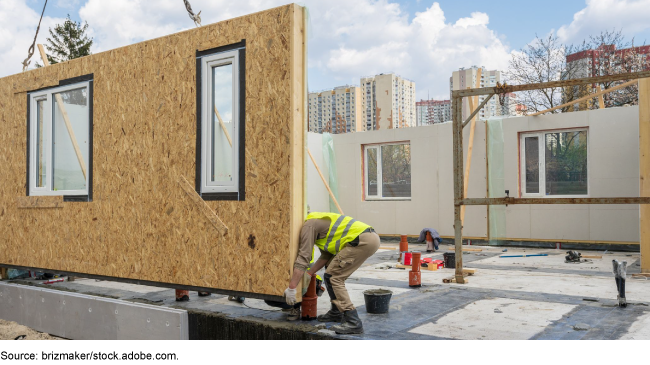
A construction worker places a wall panel for a house at a construction site.
Highlights
What GAO Found
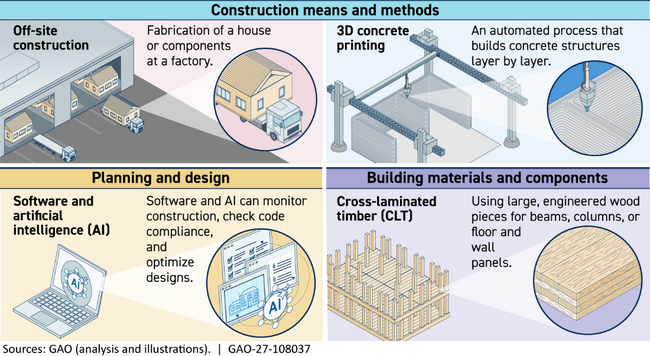
Numerous housing construction technologies could help improve production, reduce costs, and potentially increase supply and affordability. Some technologies are mature but not widely adopted, and others are new or emerging. These technologies can be grouped into three categories: planning and design, construction means and methods, and building materials and components. Examples are shown in the figure below.
Examples of housing construction technologies
Benefits of housing construction technologies such as these may include:
- Faster construction and enhanced efficiency. For example, building a house or some of its components off-site in an efficient, controlled environment can reduce the overall project time.
- Reduced costs. For example, automated technologies that cut lumber to precise dimensions can reduce costs by minimizing waste.
- Improved decision-making and regulatory oversight. Software tools that use land and regulatory data can help planners understand how local policy decisions can inform housing construction outcomes.
Challenges limiting broader adoption and use of construction technologies include:
- Regulatory challenges. More than 20,000 jurisdictions administer residential building codes, requiring significant time, labor, and money to comply.
- Workforce and education gaps. Training on new technologies requires staff, time, and money that builders may not have.
- Financial challenges. New technologies can have high up-front costs that are more than traditional construction methods for both builders and consumers.
GAO identified five policy subgoals and 14 associated policy options related to the broad goal of increasing housing supply and improving affordability (see below). These policy options are a set of alternative actions that policymakers, such as legislative bodies, government agencies, standards-setting organizations, industry, and other groups, could consider taking.
Policy Subgoals and Policy Options to Help Increase Housing Supply and Improve Affordability Using Construction Technologies
|
Subgoal: Streamline regulatory processes |
|---|
|
Policy options:
|
|
Subgoal: Reduce financial barriers |
|
Policy options:
|
|
Subgoal: Increase housing production capacity through education and training |
|
Policy options:
|
|
Subgoal: Increase public acceptance of innovative housing options |
|
Policy option:
|
|
Subgoal: Optimize government resources and leadership |
|
Policy options:
|
Source: GAO. | GAO-27-108037
Why GAO Did This Study
Housing affordability is a top concern for many Americans, as high housing costs can lead to adverse economic and social effects. Owners and renters have seen housing costs increase faster than other consumer prices and income, straining household budgets.
While housing construction is a near-trillion-dollar industry, limited inventory contributes to housing unaffordability, as potential homebuyers and renters compete to purchase or rent housing. GAO reviewed technologies that could help improve production and reduce costs of housing.
This report examines (1) current and emerging technologies that could help increase supply and affordability of housing, (2) benefits and challenges associated with these technologies in comparison to traditional construction methods, and (3) policy options that could support various policy goals related to these technologies.
To conduct this technology assessment, GAO reviewed relevant literature, documents, and reports; interviewed officials and representatives from government, industry, academia, nonprofits, and trade associations; conducted site visits; attended conferences; and convened a 2-day meeting of 17 experts.
For more information, contact Karen L. Howard at howardk@gao.gov.