
Artificial Intelligence: Actions and Opportunities to Implement Responsible Use in DOD
Fast Facts
U.S. adversaries are investing in artificial intelligence capabilities in ways that threaten global stability and U.S. national security. DOD issued an AI strategy in 2026—emphasizing speed in AI development. But DOD must do so responsibly to ensure quick and confident AI adoption on the battlefield.
This Q&A discusses how DOD has taken steps to implement AI responsibly, including through department-wide collaboration. But, as we previously reported, it hasn't defined responsibilities for AI collaboration or addressed workforce needs that affect AI adoption.
Our recommendations include that Congress consider directing DOD to do this and more.

Glowing computer chip in a circuit with brain icon.
Highlights
What GAO Found
Artificial intelligence (AI) is being used in a variety of scenarios, or use cases, in the Department of Defense (DOD). In guidance, DOD established AI Ethical Principles and the concept of Responsible AI to ensure the safety and trustworthiness of AI systems. DOD further defined six tenets to guide Responsible AI implementation. Most of the 10 DOD components GAO surveyed reported taking at least initial steps to establish oversight and implement Responsible AI tenets in the selected surveyed use cases.
The Office of the Chief Digital and AI Officer (CDAO), through its Responsible AI Division, established the Responsible AI Working Council as the working-level collaborative group for Responsible AI. However, CDAO officials said the council did not meet from late 2024 until August 2025. Officials from four DOD components told GAO they faced Responsible AI implementation challenges during this time that would have benefited from collaboration. Six of 10 surveyed components reported that sharing Responsible AI resources and best practices would benefit their implementation efforts. Although officials said the council resumed meetings in August 2025, it is at risk of lapsing again as it does not have a charter that defines roles and responsibilities and specifies meeting frequency. Another lapse could increase the risk of DOD facing Responsible AI implementation issues, such as inconsistent interpretation of related guidance, that it would not have the collaborative capacity to swiftly and effectively resolve.
CDAO officials identified additional actions that could help DOD implement Responsible AI. However, CDAO has experienced staffing shortages that have hindered its ability to take these actions. Specifically, officials said that as of February 2026, only three of the 10 authorized positions for the Responsible AI Division were filled. Responsible AI enables DOD to more quickly adopt AI. By addressing current workforce needs for the Responsible AI Division, CDAO could make more progress toward its goal of accelerating AI across DOD.
GAO previously made recommendations on issues related to DOD’s AI collaboration and workforce. DOD has not fully addressed those recommendations. Congressional action to ensure that DOD takes steps to fully address those prior recommendations would help position the department to meet its AI goals.
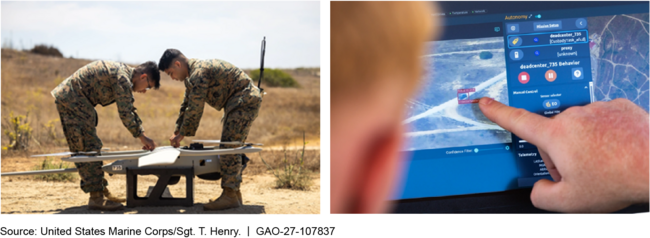
U.S. Marine Corps Service Members Conduct Training Using an Artificial Intelligence-Enabled System
Why GAO Did This Study
AI has changed the national security landscape. U.S. adversaries and competitors are investing heavily in AI and AI-enabled capabilities in ways that threaten global security. As DOD speeds AI development, it is critical for the department to do so responsibly so that warfighters can quickly and confidently adopt it.
Senate Report 118-188 accompanying a bill for the National Defense Authorization Act for Fiscal Year 2025 includes a provision for GAO to review the implementation and oversight of DOD’s Responsible AI guidance, among other things. This report discusses DOD’s approach to the responsible use of AI, including related guidance, implementation, and oversight.
GAO collected and reviewed DOD documentation related to Responsible AI. GAO also conducted a survey of 10 DOD components to understand how they have implemented Responsible AI tenets in 10 selected use cases. GAO also interviewed cognizant DOD officials.
Recommendations
GAO is recommending that Congress consider directing DOD to implement prior GAO recommendations on its AI collaboration and workforce. GAO is also making two new recommendations that DOD develop and issue a charter for the Responsible AI Working Council and ensure it addresses workforce needs of the CDAO Responsible AI Division.
The Department provided comments via email indicating concurrence with both of GAO’s recommendations.
Matter for Congressional Consideration
| Matter | Status | Comments |
|---|---|---|
| Congress should consider directing DOD to implement our open recommendations on collaboration and the AI workforce, including to (1) define the roles and responsibilities of DOD organizations and components collaborating on AI activities and (2) address AI workforce challenges across the department by assigning responsibility and establishing a timeline for completing steps to fully define and identify DOD's AI workforce. | When we confirm what actions the agency has taken in response to this recommendation, we will provide updated information. |
Recommendations for Executive Action
| Agency Affected | Recommendation | Status |
|---|---|---|
| Department of Defense | The Secretary of Defense should ensure that the Chief Digital and Artificial Intelligence Officer develops and issues a charter for the Responsible AI Working Council that outlines roles and responsibilities and that includes the CDAO's Responsible AI Division (or equivalent office) and DOD components and that specifies the frequency of council meetings. (Recommendation 1) |
When we confirm what actions the agency has taken in response to this recommendation, we will provide updated information.
|
| Department of Defense | The Secretary of Defense should ensure that the Chief Digital and Artificial Intelligence Officer addresses the Responsible AI Division's workforce needs. (Recommendation 2) |
When we confirm what actions the agency has taken in response to this recommendation, we will provide updated information.
|