
Precision Navigation Systems: Challenges Remain with Fielding New Capabilities
Fast Facts
The Department of Defense relies on GPS for military operations. But it's vulnerable to interference and jamming. DOD's decades-long efforts to strengthen GPS are behind schedule and over budget.
DOD has explored ways to get navigation data to the battlefield if GPS service is disrupted. For example, it's developing navigation receivers that use non-GPS satellites, as well as automated observations of the sun, moon, and stars. But these efforts vary in scale and are currently fragmented across the military services.
Better coordination could help DOD's efforts stay on track and within budget.
Our recommendations address this.

Two people in camouflage clothing pointing at a tablet while viewing a map and a phone on a table
Highlights
What GAO Found
The Department of Defense’s (DOD) efforts to modernize GPS continue to face delays. In response, DOD is developing new complementary sources of positioning, navigation, and timing (PNT) data to mitigate GPS threats. In 2026, after years of delays, DOD canceled the Next Generation Operational Control System ground control system and began modernizing the existing GPS Operational Control Segment. Among other effects, this creates risks for the launch, checkout, and operation of new GPS satellites. Given ongoing threats to GPS, DOD is operating and continuing development of (1) satellite-based PNT systems, (2) non-satellite-based PNT systems, and (3) backup timing solutions.
Operational Illustration of Threats to GPS and Complementary Positioning, Navigation, and Timing Systems
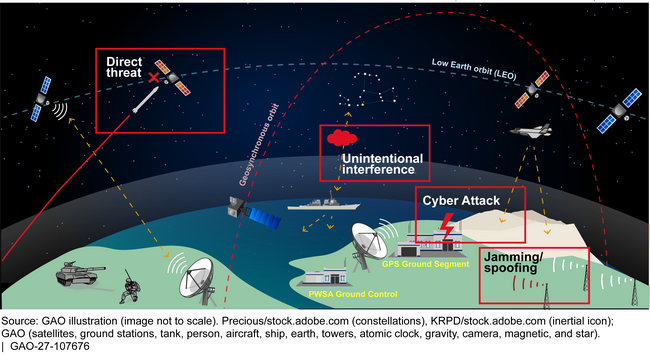
The Air Force continues to make progress developing modernized GPS military code (M-code) receiver cards, but challenges remain with fielding and integration. For example, the M-code aviation receiver programs continue to encounter development and integration challenges. In response, the Navy is developing an interim solution for its aircraft to use M-code. On the other hand, the Army and Navy are fielding M-code capable and multi-PNT receivers in ground vehicles, ships, and Army aircraft. All the military services are also pursuing integration of complementary PNT data into multi-PNT receivers.
Challenges with aligning multiple, fragmented PNT efforts across the military services impact DOD’s ability to ensure that M-code and PNT efforts are completed promptly. Congress mandated a PNT Oversight Council to oversee the portfolio. While the council can make budget-related recommendations to the services, the services are responsible for their own budgets. The PNT enterprise could benefit from consolidating and aligning efforts among the services. DOD has taken some steps to consolidate multiple PNT efforts, such as combining aircraft PNT receivers and M-code receiver card efforts into a single Air Force managed joint program office. Benefits of consolidation could include synchronization of schedules and better strategic alignment of funding.
Why GAO Did This Study
The U.S. military and civilians depend daily on accurate PNT data provided by GPS operated by the Space Force on behalf of DOD. DOD has worked for decades to modernize its GPS, including the use of a new signal—called M-code—and other features to counter evolving threats. Challenges have delayed these efforts. The military services have also started developing and fielding complementary PNT systems to ensure the availability of this foundational military capability.
Congress included a provision in law for GAO to report on DOD’s GPS modernization efforts and development and fielding of complementary PNT efforts. This report (1) addresses the progress DOD has made in modernizing GPS and providing complementary PNT data to the warfighter; (2) discusses the status of DOD efforts to develop and field modernized PNT receivers; and (3) assesses the extent to which DOD has taken steps to oversee the PNT portfolio, and what challenges it is facing.
To conduct this work, GAO reviewed documentation from GPS modernization and complementary PNT programs and efforts and interviewed relevant officials from DOD and the military departments.
Recommendations
GAO is making three recommendations for DOD to ensure that each of the three military departments assesses where consolidation of its GPS modernization and complementary PNT efforts would ensure better strategic alignment between DOD and the military departments and develop plans to consolidate efforts. DOD concurred with GAO’s recommendations.
Recommendations for Executive Action
| Agency Affected | Recommendation | Status |
|---|---|---|
| Department of Defense | The Secretary of Defense should ensure that the Secretary of the Army assesses where consolidation of its GPS modernization and complementary PNT efforts would help ensure better strategic alignment with DOD and the other services, and develop a plan to consolidate them, similar to the manner in which the Air Force and Navy aviation M-code and multi-PNT receivers along with the MGUE Inc 1 and Inc 2 programs were consolidated into the Air Force's M-code Aviation Receiver Joint Program Office. (Recommendation 1) |
When we confirm what actions the agency has taken in response to this recommendation, we will provide updated information.
|
| Department of Defense | The Secretary of Defense should ensure that the Secretary of the Navy assesses where consolidation of its GPS modernization and complementary PNT efforts would help ensure better strategic alignment with DOD and the other services, and develop a plan to consolidate them, similar to the manner in which the Air Force and Navy aviation M-code and multi-PNT receivers along with the MGUE Inc 1 and Inc 2 programs were consolidated into the Air Force's M-code Aviation Receiver Joint Program Office. (Recommendation 2) |
When we confirm what actions the agency has taken in response to this recommendation, we will provide updated information.
|
| Department of Defense | The Secretary of Defense should ensure that the Secretary of the Air Force assesses where consolidation of the Air Force and Space Force's PNT modernization efforts would help ensure better strategic alignment with DOD and the other services through its GPS modernization and complementary PNT efforts and develop a plan to consolidate them, similar to the manner in which the Air Force and Navy aviation M-code and multi-PNT receivers along with the MGUE Inc 1 and Inc 2 programs were consolidated into the Air Force's M-code Aviation Receiver Joint Program Office. (Recommendation 3) |
When we confirm what actions the agency has taken in response to this recommendation, we will provide updated information.
|