
Native American Issues: Preliminary Observations on Housing and Homelessness
Fast Facts
We testified about housing and homelessness issues affecting Native American communities.
Our testimony, given before the Senate Committee on Indian Affairs, is based on ongoing work.
So far, we've found that federal support for Native American housing is offered across 30 federal programs—but funding isn't keeping pace with rising costs. We're also looking at Tribes' experiences with homelessness (including temporarily staying with others, or, "doubling up") and how Tribes use Department of Housing and Urban Development programs to address it.
Photo of the U.S. Capitol building, with the text "GAO Testimony to Congress"
Highlights
What GAO Found
GAO’s preliminary observations indicate that 30 federal programs can provide housing support targeted to Native American communities, including those that are American Indian and Alaska Native (AI/AN) and Native Hawaiian. These include grant programs—of which the largest is the Indian Housing Block Grant program—and mortgage assistance programs. Tribes, tribal organizations, and Native Hawaiian organizations that GAO contacted indicated that they use federal programs primarily to maintain existing housing and, to a lesser extent, to construct new housing. They also identified limitations in the reach of these programs, including limited funding that had not kept pace with rising construction costs and certain program restrictions.
While tribal communities experience both sheltered and unsheltered homelessness, doubling up (or temporarily staying with others) is also widespread, according to GAO’s preliminary analysis of its interviews and prior HUD and GAO research. Tribes and tribal organizations that GAO contacted for its ongoing work on homelessness described a variety of strategies they use to address homelessness, including operating emergency shelters or transitional housing and providing supportive services.
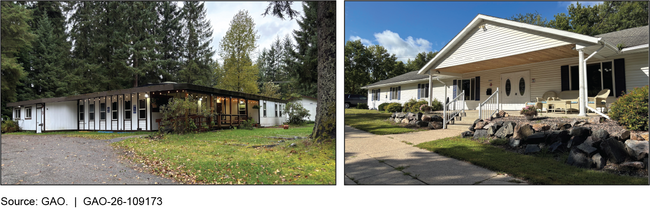
Tribal Emergency Shelter in Alaska and Transitional Housing Facilities in Minnesota
GAO’s preliminary observations indicate that many of the Tribes and tribal organizations GAO contacted had used Department of Housing and Urban Development (HUD) programs to support their homelessness strategies. However, several challenges may limit broader use of these programs. For example, some Tribes and tribal organizations described using a portion of their Indian Housing Block Grant funding to address homelessness but noted that the need to fund operation and maintenance costs for existing housing left little funding for homelessness-related efforts, such as providing shelters or emergency housing assistance. They also described requirements of the Continuum of Care program—HUD’s largest homelessness assistance program—that may limit tribal participation. For example, some Tribes and tribal organizations raised concerns that Tribes may be less competitive for funding because forms of homelessness more common in their communities, such as doubling up, do not align with the program’s definition of homelessness.
Why GAO Did This Study
Native American communities have faced longstanding housing challenges, including poor housing conditions, overcrowding, and homelessness.
This statement is based on preliminary observations and discusses (1) federal programs providing targeted housing support to Native American communities and views on program uses and limitations; (2) tribal strategies for addressing homelessness among AI/AN people; and (3) challenges associated with Tribes’ use of HUD programs to support these strategies.
GAO analyzed agency documentation on federal programs supporting Native American housing and interviewed a nongeneralizable sample of 12 Tribes and tribal organizations and one Native Hawaiian organization to obtain their views on those programs. In addition, GAO interviewed a nongeneralizable sample of 19 Tribes and tribal organizations regarding homelessness strategies and challenges. GAO selected Tribes to reflect factors such as regional variation, use of federal housing funds, and approaches to addressing homelessness.
For more information, contact Alicia Puente Cackley at CackleyA@gao.gov or Jill Naamane at NaamaneJ@gao.gov.