
Weapon Systems Acquisition: Beyond Business as Usual—Using Leading Practices to Curb Waste and Save Billions
Fast Facts
Since 1990, DOD’s costliest weapon programs have consistently exceeded cost estimates and delivery schedules—wasting billions of dollars and decades of time.
DOD pours money into efforts that fall behind while global tech accelerates. These decisions are compounded by DOD's budget process, which requires securing long-term weapon program funding early, even before they know what the military needs.
In contrast, leading companies develop cost and schedule goals that change with clients' capability needs—and they finish weapons fast. This helps them stay on budget.
But DOD hasn’t fully adopted these practices. We recommended they do so.

Person in military uniform on a laptop
Highlights
What GAO Found
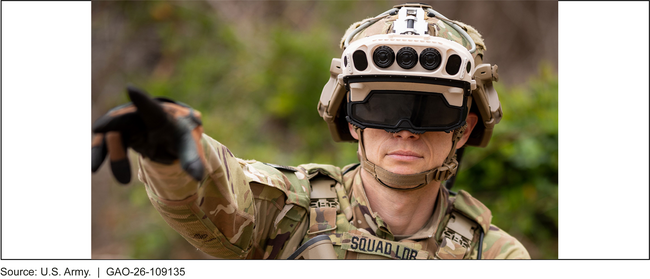
In weapon systems acquisition, waste is not merely about individual overpriced parts; it is the systemic loss of billions of dollars and decades of time. Since 1990, the Department of Defense’s (DOD) costliest weapon programs have wasted billions while often failing to deliver a usable capability to the field. For example, the Army’s Integrated Visual Augmentation program—intended to provide augmented-reality headgear for soldiers for close combat—has yet to deliver operational capability after three different acquisition efforts over the last 8 years. Though the program produced nearly 10,000 units of the first two versions, they do not meet soldiers’ needs and will go into storage, with some potentially used for testing, rather than into the field.
Thousands of Integrated Visual Augmentation System Headsets Head for Storage
GAO's decades-long body of work on DOD acquisition consistently shows that waste in these programs occurs when they are structured to “fail slow” as DOD pours time and money into efforts that stagnate while global technology accelerates. DOD is incentivized to award massive development contracts and obligate funds quickly to ensure the budget is not “lost” to another program. Success is often measured by money spent, not capability delivered. As a result, the expected time frame for major programs to deliver an initial capability now exceeds 12 years. Every month of delay in a weapon system acquisition program causes a warfighter to rely on aging, less-capable equipment for longer.
In contrast, leading commercial companies iteratively develop business cases to respond to users’ needs and finish fast, helping them stay on budget. They reassess business cases regularly to avert problems sooner. They also ramp up investments as products demonstrate progress. (See GAO-25-107130.)
However, DOD has yet to fully adopt these leading practices because acquisition policies do not treat iterative development as a founding principle for all weapon system acquisitions programs. As noted in its November 2025 policy memorandum aimed at revamping the defense acquisition system, DOD now plans to maximize acquisition flexibility, among other changes. GAO will continue to assess DOD’s efforts.
Why GAO Did This Study
DOD plans to invest over $2.4 trillion to develop and acquire its costliest weapon systems. The need for smart spending and increased urgency and innovation for these acquisitions are national imperatives to help DOD maintain a competitive edge over adversaries. But DOD continues to struggle with delivering timely, cost-effective solutions to the warfighter, and slow, linear development approaches persist.
GAO has reported for decades on the persistent issues that plague these weapon programs and on leading practices that commercial companies use to avoid these issues.
GAO was asked to discuss issues related to waste in DOD weapon systems acquisition. This report, which GAO prepared for a subcommittee roundtable, addresses (1) the wasteful DOD practices that lead to undesirable weapon system acquisition program outcomes and (2) leading commercial practices that, if thoughtfully applied, could reduce waste and improve outcomes.
GAO based this report predominantly on prior work, including recent reports on leading practices for product development and prior GAO reports on weapon systems acquisitions.
Recommendations
Over the years, GAO has made hundreds of recommendations to DOD to help improve outcomes in its weapon system programs. DOD has yet to implement many of these recommendations. GAO will continue to monitor DOD’s progress in addressing the recommendations.