
Science & Tech Spotlight: AI for Medical Notes and Coding
Highlights
Why This Matters
U.S. clinicians average a 57-hour workweek, including 7 hours of administrative work. Time spent on tasks like drafting patient visit notes or reviewing billing paperwork may contribute to clinician burnout. New AI tools could increase efficiency and reduce administrative burdens during and after patient visits.
Key Takeaways
- Some health care providers are adopting AI tools to assist with note taking and medical coding, which may save time and reduce burnout.
- The accuracy of these tools may be difficult to verify, and the overall effects on health care spending are uncertain.
- Policymakers need more information about the performance of these tools to determine the appropriate level of oversight needed to help minimize mistakes and ensure proper billing.
The Technology
What is it? Accurate documentation and billing are vital administrative tasks in health care. Health care providers are adopting AI tools to automate these tasks. AI scribes can be used to draft clinical documentation during a patient’s visit and medical coding tools can automatically generate an insurance claim afterward for reimbursement.
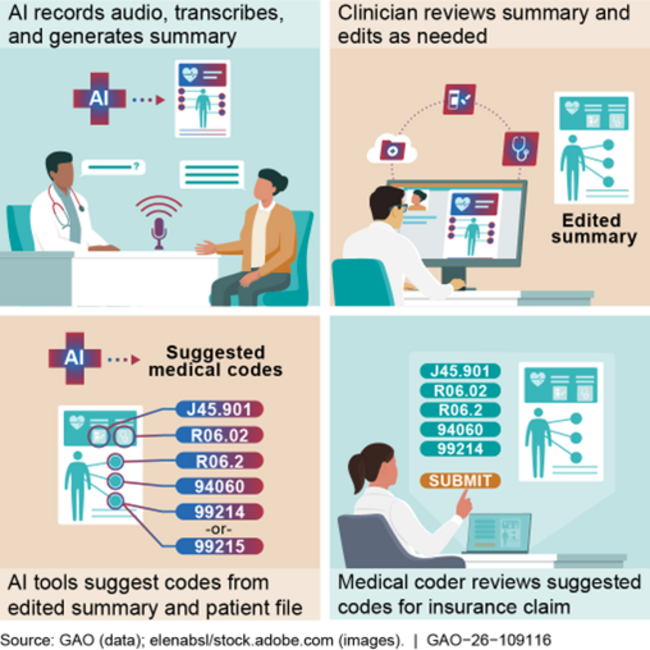
How does it work? Traditionally, clinicians take notes during a patient visit and then elaborate on and clarify their notes later to develop a clinical summary. AI “scribes” record the conversation between a patient and clinician and, using conventional and generative AI, create a written summary of the visit for the clinician to review for accuracy. This technology is called “ambient” listening, because the AI tool can operate in the background during a patient visit.
After a visit, medical coders review the summary and other patient documentation and assign standardized codes to include in the insurance claim, which represent a patient’s diagnosis and the services rendered by a clinician. AI tools that analyze patient records and suggest codes for review by medical coders are already in widespread use. New AI tools may use generative and agentic AI technologies to review patient records and assign codes autonomously. This capability could make human coders faster or replace them entirely.
Figure 1. AI Tools for Medical Notes and Coding
How mature is it? The underlying technologies for both AI scribes and medical coding tools have existed for more than a decade. However, more advanced AI technologies, such as generative AI, are enabling companies and health care systems to build new, more capable AI software tools.
According to one AI medical coding software developer, when its software was deployed at a health system with five hospitals, it generated medical codes with more than 95 percent accuracy, and the system’s emergency departments reduced annual coding costs by more than $1 million.
In 2026, the American Medical Association found that between 2024 and 2026, the share of clinicians surveyed who use AI tools to assist with clinical documentation or medical coding increased from 21 to 28 percent.
Opportunities
- Reduced administrative burden. AI scribe and medical coding tools could decrease the amount of time clinicians spend on administrative tasks and reduce burnout. In one study, clinicians reduced their documentation time by 20 percent, or two minutes per appointment, using AI scribes.
- More detailed clinical summaries. AI scribe tools may improve accuracy and reduce clinicians’ cognitive load. For example, they may capture more details than manual note taking, while helping a clinician focus on the patient.
- Increased operational efficiency. AI medical coding tools could streamline administrative processes, reducing the number of staff needed for administrative tasks.
Challenges
- Difficulties verifying accuracy. There are few independent studies evaluating the accuracy of these tools. Some tools may not store patient recordings and transcripts, which may limit the extent to which health care providers can conduct independent assessments. Inaccuracies may result in patient harm or over- or under-reimbursement from insurers to providers.
- Limited access due to costs. Under-resourced hospitals, health centers, clinics, and small medical practices may not be able to adopt AI scribe or medical coding tools because of constraints such as costs and the need for technical support or training.
- Reimbursement and cost implications. AI scribing and medical coding tools could increase health care costs if they capture more diagnoses and services rendered during visits than non-AI approaches. While this could result in higher reimbursement to providers, it could also increase health care spending with costs borne by insurers, employers, patients, or taxpayers (the latter via federal programs like Medicare).
- Data privacy and patient consent. Collecting patient data carries security and privacy risks, like breaches of personal information. Additionally, data retention practices vary across AI scribe vendors and patients may not always be informed that recordings are occurring.
Policy Context and Questions
As emerging technologies can cross multiple agencies’ jurisdictions, they can present oversight and regulation challenges. Key questions for stakeholders include:
- What information do health care providers or policymakers need to ensure AI scribe and coding tools minimize mistakes and unintended consequences?
- How can federal agencies and health insurers provide adequate oversight of the use of AI tools to ensure appropriate reimbursement?
Selected GAO Work
Science & Tech Spotlight: AI Agents, GAO-25-108519.
Science & Tech Spotlight: Generative AI in Health Care, GAO-24-107634.
Selected Reference
National Academies of Sciences, Engineering, and Medicine, An Artificial Intelligence Code of Conduct for Health and Medicine: Essential Guidance for Aligned Action (Washington, D.C.: The National Academies Press, 2025). https://doi.org/10.17226/29087.
For more information, contact Sarah Harvey at HarveyS@gao.gov.