
Combating Fraud: Managing Risks in Federally Funded, State-Administered Programs [Reissued with revisions on Aug. 7, 2026]
Fast Facts
The federal government relies on state and local governments to administer some of its benefit and grant programs. An estimated $1.2 trillion went to these programs in FY 2025.
This Q&A report looks at the 20 programs that receive nearly all of this funding—Medicaid, SNAP, and disaster assistance for example. We describe how each program is administered, including who distributes and safeguards the funds.
We also discuss fraud risks in each program and how to mitigate them. For example, federal agencies can follow our Fraud Risk Framework and implement our prior recommendations concerning fraud. We also identify ways Congress can help.

The word Fraud in bold type with the pronunciation and definition following blurred out.
Reissued with Revisions Aug 07, 2026Revised August 7, 2026 to provide additional context on recently introduced legislation on program integrity on pages 17 and 18.
Highlights
What GAO Found
Twenty programs, supporting a broad range of services from health care to disaster assistance, made up nearly 90 percent of federal obligations among programs administered by state and other government entities with obligations of over $100 million in fiscal year 2025. The 20 programs collectively accounted for $1.1 trillion in total federal obligations that year. Subrecipients, contractors, and others can also be involved in these programs, which can be helpful in delivering benefits and services. However, this decentralized structure can leave programs vulnerable to fraud schemes involving all these groups.
Information about fraud risks specific to each of the 20 selected programs varies, in part, because federal agencies have not fully assessed their risks. Of the 20 programs, five documented evidence consistent with identifying risks and assessing the likelihood of those risks to prioritize action; the other 15 did not have such documented evidence.
GAO’s review of information from GAO, Office of Inspector General, and state audit reports identified both general and specific fraud risks facing federally funded, state-administered programs.
Examples of General Fraud Risks in Federally Funded, State-Administered Programs
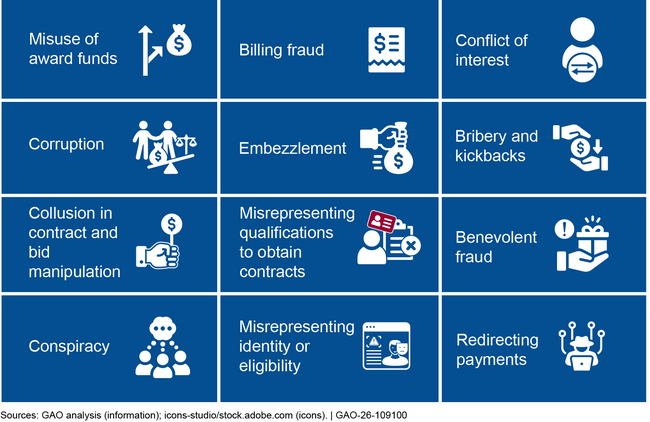
Examples of specific fraud risks GAO identified in the 20 selected programs included cases where a consultant was convicted of falsifying permits used during a $4.3 million airport improvement project; households receiving housing assistance vouchers were underreporting income and landlords were receiving payments for vacant units; and an individual allegedly ran a fraud scheme involving student financial aid applications for over 1,200 people to over 100 schools in 24 states.
GAO’s prior work and experiences from the United States and other countries provide insights that can help federal and state agencies, Congress, and others combat fraud. Federal and state agencies can better manage fraud risks and prevent fraud by
- applying GAO frameworks for managing fraud risks and improper payments, as well as other leading practices;
- leveraging available federal analytic resources, such as the Do Not Pay program, to verify recipient identity and eligibility before issuing federal funds; and
- implementing recommendations from GAO and other oversight entities that would address existing program vulnerabilities.
Key insights for Congress and federal agencies focus on efforts in three areas: (1) enhancing analytics for detecting fraud, (2) increasing transparency with prevention activities through reporting and data, and (3) adapting approaches to federal programs and professions to address evolving fraud threats.
Why GAO Did This Study
GAO estimated that the federal government loses between $233 billion and $521 billion annually to fraud, according to data from fiscal years 2018 through 2022. This represented 3 percent to 7 percent of average federal obligations government-wide. While fraud risks can vary substantially by program, every dollar or resource diverted to fraudsters hinders the federal government’s ability to achieve its goals.
GAO was asked to review fraud risks in federally funded, state-administered programs. This report—the first in a body of work—provides information on 20 of the largest programs, how they are administered and overseen, what is known about fraud risks and related risk factors in these programs, and examples of leading practices and controls to address the risks.
GAO reviewed USAspending.gov data for fiscal year 2025 to identify and select programs. It also reviewed program information, such as from GAO, Congressional Research Service, Office of Inspector General, and state audit organization reports; federal laws, regulations, and agency documents requested from the 20 selected programs; and fraud cases adjudicated by the Department of Justice. GAO reviewed existing research and criteria on practices and controls to address fraud risks, including GAO's Fraud Risk Framework and those identified by experts within the U.S. and internationally.
Reissued with revisions on Aug. 7, 2026
Revised August 7, 2026 to provide additional context on recently introduced legislation on program integrity on pages 17 and 18.Recommendations
GAO has 22 open recommendations to agencies related to fraud risk management among the programs reviewed. This report also offers key insights for combating fraud, including open GAO recommendations for Congress to enhance data analytics resources and reporting requirements. GAO will continue to monitor actions, including proposed legislation being considered by Congress, that would address these recommendations.