
Combating Fraud: Challenges in Managing Fraud Risks in Federally Funded, State-Administered Programs
Fast Facts
We testified on managing fraud risks in federally funded, state-administered programs before the House Committee on Oversight and Government Reform, Subcommittee on Government Operations.
It is based primarily on the following reports:
Fraud Risk in Federal Programs: Continuing Threat from Organized Groups Since COVID-19
COVID-19 Relief: Consequences of Fraud and Lessons for Prevention
COVID-19: Insights and Actions for Fraud Prevention
We've previously made over 200 recommendations to better manage fraud risks, but many still need to be addressed.
The U.S. Capitol building with the words GAO Testimony to Congress.
Highlights
What GAO Found
All federal programs and operations are at risk of fraud, regardless of whether they provide financial or nonfinancial benefits or delivery takes place at the federal, state, or local level. Understanding the scope of the problem is critical to combating fraud. In 2024, GAO estimated total direct annual financial losses to the government from fraud at between $233 billion and $521 billion, based on fiscal year 2018 through 2022 data. The estimate captures losses that occur at the state, local, tribal, or other government level if those losses included a federal investigative, administrative, or related action. State agencies administer federal programs, making payment, eligibility, and other decisions. In fiscal year 2025, the federal government provided an estimated $1.2 trillion to state and local governments in federal grants. The programs vary in size, but some, such as Medicaid, involve millions of beneficiaries. Decentralized program delivery such as through distributed payment and eligibility decisions can heighten the risk of fraud.
GAO has previously reported that federal and state program managers’ efforts to manage fraud risks have been challenged by weak control environments, data and system limitations, and limited capacity to manage risks. For example, one state agency administering a federally funded program reported it is restricted by state and federal laws from sharing information with other programs in the state, such as information on individuals and their use of state services. This hindered the agency’s ability to prevent and detect fraud within and across programs.
Federal programs, including those administered at the state level, are inherently subject to fraud risks from various entities and individuals (see fig.).
Types of Organized Fraud Groups Targeting Government Programs
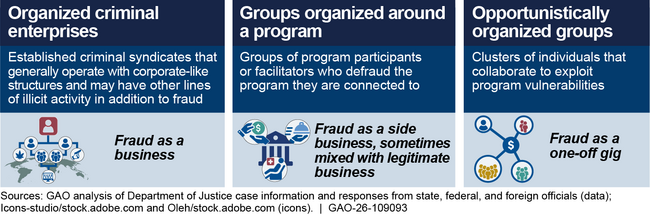
Decentralized program delivery—where federal funds are distributed to grantees, subrecipients, contractors, and subcontractors—creates vulnerabilities to different types of fraud. For example, inspectors general previously reported that the Temporary Assistance for Needy Families block grant to states faced an increased risk of fraud because of limited visibility and control over expenditures at the award recipient and subrecipient levels. Other GAO reporting has shown that, given the opportunity, organized criminal organizations, businesses, and individuals from all walks of life have sought to defraud federal programs. Certain risk factors—such as program design, culture, and personal motivation—can also increase the risk that fraudsters will target a program.
Why GAO Did This Study
The U.S. federal government is one of the world’s largest and most complex entities, spending trillions of dollars across a broad array of programs and operations, with a substantial percentage of this spending administered by the states. The size, scope, and complexity of the federal government create inherent risks that need to be recognized and managed properly.
Fraud is one such risk that must be managed to ensure that program delivery and taxpayer dollars are safeguarded. Every dollar or resource diverted to fraudsters hinders the federal government’s ability to achieve its goals. Financial losses also place an increased burden on the government’s financial outlook. Fraud also erodes public trust in government and hinders agencies’ efforts to execute their missions.
This statement focuses on fraud in federally funded, state-administered programs by (1) outlining the scope of the problem and fraud risk landscape, (2) examining challenges facing federal and state agencies in combating fraud, and (3) examining fraud threats the government faces and why it is difficult to combat them. This statement is based on a body of work of selected reports that GAO issued between 2010 and 2026.
Recommendations
GAO is not making recommendations at this time. As of April 2026, GAO has made 215 recommendations to federal agencies and programs to better manage fraud risks, of which about 40 percent remain open.