
National Security Snapshot: DOD's Military Health System Reforms and Challenges
Highlights
The Big Picture
The Department of Defense (DOD) military health system provides medical care to 9.4 million beneficiaries, including service members and their families around the globe. This care is delivered through over 700 medical facilities with more than 100,000 military, civilian, and contractor employees, and a vast network of private sector health care providers. DOD estimates that it will spend over $72.5 billion for the military health system in fiscal year 2027.
For more than a decade, DOD has taken actions to reform its health system in response to legislative requirements and to more effectively manage the system. For example, in response to December 2016 legislation, the Defense Health Agency (DHA)—a combat support agency—took over the administration and management of DOD’s medical facilities from the Army, Navy, and Air Force. In making this change, DOD sought to create a more efficient oversight structure for the medical facilities that would help lower costs and improve beneficiary care, in part by shifting some patients to private sector care.
Military Health System Organizational Reforms Since 2016
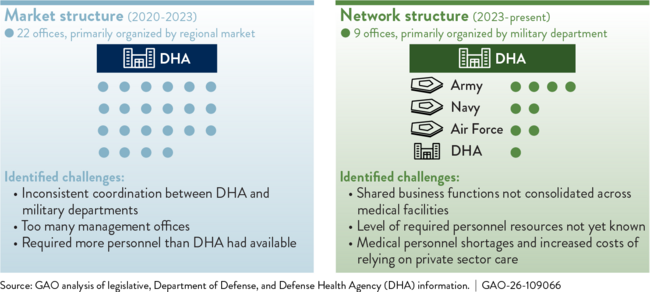
However, as GAO reported in July 2025, the ability to supply health care across the military health system remains constrained by insufficient numbers of medical personnel and allocation of fiscal resources to other readiness priorities, according to DHA officials. DOD continued to examine the need for further reform and adopted a new strategy to increase the capacity of DOD’s medical facilities to provide both beneficiary care and training opportunities for military medical personnel. According to DOD, such efforts are intended to stabilize the military health system by reattracting beneficiaries to its facilities from private sector care.
Key Challenges Identified by GAO
GAO’s work has identified various organizational reform and personnel management challenges that affect the success of the military health system.
Organizational reform challenges. DOD has not identified the necessary resources or conducted sufficient oversight to support its reform efforts.
Personnel management challenges. DOD does not have key information needed to manage and oversee its military medical personnel nor sufficient metrics to assess their clinical readiness.
Implications for National Security
The military health system supports the health of service members so that they are ready to deploy. In addition, the system exists to ensure that military medical personnel are prepared to provide medical care in support of missions that include operational, wartime, and mass casualty events. This is referred to as clinical readiness.
GAO has reported on a long-standing concern that DOD’s medical facilities may not be able to provide sufficient opportunities to sustain the skills of some military medical personnel, such as those who provide trauma and critical care services. DOD’s efforts to address legislative reforms over time have been, in part, intended to address this concern by increasing the clinical readiness of military medical personnel.
Addressing the persistent challenges identified in this product, such as by implementing GAO’s related recommendations, would enhance DOD’s ability to ensure the clinical readiness of its medical personnel in operational and wartime environments. This would further help DOD achieve its goal of stabilizing and improving the health system. DOD generally concurred with the recommendations listed in this product and has stated plans to address them over time.
GAO Recommendations
Selected GAO Open Recommendations Related to DOD’s Military Health System from Fiscal Year 2019 Through June 2026
|
Resources needed to support organizational reform efforts The Department of Defense (DOD) has not fully determined the resources necessary for implementing its organizational reform. |
|
|
Oversight of organizational reform efforts DOD has not comprehensively monitored or involved Congress in the development of its organizational reform efforts. |
|
|
Management and oversight of medical personnel DOD does not have key information needed to better monitor medical facility staffing and address staffing gaps. |
|
|
Efforts to monitor clinical readiness of medical personnel DOD has not developed sufficient metrics to assess and monitor clinical readiness of medical personnel. |
|
For more information, contact Rashmi Agarwal at AgarwalR@gao.gov.