
Flood Risk Mitigation: Reducing Fiscal Exposure and Improving Affordability
Fast Facts
We testified on flood risk mitigation before the House Committee on Financial Services, Subcommittee on Housing and Insurance.
Our testimony is based primarily on the following reports:
Flood Mitigation: Actions Needed to Improve Use of FEMA Property Acquisitions
National Flood Insurance Program: Fiscal Exposure Persists Despite Property Acquisitions
Additionally, it updates some data and figures we reported in our prior work.
The Federal Emergency Management Agency has addressed some of our recommendations but still needs to address others. We have also made recommendations for congressional consideration and offered policy options related to these issues.

Picture of the U.S. Capitol Building
Highlights
What GAO Found
The Federal Emergency Management Agency (FEMA) administers three primary programs that mitigate flood risk for properties insured by the National Flood Insurance Program (NFIP). A small number of these properties—known as repetitive loss properties, which have flooded and received claim payments multiple times—contribute to the program’s fiscal challenges. According to FEMA, unmitigated repetitive loss properties make up about 2.5 percent of NFIP policies, but 48 percent of NFIP claims by dollar value have been paid to properties with two or more losses.
From 1989 through 2025, 77 percent of the properties FEMA mitigated were funded by the Hazard Mitigation Grant Program. FEMA supports four mitigation strategies—acquisition, elevation, relocation, and floodproofing. FEMA has mitigated flood risk primarily through acquisitions, which accounted for 69,415 (about 72.5 percent) of the properties mitigated from 1989 through 2025.
FEMA Hazard Mitigation, by Grant Program and Method, Fiscal Years 1989–2025
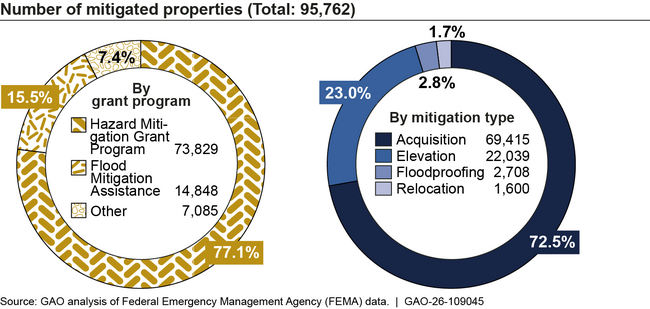
While acquisitions offer benefits, the process faces significant challenges that can discourage communities and homeowners from participating. These challenges include a lengthy and complex process, limited state and community capacity, and financial constraints.
NFIP represents a fiscal exposure to the federal government because FEMA is statutorily required to charge premium rates that do not fully reflect flood risk. Although mitigation reduces flood losses, it also requires substantial investment. Without addressing mitigation challenges, the number of repetitive loss properties will continue to grow, increasing costs to NFIP policyholders and federal taxpayers. One way to address the program’s fiscal exposure is to target mitigation efforts to those properties contributing most to the premium shortfall. These may disproportionately include repetitive loss properties, which face greater flood risk and higher full-risk premiums. By reducing risk, mitigation could also address affordability in the long term.
Why GAO Did This Study
Flooding is the most expensive natural disaster in the U.S., and in 2024, it caused over $8 billion in damages, according to FEMA. Congress created NFIP in 1968 to protect homeowners from flood losses, minimize property exposure to flood damage, and limit taxpayers' fiscal exposure to flood losses. However, the program faces multiple serious and longstanding challenges, primarily because it has two competing goals: keeping flood insurance affordable while maintaining the program’s fiscal solvency.
This statement discusses (1) the role of mitigation in addressing NFIP’s fiscal exposure from repetitive loss properties and (2) how targeting mitigation efforts could reduce NFIP’s exposure and address affordability.
This statement is based on GAO work issued in 2017–2023, including GAO-17-425, GAO-20-508, GAO-22-106037, and GAO-23-105977. Detailed information on the objectives, scope, and methodology can be found within each report.
Recommendations
GAO has made nine recommendations to FEMA and eight to Congress related to improving the mitigation process, addressing challenges in property acquisitions, and reducing NFIP’s fiscal exposure while addressing affordability for policyholders. As of March 2026, FEMA has implemented four of these recommendations.