
Hurricane Maria: Mortgage Performance in Puerto Rico
Highlights
Why This Matters
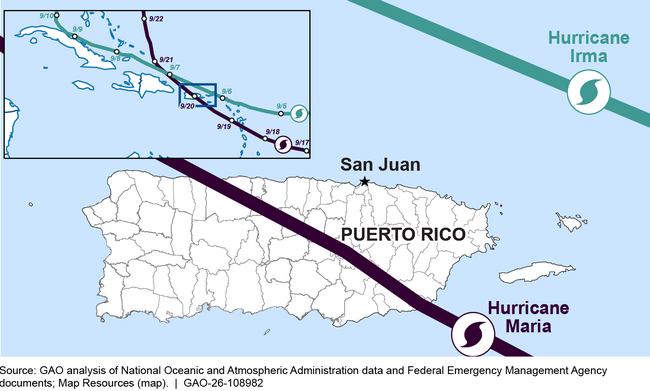
In September 2017, Hurricanes Irma and Maria struck Puerto Rico, causing billions of dollars in damage to its housing, infrastructure, and economy.
Paths of Hurricanes Irma and Maria in Puerto Rico, September 2017
Puerto Rico had already experienced a prolonged economic recession before the hurricanes, contributing to increases in mortgage delinquencies and foreclosures. The widespread devastation from Maria raised questions about how foreclosure rates in Puerto Rico might be affected.
In November 2023, the Federal Reserve Bank of New York published a report that examined the effects of Irma and Maria on the stability of banks and their ability to lend, as well as the performance of bank-held and federally owned or guaranteed mortgages. Specifically, it compared the performance of mortgages in Puerto Rico before and after Maria, including rates of delinquency, banks’ mortgage loss, and foreclosure. The report also provided information on homeownership rates.
According to the report, Maria’s effect on mortgages in Puerto Rico appears to have been mild or short-lived. The following summarizes the report’s key findings.
Delinquency Rates
At the time Maria struck, more than 10 percent of active mortgages in Puerto Rico were already delinquent. The rate roughly tripled by November 2017 but returned to pre-Maria levels 1 year later.
Loss Rates for Bank-Held Mortgages
Bank losses on mortgages generally represent the unpaid principal balance of loans in default minus amounts recovered from the proceeds of the sale of the home and mortgage insurance. Banks’ mortgage loss rates can be considered a proxy for estimating mortgage default rates in Puerto Rico.
According to the report, various financial protections helped limit bank losses and contributed to relatively mild and short-lived financial effects. For example, mortgage insurance and government assistance helped protect banks from losses on residential mortgages in Puerto Rico. Banks experienced the greatest losses on conventional mortgages without private mortgage insurance. Loans covered by mortgage insurance (private or through the Federal Housing Administration) or guaranteed by the Department of Veterans Affairs were less likely to result in bank losses. These insured or guaranteed loans made up about 37 percent of all loans. Losses were more common among loans that were already troubled before Maria.
Foreclosure Rates
In response to Maria, the Department of Housing and Urban Development, Federal Housing Administration, Fannie Mae, Freddie Mac, and the U.S. Department of Agriculture imposed a foreclosure moratorium from the fourth quarter of 2017 through the third quarter of 2018. Despite the spike in delinquencies, foreclosures continued to decline during the moratorium. After it was lifted, foreclosures rose for several months before returning to prior trends after about 1 year. Many mortgages foreclosed in 2019 were likely delinquent before Maria, suggesting that the effect of Maria was modest.
Homeownership Rates
In 2017, homeownership rates in Puerto Rico were comparable to those on the U.S. mainland. However, mortgage financing was less common in Puerto Rico—about 41 percent of owner-occupied homes had a mortgage, compared with about 67 percent on the mainland. According to the report, residents in Puerto Rico’s large informal housing sector (such as homes built on public land and subdivided family plots) may lack title to their property, making it hard to obtain a mortgage.
Rates of Return for Housing Developers
The Economic Growth, Regulatory Relief, and Consumer Protection Act also required GAO to report on rates of return for housing developers in Puerto Rico, but this analysis could not be conducted because data were not available.
Why GAO Did This Study
The Economic Growth, Regulatory Relief, and Consumer Protection Act includes a provision for GAO to report on foreclosures in Puerto Rico before and after Hurricane Maria, including rates of delinquency, default, foreclosure, and homeownership. This report summarizes key relevant findings from a November 2023 Federal Reserve Bank of New York report that examined this issue.
For more information, contact Jill Naamane at naamanej@gao.gov.