
Personnel Vetting: Leadership Attention Needed to Prioritize System Development and Achieve Reforms
Fast Facts
This testimony before the House Subcommittee on Government Operations discusses our work on personnel vetting, specifically the Department of Defense's system for background investigations.
We reviewed DOD's 2025 cost estimate and schedule for the system. While the cost estimate is reliable, we found DOD's schedule doesn't meet all best practices.
For example, DOD hasn't yet completed a schedule risk analysis, which could help it prioritize addressing risks that would lead to delays.
We recommended DOD implement this and other best practices for a reliable schedule.
The Capitol building with text that reads, GAO Testimony to Congress.
Highlights
What GAO Found
Since 2016, the Department of Defense (DOD) has been developing the National Background Investigation Services (NBIS)—an IT system for conducting background investigations for most federal agencies and over 13,000 industry organizations that work with the government. DOD originally expected NBIS to be complete in 2019, but repeated delays have hindered deployment. GAO has also found that the previous NBIS cost estimate and schedules were unreliable. After missing multiple targets, DOD’s Defense Counterintelligence and Security Agency (DCSA) paused NBIS development in 2024 to revise its approach. In 2025, it developed a new cost estimate and changed its approach to scheduling.
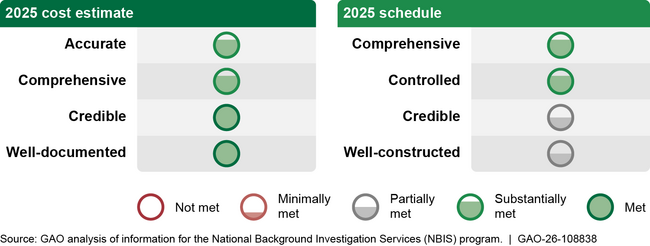
GAO reviewed DCSA’s 2025 NBIS cost estimate and found it to be reliable because it at least substantially met four characteristics of a reliable cost estimate. DOD now projects spending an additional $2.2 billion on NBIS development through fiscal year 2031, which is in addition to $2.4 billion previously spent on NBIS and legacy systems through fiscal year 2024. A reliable cost estimate should help prevent unexpected cost overruns and provide needed visibility.
GAO also found that DCSA continues to lack a reliable schedule for NBIS. The program’s schedule showed improvements, substantially meeting two characteristics of a reliable schedule. However, it only partially met the credible and well-constructed characteristics. For example, a risk analysis can help the program prioritize those risks that may lead to delays. Not having a reliable schedule is likely to continue to affect the NBIS program’s ability to meet milestones, including the goal to complete development in fiscal year 2027.
Assessment of Department of Defense’s 2025 NBIS Cost Estimate and Schedule Against Best Practices
Continued prioritization of NBIS development will be critical to successfully implement government-wide personnel vetting reforms and address persistent challenges. For example, GAO has found federal agencies have not met timeliness goals for nearly all phases of the security clearance process. In particular, average times for initial Top Secret clearances have consistently trended longer from fiscal year 2022 to 2025. Sustained leadership attention is key to fully deploying the NBIS system and achieving personnel vetting reform.
Why GAO Did This Study
U.S. government personnel vetting processes, such as background investigations, rely on IT systems to process data on millions of federal employees and contractor personnel. DOD has been developing NBIS as the new IT system for personnel vetting since 2016. In 2018, the government initiated a major reform of personnel vetting to better protect national security called Trusted Workforce 2.0. GAO placed the personnel vetting process on its High-Risk List in the same year.
This statement discusses (1) the reliability of DCSA’s 2025 cost estimate for the NBIS program, (2) the extent to which the NBIS program has met scheduling best practices, and (3) the importance of NBIS to achieve personnel vetting reforms under Trusted Workforce 2.0.
This statement is based on GAO’s analysis of DCSA’s 2025 cost estimate and schedule, prior GAO reports on NBIS from December 2021 through September 2025, and ongoing work assessing NBIS development. To perform prior and ongoing work, GAO analyzed information on NBIS from DCSA and interviewed knowledgeable officials.
Recommendations
GAO is making two recommendations to DOD to ensure it aligns its NBIS schedule with best practices. DOD provided technical comments, which GAO incorporated as appropriate.
In prior reports, GAO made one matter for congressional consideration to require DCSA to develop a reliable schedule and cost estimate for NBIS and recommendations to DOD to improve NBIS cybersecurity. GAO will continue to monitor this high-risk area.
Recommendations for Executive Action
| Agency Affected | Recommendation | Status |
|---|---|---|
| Department of Defense | The Secretary of Defense should ensure that the Director of the Defense Counterintelligence and Security Agency aligns DCSA's schedule for the National Background Investigation Services program with the "well-constructed" characteristic as defined in GAO's guides for scheduling and Agile software development by addressing those scheduling best practices that were partially met, including establishing a valid critical path. (Recommendation 1) |
DOD concurred with this recommendation. In response, DCSA provided evidence of how they had aligned the NBIS schedule to meet the well-constructed characteristic. We conducted an analysis of this evidence and found in August 2026 that the program had met the well-constructed characteristic of a reliable schedule. DOD met the purpose of this recommendation, which will decrease the risk of continued delays in delivering NBIS capabilities.
|
| Department of Defense | The Secretary of Defense should ensure that the Director of the Defense Counterintelligence and Security Agency aligns DCSA's schedule for the National Background Investigation Services program with the "credible" characteristic as defined in GAO's guides for scheduling and Agile software development by addressing those scheduling best practices that were partially or minimally met, including conducting a schedule risk analysis. (Recommendation 2) |
DOD concurred with this recommendation. In response, DCSA provided evidence of how they had aligned the NBIS schedule to meet the credible characteristic. We conducted an analysis of this evidence and found in August 2026 that the program had met the credible characteristic of a reliable schedule. DOD met the purpose of this recommendation, which will decrease the risk of continued delays in delivering NBIS capabilities.
|