
Drug Scheduling: While DEA Decisions Have Aligned with Recent HHS Recommendations, Both Need Comprehensive Policies
Fast Facts
Illicit and prescription drugs that pose a risk for abuse and dependence—like fentanyl—are placed into "schedules" that control their availability. The Drug Enforcement Administration, in consultation with the FDA, makes these scheduling decisions.
In this Q&A, we found that both agencies could improve their scheduling policies. For example, DEA does not have policies that identify roles, responsibilities, and procedures. Additionally, FDA doesn't specify how its staff are to conduct evaluations or develop recommendations.
We recommended, among other things, that both agencies develop these policies and procedures to ensure consistency.

A variety of different pills, syringes, and vials scattered on a table.
Highlights
What GAO Found
Under the Controlled Substances Act, substances that pose a risk of abuse and dependence are placed in categories—referred to as schedules. To carry out certain scheduling actions, the Drug Enforcement Administration (DEA) is required to obtain a scheduling recommendation from the Department of Health and Human Services (HHS) based on a scientific and medical evaluation from the Food and Drug Administration (FDA). Evaluations and recommendations from HHS or DEA are not required for substances scheduled through legislation.
Of the 208 substances for which DEA took scheduling actions from 2020 through 2025, DEA considered HHS evaluations and recommendations for all 95 substances for which they were required. Of those 95 substances, DEA’s final scheduling decision aligned with HHS’s recommendation for all 84 substances for which DEA had published a final rule as of December 31, 2025. The remaining 11 substances were still under extended temporary scheduling orders. We selected this timeframe to assess DEA scheduling actions during the most recent 6 calendar years.
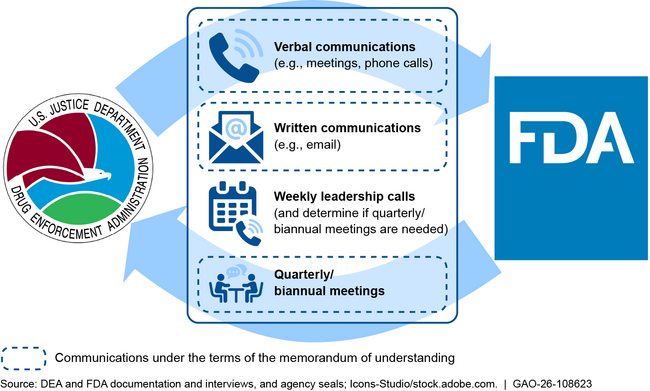
DEA and FDA have policies that address aspects of the scheduling process, including a memorandum of understanding (MOU) for sharing information; however, these policies have gaps. For example, DEA does not have policies that identify roles, responsibilities, and procedures related to scheduling. FDA does not have policies or procedures specifying how its staff are to conduct evaluations or develop recommendations. Developing such policies and procedures could help ensure operational consistency, especially if key personnel with longstanding subject matter expertise depart. The below figure shows DEA and FDA methods for coordinating regarding evaluations and recommendations for substances.
Figure: DEA and FDA Methods for Coordinating Regarding Evaluations and Recommendations for Substances
FDA has another MOU with the National Institutes of Health’s (NIH) National Institute on Drug Abuse (NIDA) that describes procedures for FDA to consult NIDA when developing recommendations, but the MOU is over 40 years old and does not reflect the current entities involved or procedures. Without updating and regularly reviewing the MOU, FDA and NIDA staff may not know the entities and procedures to follow to ensure that NIDA’s expertise about drug abuse informs scheduling recommendations.
According to DEA and FDA officials, differences of scientific opinion between the two agencies about a substance’s schedule have occurred but are rare. In such cases, they usually discuss their differences, share information, and resolve differences prior to soliciting public comments.
Why GAO Did This Study
The use of illicit drugs and misuse of prescription drugs has been a long-standing public health issue in the U.S. DEA, in consultation with HHS, may schedule such substances. Scheduling and quantity of a controlled substance control the extent to which criminal penalties under the Controlled Substances Act may be levied.
Members of Congress have raised questions about how DEA considers HHS evaluations and recommendations. This report identifies when DEA is required to request and consider HHS evaluations and recommendations, the extent to which DEA requested and considered HHS evaluations and recommendations for scheduling actions from 2020 through 2025, and the extent to which the agencies have related policies.
GAO analyzed relevant statutes and regulations, available agency policies, and DEA and FDA data on substances for which DEA took scheduling actions. GAO analyzed regulatory dockets to validate and supplement data. GAO also interviewed officials from DEA and HHS, including FDA and NIH.
Recommendations
GAO recommends that: (1) DEA develop policies and procedures for evaluating and scheduling substances; (2) FDA develop policies and procedures for conducting evaluations and developing recommendations; and (3) FDA and NIH update their MOU to reflect current entities and procedures. The agencies concurred with our recommendations.
Recommendations for Executive Action
| Agency Affected | Recommendation | Status |
|---|---|---|
| Drug Enforcement Administration | The Administrator of DEA should develop policies and procedures that identify DEA's roles, responsibilities, and procedures for evaluating and scheduling substances through administrative scheduling, new drug application scheduling, temporary scheduling, and international treaty scheduling under relevant statutes (including collecting and evaluating data, conducting three-factor and eight-factor analyses, and determining scheduling decisions). (Recommendation 1) |
When we confirm what actions the agency has taken in response to this recommendation, we will provide updated information.
|
| Food and Drug Administration | The Commissioner of FDA should develop policies and procedures that Center for Drug Evaluation and Research staff are to use to when completing eight-factor evaluations and developing scheduling recommendations, including the criteria and process for determining a substance's "potential for abuse," including abuse potential relative to other substances. (Recommendation 2) |
When we confirm what actions the agency has taken in response to this recommendation, we will provide updated information.
|
| Food and Drug Administration | The Commissioner of FDA and the Director of NIH should update their memorandum of understanding (MOU) concerning developing drug scheduling recommendations. The updated MOU should reflect the current entities involved and procedures and include a term clause to ensure the MOU is regularly reviewed. (Recommendation 3) |
When we confirm what actions the agency has taken in response to this recommendation, we will provide updated information.
|