
Federal Law Enforcement: Status Update with Regard to Criminal Sexual Acts while Serving in Official Capacity (Fiscal Year 2025)
Fast Facts
A law that went into effect Oct. 1, 2022, makes it illegal for someone acting in their capacity as a federal law enforcement officer to engage in a sexual act with someone who is under arrest or supervision, in detention, or in federal custody. Consent is not a defense to a violation.
We reported that there were no charges or convictions under this provision in FY 2023 and 2024, and there were none in FY 2025. This may be because prosecutors can use other statutes to charge officers committing criminal sexual acts against individuals in custody. It can also take years to convict an officer for a violation.
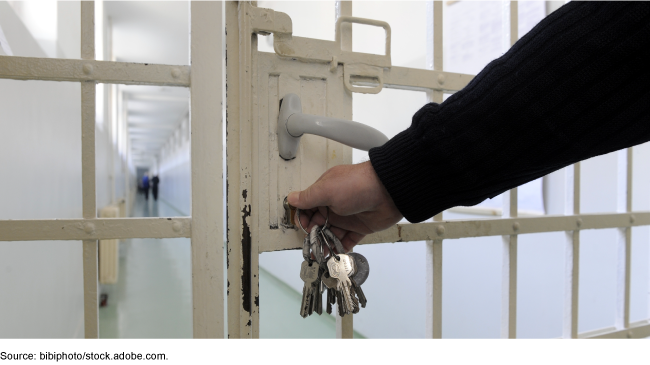
A person's hand is unlocking a heavy metal barred door with a large set of keys in a prison.
Highlights
What GAO Found
The Consolidated Appropriations Act, 2022, contains a provision, codified at 18 U.S.C. § 2243(c), making it unlawful for someone, while acting in their capacity as a federal law enforcement officer, to knowingly engage in a sexual act with an individual who is under arrest, under supervision, in detention, or in federal custody. According to a 2022 Department of Justice (DOJ) report, consent is not a defense to a violation of 18 U.S.C. § 2243(c) and therefore federal law enforcement officers are automatically liable if they engage in the prohibited conduct. Generally, DOJ's Civil Rights Division and the 94 U.S. Attorneys' Offices throughout the country prosecute sexual offenses committed by federal law enforcement officers.
According to DOJ data, there were no cases filed and no violations (criminal convictions) pursuant to 18 U.S.C. § 2243(c) in fiscal year 2025. Similarly, as GAO reported in its prior two reports on this topic, there were also no cases filed and no violations in fiscal year 2023 and 2024.
As GAO noted in its prior reports, there are several factors that could explain why there have been no cases filed and no violations as of September 30, 2025. First, according to the 2022 DOJ report noted above, federal law enforcement officers committing criminal sexual acts against individuals under arrest, under supervision, in detention, or in federal custody may be prosecuted under other criminal statutes. Prosecutors must assess whether certain statutes apply to a case, based on the facts and circumstances of the case and the relevant case law in their jurisdiction. Second, individuals cannot be charged for prohibited conduct that occurred prior to the provision's effective date of October 1, 2022, and it can take several years from the time of an alleged incident to the filing of a criminal case to a disposition of the criminal case. Finally, according to an official from DOJ's Office on Violence Against Women, many victims do not report sexual abuse immediately due to a variety of factors, including fear of retaliation. The official also noted that there is a high rate of underreporting of sex offenses in general, particularly when it involves victims in custody or detention, where victims are reluctant to report "the police to the police."
Why GAO Did This Study
The Consolidated Appropriations Act, 2022, includes a provision for GAO to report on violations of 18 U.S.C. § 2243(c) committed between October 1, 2022, and September 30, 2023, and then to report annually thereafter. GAO issued two reports addressing this topic, the first covering fiscal year 2023 in October 2023, and the second covering fiscal year 2024 in October 2024.
This report provides information on the number of cases filed by DOJ and the number of violations of 18 U.S.C. § 2243(c) during fiscal year 2025. To address this objective, GAO requested and received data from DOJ on charges and convictions pursuant to 18 U.S.C. § 2243(c), and interviewed officials from EOUSA. GAO also interviewed DOJ officials to understand how they report cases filed and violations in their data system and assessed the reliability of that data.
For more information, contact Gretta Goodwin at goodwing@gao.gov.