
Foreign Assistance: Agencies Made Broad Changes, but State Lacked Guidance for Decisions
Fast Facts
The U.S. provides foreign assistance to help countries and populations in need. The U.S. Agency for International Development has historically provided the most assistance of any agency, but a 2025 executive order ended USAID operations.
The State Department took over USAID’s remaining programs. But State doesn't have documented guidance to ensure that its decisions about foreign assistance are consistent and effective.
State also lacks complete and accurate data about foreign assistance awards, grants, and staffing. Such data is key to making informed funding and program decisions.
Our recommendations address these issues.
USAID food delivery in Ukraine.
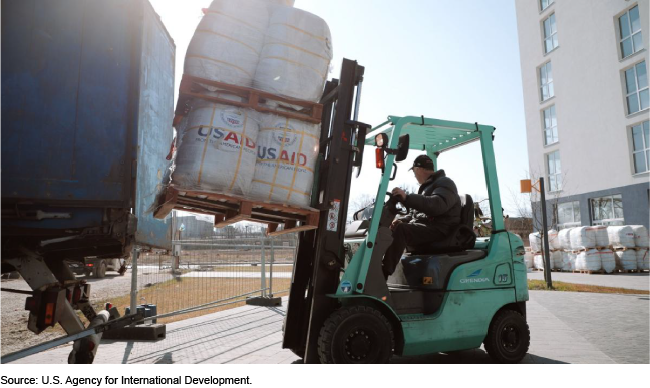
A worker uses a forklift to load food onto a truck.
Highlights
What GAO Found
In response to multiple executive orders issued beginning in January 2025, selected agencies have made changes, some significant, to their foreign assistance programming and staffing. Eight of the nine agencies included in GAO’s review decreased funding (e.g., obligations) for foreign assistance awards. One agency did not decrease the number of awards but has been unable to disburse funds to awardees since January 2025. Most notably, the U.S. Agency for International Development (USAID) terminated approximately 6,780 of 7,510 awards between January 2025 and March 2026, according to State data. The value of obligations of the terminated awards from their beginning until March 2026 was $79.1 billion. The remaining active awards, now managed by State, represented about $52.1 billion as of March 2026. The Europe and Eurasia region had the highest dollar value of terminated awards but still has the highest dollar value of remaining active USAID awards. (see figure) State announced that USAID ceased administering foreign assistance awards as of July 1, 2025.
Value of USAID Terminated and Active Awards by Region, March 2026
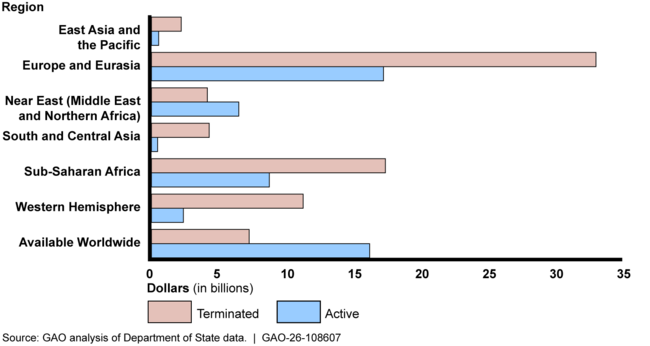
Note: Funding represents cumulative obligations from 2015 through March 2026 or the award termination date.
All nine agencies decreased staff, including both headquarters and overseas personnel, from January 2025 up to May 2026. The most significant change occurred at USAID which decreased from about 13,600 staff worldwide in January 2025 to 241 staff in April 2026, according to USAID and government-wide data. State is now the primary provider of foreign assistance, but the full range of its workforce reductions is unknown because State was unable to produce data on its staffing levels during the eleven months that GAO requested it. Without readily available staffing data, State cannot effectively plan for operational requirements, respond to risks posed by its staffing changes, or address oversight needs. State also could not provide evidence of its guidance to staff including standards for making foreign assistance changes. Without documented guidance, officials responsible for foreign assistance programming may make inconsistent, ad hoc, or inefficient decisions that could waste taxpayer money. For example, State officials may make incorrect assumptions about desired program changes that could lead to legal dispute or the retraction of terminated awards.
Why GAO Did This Study
The U.S. government uses foreign assistance to aid strategically important countries, countries in conflict, and populations in need. In January 2025, the President issued an executive order pausing U.S. foreign development assistance programs to assess them for programmatic efficiencies and consistency with U.S. foreign policy. Subsequent orders led to decreases in staff and reorganizations at agencies that carry out foreign assistance programming.
GAO examined changes to foreign assistance programming and staffing in nine selected agencies from January 2025 up to May 2026, and the extent to which these agencies developed and documented processes to inform their foreign assistance reviews.
GAO selected nine agencies, including State and USAID, based on agencies identified within appropriations legislation for the Department of State, foreign operations, and related programs, as well as agencies impacted by certain executive orders. GAO reviewed data, documents, and guidance from agencies and interviewed agency officials regarding their foreign assistance programming, funding, and staffing, as well as processes for decision-making.
Recommendations
GAO is making three recommendations to State, including for State to ensure that it can generate comprehensive data on the composition of its workforce and to improve State’s guidance regarding changes in foreign assistance programming.
State agreed with the recommendations. State noted it can generate workforce data and will take GAO’s recommendation on guidance into account for future planning cycles.
Recommendations for Executive Action
| Agency Affected | Recommendation | Status |
|---|---|---|
| Department of State | The Secretary of State should direct the Chief Acquisition Officer and Director of the Bureau of Global Acquisitions and other relevant programming bureaus to ensure that the status of foreign assistance grants and agreements in the MyGrants database is consistent, accurate, and up to date. |
When we confirm what actions the agency has taken in response to this recommendation, we will provide updated information.
|
| Department of State | The Secretary of State should direct the Chief Human Capital Officer and Comptroller, or other appropriate official, to take steps to ensure that State is able to obtain or generate comprehensive data on the composition of its workforce, including Foreign Service, Civil Service, locally employed staff, and personal services contractors, by location. |
When we confirm what actions the agency has taken in response to this recommendation, we will provide updated information.
|
| Department of State | The Secretary of State should ensure that the Director, Office of Policy Planning or other appropriate office develops, documents, and communicates agencywide guidance with standards for aligning foreign assistance program and project decisions with foreign policy priorities. |
When we confirm what actions the agency has taken in response to this recommendation, we will provide updated information.
|