
Army Corps of Engineers: Disaster Funding and Information Used to Support Flood Risk Management
Fast Facts
The U.S. Army Corps of Engineers plans, designs, and builds much of the nation’s federally funded flood risk management infrastructure, such as dams and levees. It also helps respond to floods and repairs or pays for repairs to projects when natural disasters damage them.
The Corps usually doesn't request funds for disaster response and project repairs during the annual budget cycle. Instead, it receives supplemental appropriations for such activities after a disaster has occurred.
From FYs 2006-2025, the Corps spent $34 billion on disaster preparedness and response, among other disaster-related activities.
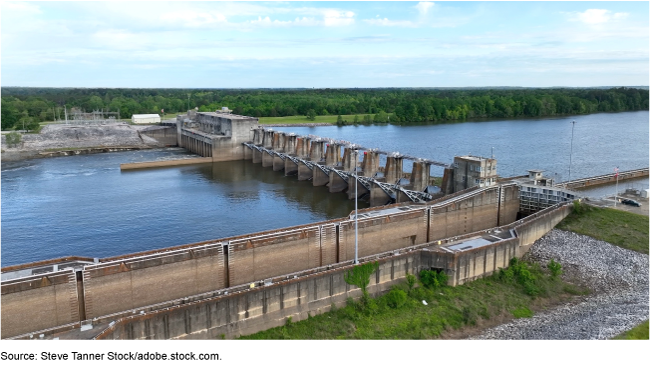
A dam built by the Army Corps of Engineers.
Highlights
What GAO Found
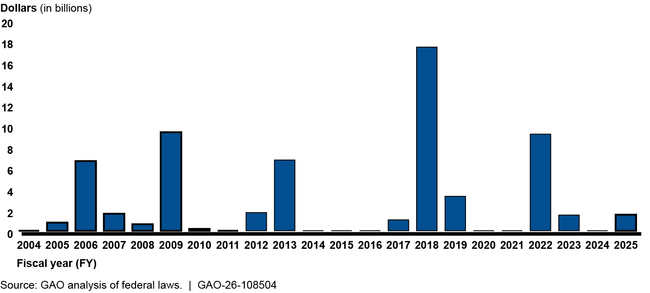
The U.S. Army Corps of Engineers is responsible for planning, designing, and constructing much of the nation’s federally funded flood risk management infrastructure. The Corps usually does not request funds for disaster response during the annual budget cycle but instead receives supplemental appropriations for such activities after a disaster has occurred. In fiscal year (FY) 2004 through FY 2025, Congress appropriated more than $60 billion to the Corps for disaster response through 19 post-disaster supplemental appropriations acts and $450 million through annual appropriations acts.
Post-Disaster Supplemental Appropriations to the Corps for Disaster Response, FYs 2004–2025
If necessary to address disasters, the Corps can transfer funds from certain other appropriations accounts to the Flood Control and Coastal Emergencies account, which funds the Corps’s disaster work. The Corps has transferred about $910 million into this account since FY 2004. Officials said they reimburse funds transferred once they receive an appropriation.
The Corps spent more than $34 billion on disasters from FY 2006 through FY 2025. Because the Corps has historically received “no-year” appropriations that are available for obligation indefinitely, the Corps does not have to immediately expend funds. Disaster spending during this period included activities related to preparedness (such as supplies and equipment, planning, and training), emergency response, and project repair.
After a disaster, the Corps gathers information by assessing damage to projects. The Corps may use this information to support flood risk management and emergency response. This includes activities such as improving flood risk management models and informing early warnings systems and evacuation protocols. The Corps has also used this information to make decisions about modifications to damaged projects to provide greater protection and improve resilience, such as increasing the height of a levee. The Corps’s Emergency Response to Natural Disasters program has exercised its authority under P.L. 84-99 to modify several projects.
Why GAO Did This Study
Many of the nation’s dams and levees were built over 50 years ago and, like other aging infrastructure, may be more vulnerable to failure, especially given the rise in the number of disasters and increasing challenges related to delivery of federal disaster assistance.
The Thomas R. Carper Water Resources Development Act of 2024 includes a provision for GAO to analyze Corps disaster preparedness and response activities. This report provides information on how Corps disaster response and praeparedness activities have been funded since FY 2004 and how the Corps uses information about the effects of natural disasters when making decisions on flood risk management projects.
To conduct this work, GAO analyzed budget requests, appropriations acts, and Corps expenditure data and reviewed Corps documents, including agency guidance and webpages. GAO is reporting expenditure data from post-disaster supplemental appropriations beginning in FY 2006 rather than FY 2004 because that is when the Corps began using specific codes in its financial system of record to link expenditures to post-disaster supplemental appropriations acts. GAO also examined publicly available information on levees and dams and interviewed Corps officials.
For more information, contact Rachel Frisk at FriskR@gao.gov.