
Grants Management: Efforts to Address Challenges Through Government-wide Collaboration
Fast Facts
The federal government awarded $1.2 trillion in grants to tribal, state, local, and territorial governments in fiscal year 2024.
There is significant variation in how grants are designed and managed across agencies, which can complicate efforts to address challenges in a coordinated way.
The Council on Federal Financial Assistance, established in 2023, helps agencies collaborate on grants issues. Senior officials from each agency work together to interpret and implement guidance more consistently across their agencies.
In fiscal year 2024, this council represented 38 of the 40 federal grantmaking agencies and over 99% of federal grant funding.

The U.S. Capitol building in front of a background of $100 bills.
Highlights
What GAO Found
To design and administer federal grant programs, agencies must navigate a variety of requirements and guidance. While there are certain standard requirements, each grant program has different authorizing legislation and may also be subject to agency-specific regulations and guidance. For some aspects of grant design and administration, agencies also have more discretion to make decisions. As a result of these factors, there is substantial variation in the design and administration of grant programs across federal agencies.
To improve consistency and coordination for federal grants management, the Office of Management and Budget (OMB) established the Council on Federal Financial Assistance (COFFA) in August 2023. In fiscal year 2024, COFFA represented 38 of the 40 grantmaking agencies that obligated grant funding and over 99 percent of the total grant funding obligated by the federal government. COFFA is co-chaired by OMB and a member agency—the Department of Health and Human Services (HHS).
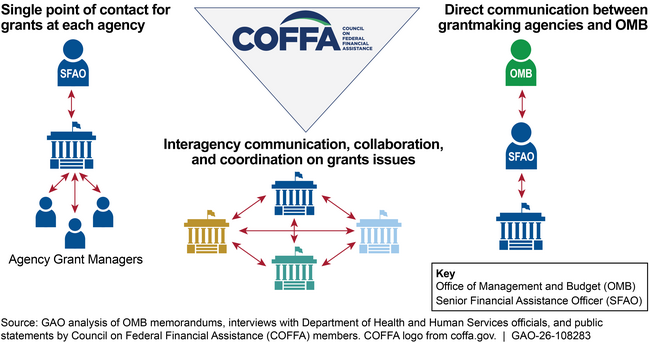
Member agencies communicate and collaborate in a variety of ways through COFFA, as shown in the figure below. For example, each agency has designated a senior official, known as a Senior Financial Assistance Officer, to serve as a single point of contact for grant programs at their agencies and raise questions and concerns at COFFA meetings. These officials communicate directly with OMB and with each other to share feedback and lessons learned. For example, when OMB revised guidance in 2024 to be clearer and more concise, the points of contact provided feedback to inform the revisions. In addition to providing feedback, COFFA also issued clarifying guidance to help agencies implement OMB’s revised guidance.
Communication and Collaboration Methods Under COFFA
Why GAO Did This Study
In fiscal year 2024, the federal government obligated approximately $1.2 trillion in grants to tribal, state, local, and territorial governments. GAO’s prior work found opportunities to address long-standing challenges to federal grants management.
In recent years, multiple government-wide initiatives have been implemented to reform aspects of federal grants management. However, the flexibility at the grant program and agency level that may help programs meet specific goals can result in variation and complexity. This variation and complexity may hinder government-wide efforts to address crosscutting challenges.
GAO was asked to review recent initiatives to support agencies’ ability to collaboratively address grants management challenges. This report describes (1) the government-wide legal and administrative framework for federal grants management and (2) how member agencies communicate and collaborate through COFFA.
To describe the framework for federal grants management, GAO reviewed relevant legal and administrative documents, such as the Uniform Administrative Requirements, Cost Principles, and Audit Requirements for Federal Awards. GAO also reviewed relevant federal laws and executive orders.
To describe how member agencies interact through COFFA, GAO reviewed relevant OMB and COFFA guidance, and available information such as recorded events. GAO also interviewed officials and reviewed information from HHS.
For more information, contact Jeff Arkin at arkinj@gao.gov.