
International Commitments: State Should Improve Timeliness and Completeness of Reporting to Congress
Fast Facts
The State Department must report certain international commitments to Congress and the public. This is critical for Congress to meaningfully oversee U.S. commitments with foreign partners and to provide transparency to the public.
However, we found that State reported nearly one-third of such commitments to Congress late between October 2023 and March 2025. For example, one agreement wasn't reported to Congress until nearly 5 months after it was concluded.
We also found that State consistently missed the deadline for publishing these commitments on its website.
We made 7 recommendations to address these issues.
Highlights
What GAO Found
The Department of State must report to Congress all international agreements and qualifying nonbinding instruments twice: (1) after being signed, concluded, or otherwise finalized, including their authorizing authority, and (2) after entering into force or becoming operative, including any implementing authority. This twofold reporting enables Congress to provide oversight of U.S. government agencies’ agreements and instruments before and after they enter into force or become operative.
State reported 311 agreements and instruments to Congress between October 2023 and March 2025, but nearly one-third were reported late at one or both points. Late-reported agreements and instruments were on average 2.3 reporting cycles late. For example, an agreement concluded on November 4, 2024, was to have been reported by the end of December 2024 but was not reported until the end of March 2025 (three reporting cycles late). This means Congress was notified about the agreement about 5 months after its conclusion. GAO found that State does not track the timeliness of State bureaus or offices or other federal agencies in submitting their agreements or instruments for State to report to Congress. Doing so would better position State to identify and address potential related challenges. State also does not collect, from agencies or State bureaus or offices, the legal authorities for their instruments, although it is required to report this information to Congress. The timing and completeness of State’s reporting is critical for Congress to meaningfully oversee the agreements and instruments, including to evaluate whether they align with U.S. national security and foreign policy interests.
Timeliness of State Reporting of International Agreements and Qualifying Nonbinding Instruments to Congress Between October 2023 and March 2025
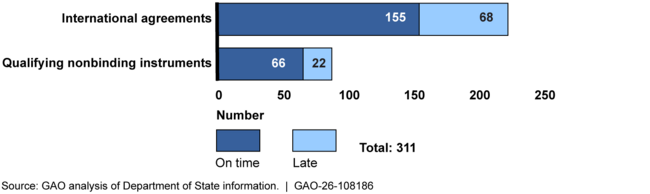
Note: A late-reported agreement or instrument is one that was signed, concluded, or otherwise finalized during the prior month, or that entered into force or became operative during the prior month, but was not reported during the following month.
GAO’s analysis of a generalizable sample of agreements and instruments found that State generally published text and legal authority information for agreements and instruments on its website but missed the 120-day statutorily mandated deadline about half of the time. GAO also found State’s website for agreements and instruments does not enable Congress or the public to find information efficiently, when compared to best practices. Specifically, State posted fragmented information on agreements, instruments, and their legal authorities across four webpages on its website, without a way to search across the universe of agreements and instruments, such as by country, agency, or subject. By establishing written, standard operating procedures to help ensure information is published within the 120-day deadline, and optimizing its website for efficiency and searchability, State could maximize transparency for Congress and the public, and the usability of its website.
Why GAO Did This Study
Amendments in the James M. Inhofe National Defense Authorization Act for Fiscal Year 2023, which took effect on September 19, 2023, expanded the Case-Zablocki Act’s transparency provisions. For the first time, qualifying nonbinding instruments—commitments that do not legally bind the U.S. to their terms—must generally be reported to Congress and made available to the public. Previously, reporting and publishing requirements applied only to international agreements, which are legally binding under international law. The statute mandates that U.S. government agencies report their agreements and instruments to State. State is responsible for reporting them to Congress and publishing them on State’s website.
Congress included a provision in statute for GAO to review State’s implementation of the amended requirements. This report examines the extent to which State addressed reporting and publishing requirements related to international agreements and qualifying nonbinding instruments and any challenges to meeting those requirements. GAO assessed information State reported to Congress between October 2023 and March 2025 and posted to its website in relation to statutory requirements. GAO interviewed officials from State and six other agencies about late reporting.
Recommendations
GAO is making seven recommendations, including that State improve the timeliness and completeness of its reporting on agreements and instruments, and optimize its website for discoverability and searchability. State concurred with five recommendations and did not concur with two. GAO continues to believe all the recommendations are warranted, as discussed in the report.
Recommendations for Executive Action
| Agency Affected | Recommendation | Status |
|---|---|---|
| Department of State | The Secretary of State should ensure that the Office of the Assistant Legal Adviser for Treaty Affairs takes steps to track timeliness of submissions by U.S. government agencies as well as State bureaus and offices of information on international agreements and qualifying nonbinding instruments. (Recommendation 1) |
State concurred with this recommendation. In commenting on the report, State said it would take steps to track timeliness of submissions by U.S. government agencies as well as State bureaus and offices of information on international agreements and qualifying nonbinding instruments. When we confirm what actions the agency has taken in response to this recommendation, we will provide updated information.
|
| Department of State | The Secretary of State should ensure that the Office of the Assistant Legal Adviser for Treaty Affairs periodically assesses the timeliness of submissions by U.S. government agencies as well as State bureaus and offices of information on international agreements and qualifying nonbinding instruments, and takes steps to improve timeliness, as needed, based on the assessment. (Recommendation 2) |
State concurred with this recommendation. In commenting on the report, State said it would take steps to assess and improve, as needed, the timeliness of submissions by U.S. government agencies as well as State bureaus and offices of information on international agreements and qualifying nonbinding instruments. When we confirm what actions the agency has taken in response to this recommendation, we will provide updated information.
|
| Department of State | The Secretary of State should ensure that the Office of the Assistant Legal Adviser for Treaty Affairs updates its template for submitting qualifying nonbinding instruments to include legal authority information. (Recommendation 3) |
State concurred with this recommendation. In commenting on the report, State said it would update its template for submitting qualifying nonbinding instruments to include legal authority information. When we confirm what actions the agency has taken in response to this recommendation, we will provide updated information.
|
| Department of State | The Secretary of State should ensure that the Office of the Assistant Legal Adviser for Treaty Affairs establishes and communicates the availability of a mechanism for State personnel to report potential instances of noncompliance with the Case-Zablocki Act's transparency provisions. (Recommendation 4) |
State concurred with this recommendation. In commenting on the report, State said it would take steps to establish and communicate the availability of a mechanism for State personnel to report potential instances of noncompliance with the Case-Zablocki Act's transparency provisions. When we confirm what actions the agency has taken in response to this recommendation, we will provide updated information.
|
| Department of State | The Secretary of State should ensure that the Office of the Assistant Legal Adviser for Treaty Affairs updates its guidance to request U.S. government agencies as well as State bureaus and offices periodically confirm that they have either submitted all applicable international agreements and qualifying nonbinding instruments or do not have any agreements and instruments to submit for a given reporting period. (Recommendation 5) |
In commenting on the report, State did not concur with this recommendation. GAO continues to believe the recommendation is warranted, as discussed in the report. By periodically asking agencies to confirm that they have either submitted all applicable international agreements and qualifying nonbinding instruments or do not have any to submit, State would have greater assurance that it is identifying all agreements and instruments and reporting complete information to Congress.
|
| Department of State | The Secretary of State should ensure that the Office of the Assistant Legal Adviser for Treaty Affairs establishes written, standard operating procedures for its publishing process to help ensure international agreements and qualifying nonbinding instruments and their legal authorities are published within the 120-day deadline. (Recommendation 6) |
In commenting on the report, State did not concur with this recommendation. GAO continues to believe the recommendation is warranted, as discussed in the report. By establishing written, standard operating procedures that lay out the process needed to ensure information is published within the 120-day deadline, State could minimize the risk of limiting the public's timely access to international agreements and qualifying nonbinding instruments and their legal authorities.
|
| Department of State | The Secretary of State should take steps to optimize the webpages on its website for international agreements and qualifying nonbinding instruments and their legal authorities for discoverability and searchability. (Recommendation 7) |
State concurred with this recommendation. In commenting on the report, State said it would take steps to improve searchability of its website for international agreements and qualifying nonbinding instruments. When we confirm what actions the agency has taken in response to this recommendation, we will provide updated information.
|