
Health Care Funding: Information on Crisis Pregnancy Centers, Fiscal Years 2018 Through 2024
Fast Facts
Crisis pregnancy centers provide certain free or low-cost services. These include pregnancy testing, education, and infant supplies. They also encourage adoption as an alternative to abortion. These centers are usually nonprofit organizations funded by private sources, but some receive federal dollars.
This Q&A reviews federal funds awarded to these centers from 2018-2024. While the total amount is unknown because these organizations are not easy to identify in government spending data, we did find that $34 million was awarded by the Department of Health and Human Services to 16 such centers.
Infant supplies available at a crisis pregnancy center
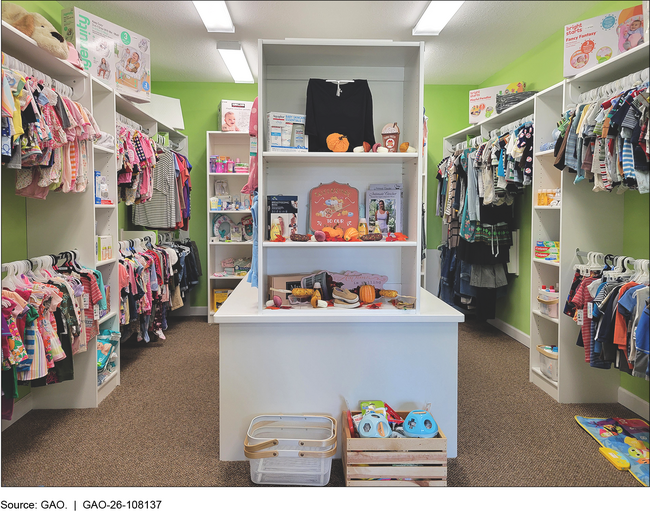
A crisis pregnancy center room with infant supplies, such as clothing, toys, and diapers.
Highlights
What GAO Found
The Department of Health and Human Services (HHS) provides grant awards to organizations that support its mission to enhance the health and well-being of all Americans. This includes funding to engage in reproductive health-related activities, such as pregnancy testing and education that crisis pregnancy centers (CPC) offer. CPCs, also called pregnancy help organizations or pregnancy resource centers, are generally nonprofit, faith-based organizations that provide certain reproductive health-related services, encourage parenting and adoption, and do not perform or refer clients for abortion services.
GAO found there is no standard definition of a CPC, and differing perspectives exist regarding their characteristics and total number. For example, in 2025, stakeholder estimates in the U.S. ranged from about 2,400 to 2,800 CPCs. Stakeholders reported the majority of CPC funding comes from private sources—such as individuals and nongovernmental organizations. The total amount of federal funds obligated to CPCs is unknown because CPCs are not easily identified in USAspending.gov—the official government-wide source of public data on U.S. spending— compared to some other organizations, such as hospitals.
For those CPCs GAO was able to identify, GAO found that HHS directly obligated at least $34 million in federal funds across 16 CPCs to provide reproductive health-related services, from fiscal years 2018 through 2024. However, this analysis likely underestimates total obligations to all CPCs due to challenges identifying these organizations.
Why GAO Did This Study
GAO was asked to review the amount of federal funding that CPCs have received. This report describes what available data show about CPCs and the amount of federal funds obligated to CPCs in the U.S. and its territories from fiscal years 2018 through 2024 for reproductive health-related grants. In general, an obligation is a commitment made by a federal agency that creates a legal liability to make payment.
GAO reviewed HHS grant documentation and analyzed data on HHS grant obligations for fiscal years 2018 through 2024. GAO also interviewed HHS officials and representatives from a nongeneralizable selection of stakeholders with a range of perspectives, such as CPCs and researchers.
For more information, contact Mary Denigan-Macauley at DeniganMacauleyM@gao.gov.