
Financial Audit: FY 2025 and FY 2024 Consolidated Financial Statements of the U.S. Government
Fast Facts
The Financial Report of the U.S. Government provides a comprehensive view of government finances, including revenues, costs, assets, liabilities, and long-term sustainability.
We audit the financial statements in that report each year, but we haven't yet been able to determine if they are fairly presented. This year, it was primarily due to:
Serious financial management problems at the Department of Defense
Problems in accounting for transactions between federal agencies
Weaknesses in the process for preparing the statements
Financial management challenges at eight other major agencies

U.S. Capitol Building overlaid on cash.
Highlights
What GAO Found
To operate as effectively and efficiently as possible, Congress, the administration, and federal managers must have ready access to reliable and complete financial and performance information—both for individual federal entities and for the federal government as a whole. GAO’s report on the U.S. government’s consolidated financial statements for fiscal years 2025 and 2024 discusses progress that has been made but also underscores that much work remains to improve federal financial management and that the federal government continues to face an unsustainable long-term fiscal path.
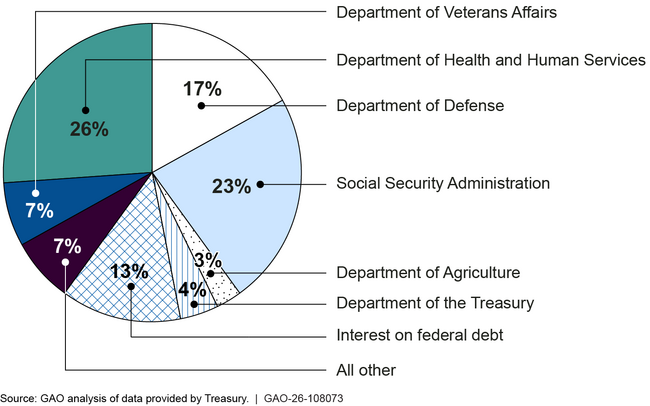
The federal government’s net costs were about $7.3 trillion in fiscal year 2025.
Fiscal Year 2025 Net Costs of U.S. Government Operations ($7.3 Trillion)
GAO found the following:
- Certain material weaknesses in internal control over financial reporting and other limitations resulted in conditions that prevented GAO from expressing an opinion on the accrual-based consolidated financial statements as of and for the fiscal years ended September 30, 2025, and 2024.
- Significant uncertainties, primarily related to the achievement of projected reductions in Medicare cost growth, and a material weakness in internal control prevented GAO from expressing an opinion on the sustainability financial statements (e.g., Statements of Long-Term Fiscal Projections and social insurance statements).
- Material weaknesses resulted in ineffective internal control over financial reporting for fiscal year 2025.
- Material weaknesses and other scope limitations, discussed above, limited tests of compliance with selected provisions of applicable laws, regulations, contracts, and grant agreements for fiscal year 2025.
Three major impediments have continued to prevent GAO from rendering an opinion on the federal government’s accrual-based consolidated financial statements: (1) serious financial management problems at the Department of Defense, (2) the federal government’s inability to adequately account for intragovernmental activity and balances between federal entities, and (3) weaknesses in the federal government’s process for preparing the consolidated financial statements. In addition, several other significant federal entities, such as the Small Business Administration, were not able to obtain opinions on their fiscal years 2025 and 2024 financial statements. Efforts are under way to resolve these issues.
The material weaknesses underlying the three major impediments and the other financial management challenges (1) affect the federal government’s ability to reliably measure the full cost, as well as the financial and nonfinancial performance, of certain programs and activities; (2) impair the federal government’s ability to adequately safeguard significant assets and properly record various transactions; (3) hamper the federal government’s ability to reliably report a significant portion of its assets, liabilities, costs, and other related information; and (4) hinder the federal government from having reliable, useful, and timely financial information to operate effectively and efficiently.
Two other continuing material weaknesses are the federal government’s inability to (1) determine the full extent to which improper payments, including fraud, occur and reasonably assure that appropriate actions are taken to reduce them and (2) identify and resolve information system control deficiencies and manage information security risks on an ongoing basis. The fiscal year 2025 government-wide total of reported improper payment estimates was $186 billion, but it did not include estimates for certain government programs. Thirteen of the 24 agencies covered by the Chief Financial Officers Act of 1990 reported material weaknesses or significant deficiencies in information system controls.
The Statement of Long-Term Fiscal Projections and related information show that based on current revenue and spending policies, the federal government continues to face an unsustainable long-term fiscal path. Since 2017, GAO has suggested that Congress develop a strategy to place the federal government on a sustainable fiscal path.
In commenting on a draft of this report, Department of the Treasury officials expressed their continuing commitment to addressing the problems this report outlines.
Why GAO Did This Study
The Secretary of the Treasury, in coordination with the Director of the Office of Management and Budget, is required to annually submit audited financial statements for the U.S. government to the President and Congress. GAO is required to audit these statements. The Government Management Reform Act of 1994 has required such reporting, covering the executive branch of government, beginning with financial statements prepared for fiscal year 1997. The consolidated financial statements include the legislative and judicial branches.
For more information, contact Dawn B. Simpson at simpsondb@gao.gov. or Robert F. Dacey daceyr@gao.gov.