
VA Health Care: Efforts to Assess Mental Health Support for Veteran Caregiver Program Need Strengthening
Fast Facts
Veterans with serious injuries or other impairments often rely on caregivers for around-the-clock care. The Department of Veterans Affairs operates a program to support caregivers' mental health. Caregiving can be very stressful and demanding—and can cause anxiety or depression.
VA advertises its Caregiver Support Program but hasn't fully assessed how effective its outreach is. VA also tracks how many caregivers use virtual therapy but hasn't set goals or collected data for other services. We recommended that VA set goals, collect related data, and more to better understand whether its efforts are supporting caregivers.

A woman interacts with a man in a wheelchair.
Highlights
What GAO Found
The Veterans Health Administration’s (VHA) Caregiver Support Program offers mental health support, among other benefits, to eligible caregivers who provide around the clock care for veterans with serious injuries. This includes support groups and respite care. In fiscal year 2025, VHA data show the program served about 98,000 caregivers. In addition, VHA obligated $2.6 billion to implement the program, according to officials. VHA officials told GAO the program has grown significantly since fiscal year 2021 due in part to expanded eligibility criteria that allowed more caregivers to participate as of October 1, 2020.
Caregivers Participating in Veterans Health Administration Caregiver Support Program, Fiscal Years 2021 Through 2025
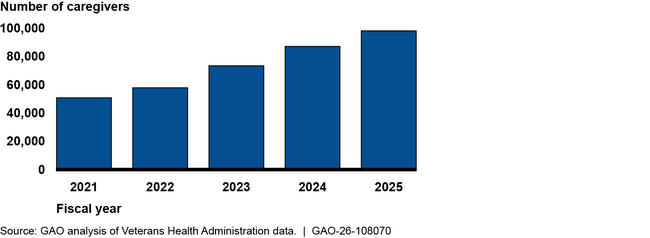
VHA advertises the Caregiver Support Program through various methods, such as email updates and brochures at Department of Veterans Affairs (VA) medical centers. Some caregivers GAO interviewed said they learned about the program through these methods. However, they wished they had learned about it sooner. They also felt other caregivers did not know about the mental health support available to them through the program.
VHA established four goals to assess whether its outreach efforts are effective at increasing caregivers’ awareness of the program. One goal is to increase program enrollment by 15 percent each fiscal year. However, the other three goals, such as increasing subscribers to its email updates, do not have quantitative targets and time frames. Setting targets and time frames for these goals would better enable VHA to measure its progress in increasing awareness of the program among caregivers who are not enrolled, help the agency assess how well its outreach efforts are working, and make any needed adjustments.
VHA has also taken steps to assess how the program supports caregivers by establishing a goal to increase telehealth appointments by 10 percent in fiscal year 2025. VHA collects data on these appointments, which increased by 50 percent from fiscal year 2024 to 2025. However, the agency has not established goals and collected related data for other program services, such as other types of mental health treatment. Setting goals and collecting more complete information would better position VA to assess program performance. VHA could make any needed adjustments to further support caregivers’ wellbeing, allowing it to better support veterans.
Why GAO Did This Study
Several factors, including the demands of their care duties, can affect caregivers’ mental health and wellbeing. Research suggests that such caregiving can be linked to high levels of stress and burden and can result in depression or anxiety.
The Senator Elizabeth Dole 21st Century Veterans Healthcare and Benefits Improvements Act includes a provision for GAO to review mental health support provided by the VHA Caregiver Support Program. This report examines VHA’s efforts to make caregivers aware of the mental health support available to them and VHA’s efforts to assess program performance, among other objectives.
GAO reviewed VHA documentation and data for fiscal years 2021 through 2025. GAO also interviewed VHA officials, program staff and selected caregivers at four VA medical centers, and representatives from four organizations serving veterans and caregivers. GAO selected the medical centers based on program size, geography, and rurality. GAO selected organizations that focus on caregivers and have national reach. GAO also conducted a literature search and review of relevant research.
Recommendations
GAO is making two recommendations to VA to implement key performance management practices for the Caregiver Support Program, including setting quantitative targets and time frames for outreach goals, and setting goals and collecting relevant data to assess services the program offers to support caregivers’ mental health. VA concurred with the recommendations and identified steps VHA plans to take to implement them.
Recommendations for Executive Action
| Agency Affected | Recommendation | Status |
|---|---|---|
| Department of Veterans Affairs | The Secretary of the Department of Veterans Affairs should ensure the Under Secretary for Health implements key performance management practices to increase the awareness of the Caregiver Support Program by (1) establishing quantitative targets and time frames for all of its program goals, such as increasing the number of program inquiries, and (2) using these data to assess program performance and make adjustments as appropriate. (Recommendation 1) |
In July 2026, VHA stated that the Caregiver Support Program completed targeted outreach to caregivers of veterans in April 2026, which generated an increase in program applications and requests for program information as of July 2026. VHA said it will assess initial outcomes to inform the development of quantitative targets and time frames for increasing awareness of the program by February 2027. Once we receive more information on VHA's targets and time frames, we will assess the extent to which these efforts address our recommendation.
|
| Department of Veterans Affairs | The Secretary of the Department of Veterans Affairs should ensure the Under Secretary for Health implements key performance management practices to assess the mental health support offered by the Caregiver Support Program by (1) establishing goals with quantitative targets and time frames for all of the mental health support offered through the program, including referrals for mental health care provided at VA medical facilities; (2) collecting performance information to measure progress towards meeting these goals, and (3) using these data to assess program performance and make adjustments as appropriate. (Recommendation 2) |
In July 2026, VHA stated that the Caregiver Support Program is working to build the infrastructure to measure mental health support for caregivers participating in the comprehensive component. Specifically, VHA said it developed a dashboard to track timeliness for virtual psychotherapy encounters and is developing a dashboard to track facility level utilization of mental health services. VHA also told GAO it will establish baseline measures to inform the development of quantitative targets and timeframes that align with performance management practices for goal setting, performance management, and ongoing program assessment. VHA said it expects to complete these actions by February 2027. Once we receive more information on VHA's measures, targets, and time frames, we will assess the extent to which these efforts address our recommendation.
|