
Technology Transfer: Funding Recipients Keep Most Federally Funded Inventions, but Some Cited Reporting Challenges
Fast Facts
Technology Transfer: Funding Recipients Keep Most Federally Funded Inventions, but Some Cited Reporting Challenges
Federal funding has led to thousands of inventions, including medicines, defense systems, and space technologies.
To encourage inventions that benefit the public, Congress allows recipients of federal research funding—such as universities, small businesses, and nonprofits—to take ownership and profit from their inventions. In return, they must disclose their inventions to the government and report annually on efforts to profit from them.
Recipients took ownership most of the time. We also found that reporting can be challenging for recipients and agencies. However, greater use of web-based reporting could help with some of the issues they face.

A person in a white coat and a clear face shield works in a laboratory on a circuit board.
Highlights
What GAO Found
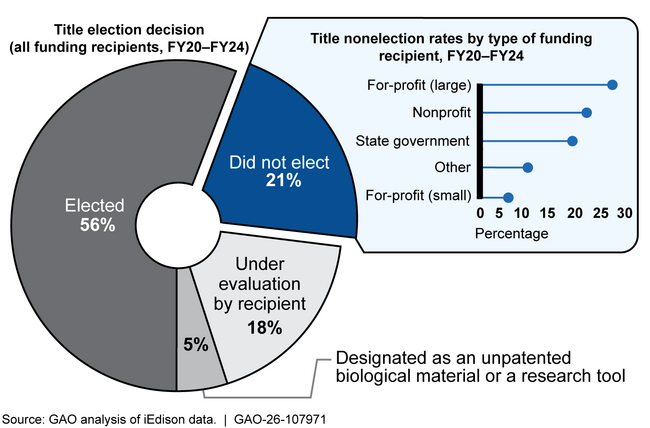
The Bayh-Dole Act lets recipients of federal funding retain ownership rights, or “elect title,” to inventions made with federal funding if they meet certain reporting requirements. GAO found that when recipients (e.g., universities and businesses) invented useful technologies, most chose to retain ownership rights, while about 21 percent declined to do so, from fiscal year 2020 through 2024 (see figure). The most common reason they declined was low commercial potential for the inventions (meaning they would not be likely to find a commercial partner to bring the invention to market, according to university representatives). Small for-profit funding recipients had the lowest rate of declining ownership rights.
Title Election Decisions and Rates of Nonelection by Type of Funding Recipient, Fiscal Years (FY) 2020–2024
Funding recipients cited several challenges to meeting invention reporting requirements. These challenges included inconsistent requirements across agencies, time-consuming annual reporting, and delays with requests for deadline extensions. Despite these challenges, one organization representing small businesses told GAO that compliance with reporting requirements generally does not prevent small businesses from bringing their federally funded inventions to market.
Several recipients said continued use of a web-based reporting system, known as iEdison, could help address some of these challenges. However, some agencies said there were still concerns with iEdison, including occasional incomplete reporting by funding recipients. For example, iEdison allows funding recipients the flexibility to submit information using their own formats. But some stakeholders said recipients may not know what information to include. Agency review time increases as a result, officials said.
In March 2026, the National Institute of Standards and Technology (NIST) published a sample form for funding recipients to use when disclosing a new invention. Use of the optional sample form may improve the consistency and completeness of submissions.
Why GAO Did This Study
Federal agencies fund billions of dollars in research each year that can result in new inventions. The Bayh-Dole Act of 1980 created an incentive for federally funded researchers to bring inventions to market so the public could benefit. Specifically, recipients of federal research funding, such as universities, small businesses, and nonprofits, may elect ownership of and profit from their inventions if the recipients meet certain requirements. For example, they must disclose their inventions to the government and report annually on commercialization efforts. To streamline invention reporting, many agencies use iEdison, a web-based system managed by NIST. A July 2023 executive order directed specific agencies to take steps to transition to iEdison by the end of 2025.
GAO was asked to review the federal invention disclosure process. This report examines (1) the percentage of disclosed inventions for which funding recipients elected to retain title and the reasons for not doing so, (2) challenges funding recipients face in complying with reporting requirements, and (3) how selected agencies are managing the transition to a single federal disclosure system.
GAO analyzed inventions data reported to 30 agencies by funding recipients; interviewed stakeholders, such as groups that represent universities and small businesses; and interviewed officials from five selected research funding agencies.
GAO’s draft report recommended that NIST finalize and publish guidance, such as a sample form, that identifies required invention reporting elements. In response, in March 2026, NIST published a sample form and additional guidance on its website. As a result, GAO removed the recommendation and revised the report accordingly.
For more information, contact Candice N. Wright at wrightc@gao.gov.