
Facility Security: VA Should Fully Implement Federal Security Requirements and Improve Performance Reporting
Fast Facts
We reviewed security at VA medical facilities. Most of the 74,700 crimes committed at these facilities in FYs 2024 and 2025 were nonviolent. These crimes included disorderly conduct, theft, and drug offenses.
In covert tests, VA staff didn't detect a prohibited weapon that our investigators carried into 30 facilities—two of which had metal detectors. In 25 of 26 covert tests, VA staff didn't confront an investigator appearing to drink alcohol in plain view, which is generally prohibited at VA facilities.
We recommended ways for VA to address security at its medical facilities. This could help provide a safer environment for veterans and staff.
Covert Test at VA Medical Facility
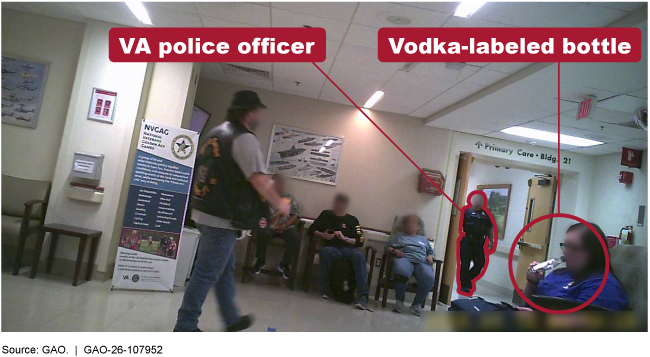
An undercover GAO investigator appearing to drink alcohol in a waiting room with several people at a VA medical facility
Highlights
What GAO Found
Department of Veterans Affairs (VA) police records report around 74,700 crimes at VA medical facilities in fiscal years 2024 and 2025. The overwhelming majority were nonviolent and included disorderly conduct, theft, and drug offenses, according to GAO analysis. GAO found that the average crime rate for the 2-year period was about two times higher in areas with more urban VA facilities (214 crimes per facility) than rural facilities (123 crimes per facility), which is consistent with a Department of Justice report on overall criminal trends.
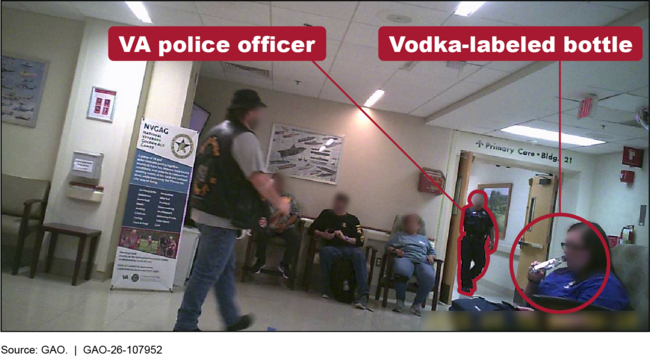
The Interagency Security Committee (ISC)—which VA is a member of—developed a risk management standard that federal agencies are required to follow to identify and address security risks. However, VA has not fully implemented all ISC requirements, such as documenting decisions on which security strategies it will adopt or measuring the performance of its security strategies. In covert tests, VA staff did not detect a prohibited weapon that GAO investigators carried into any of the 30 tested VA medical facilities, including two that had metal detectors. In 25 of 26 covert tests, VA staff did not confront an investigator drinking in plain view from a bottle labeled vodka—which is prohibited at VA facilities. Developing a plan with milestones and assessing resource requirements to fully implement the standard could help VA better manage security risks to create a safe environment for veterans and VA staff.
Undercover GAO Investigator Appearing to Drink Alcohol in a VA Medical Facility
Consistent with ISC and internal control standards, VA obtains security and threat information and works to address security gaps through its capital planning. VA has a performance goal to address security gaps for capital projects. While VA has met its overall security gap planning goal, two of the 18 regions did not in fiscal years 2023 through 2025 and did not take actions to improve performance. This is because VA headquarters—the entity that tracks each region’s progress—did not communicate to the regions that they were not meeting this goal. Communicating this information to the regions could help VA ensure that it continues to meet this goal.
Why GAO Did This Study
VA oversees the largest integrated health care system in the U.S., serving 9 million enrolled veterans at over 1,300 facilities. These facilities have been the target of violence, threats, and other security-related incidents. VA is responsible for physical security at its medical facilities.
GAO was asked to review security at VA medical facilities. This report examines (1) the nature of reported criminal activity at VA medical facilities, (2) the extent VA implemented federal security requirements and detected security vulnerabilities at VA facilities, and (3) VA processes for obtaining and incorporating security and threat information into infrastructure planning.
GAO reviewed VA security and infrastructure planning policies, crime data from fiscal years 2024 and 2025, and risk assessment and infrastructure performance data from fiscal years 2023, 2024, and 2025. GAO also conducted covert security tests at a non-generalizable sample of 30 VA facilities, selected to ensure variation in the size and geographic locations of facilities, among other factors. GAO interviewed VA personnel and veterans in Arkansas and California.
Recommendations
GAO is recommending VA develop a plan with milestones and assess resources needed to fully implement the ISC’s risk management standard and communicate to the regions their progress in meeting the security gap planning goal. We provided a draft of this report to VA for review and comment. VA did not provide comments on the report.
Recommendations for Executive Action
| Agency Affected | Recommendation | Status |
|---|---|---|
| Department of Veterans Affairs | The Secretary of Veterans Affairs should develop a plan with milestones for fully implementing the ISC's risk management standard. (Recommendation 1) |
In June 2026, VA official provided documentation of its plan to implement the Interagency Security Committee's (ISC) risk management standard that included milestone dates. For example, the implementation plan has a goal of measuring the performance of its security-the last step in the ISC process-by the end of June 2027. As a result, VA will be better positioned to fully implement the ISC standard and track progress towards this goal.
|
| Department of Veterans Affairs | The Secretary of Veterans Affairs should assess the resources needed to fully implement the ISC's risk management standard. (Recommendation 2) |
VA agreed with GAO's recommendations and in a May 13, 2026 statement before the Senate Committee on Veterans' Affairs, VA's Assistant Secretary for Operations, Security, and Preparedness stated that VA will take action to address all of GAO's recommendations. Assessing the resources needed to fully implement the standard could help VA better manage security risks to create a safe environment for veterans and VA staff. GAO will monitor VA efforts.
|
| Department of Veterans Affairs | The Secretary of Veterans Affairs should develop a mechanism for VA headquarters to communicate with VISN officials on their progress in meeting VA's 95-percent security gap closure planning goal. (Recommendation 3) |
In May 2026, VA agreed with GAO's recommendations, and stated that VA will develop a mechanism by September 2026. Developing a mechanism and communicating this information to the regions could help VA ensure that it is positioned to address security gaps and meet its planning goal. GAO will monitor VA efforts.
|