
Airport Financial Reporting: FAA Should Implement Controls to Improve Data Quality
Fast Facts
Every year, about 500 airports must report data to the Federal Aviation Administration about how they collect and spend funds. Stakeholders, such as industry associations and researchers, use this data to analyze things like airports' financial performance.
We found that most of these airports submitted data to FAA. However, it's hard for FAA to track whether the airports did so on time. The data in these reports also have anomalies and potential errors.
We made 3 recommendations, including that FAA improve the quality of the data on its website.

A flying airplane viewed from the window of an airport seating area.
Highlights
What GAO Found
The Federal Aviation Administration (FAA) created the Certification Activity Tracking System (CATS) website for officials at commercial service airports to file and certify their annual financial data, such as operating expenses and revenues. This database is the only centralized source of airport financial data. FAA, industry stakeholders, and researchers have used the data for multiple purposes. For example, a researcher used CATS data on airport revenues and expenses to develop policy options for Congress to improve airport financing.
Most airports required to submit data to CATS did so, but the extent of the timeliness and accuracy of CATS data is unknown. Airports that receive certain federal grants, provide commercial service, and had at least 2,500 passenger boardings in the prior year are required to submit data. Most of these airports did so for fiscal year 2023 (the most recent data available at the time of GAO’s review), but some of the smallest airports did not, for reasons that included staff turnover. Limitations in CATS make it difficult for FAA to track whether airports meet reporting deadlines. Moreover, airports must report data within a certain period after the end of their fiscal year, which varies by airport. As a result, CATS users must wait almost a year to obtain data for a particular fiscal year. Further, CATS data have anomalies and potential errors, such as data from airports that were not required to file, which can affect totals for a given year.
Airport Financial Reports Submitted to FAA by Airport Category, Fiscal Year 2023
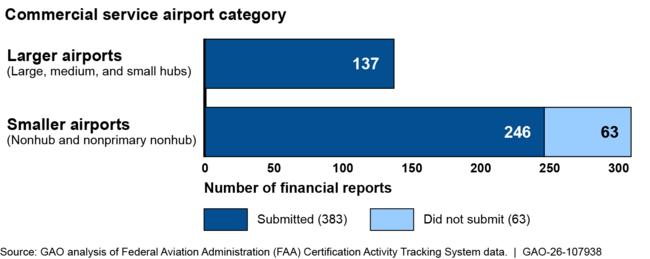
Note: While 506 airports were required to submit data, FAA allowed two airport sponsors to consolidate multiple airports into a single submission, resulting in 446 expected airport submissions.
FAA has taken some steps to improve CATS data quality, such as performing occasional data checks. However, FAA does not have sufficient data controls to ensure the quality of CATS data. For example, FAA does not have a procedure to consistently identify airports newly required to submit data due to increased passenger boardings. FAA officials told GAO they planned to update the CATS website, which could add this and other functions, but that the update had been delayed. Implementing data controls would result in better quality data to inform policy and other decisions. Additionally, FAA has not communicated specific data limitations to users. For example, information about the number of airports that submitted their financial data for a particular fiscal year could help users understand the completeness of the data and qualify the data for their purposes.
Why GAO Did This Study
Each year, approximately 500 commercial service airports must submit their financial data to FAA, within the Department of Transportation. These reporting requirements were enacted in 1994 to enable FAA to evaluate airports’ compliance with revenue-use requirements and inform the public on how airports collect and spend funds, according to FAA. These airports are generally publicly owned and rely on a mix of revenue sources, such as airline payments, parking revenue, and federal grants.
The FAA Reauthorization Act of 2024 includes a provision for GAO to review airport financial reporting. This report examines (1) how FAA and stakeholders have used CATS data; (2) the extent to which CATS data are complete, timely, and accurate; and (3) the extent to which FAA has taken actions to improve CATS data quality and communicated any data limitations to users.
GAO reviewed CATS data for fiscal years 2019 through 2023; FAA guidance; and publications that cited CATS, identified through a literature search. GAO interviewed officials from FAA headquarters and nine regions; 12 industry stakeholders and researchers; and officials from 10 airports, selected at random but to reflect a range of sizes and regions. GAO also compared CATS data quality policies with federal data standards.
Recommendations
GAO is making three recommendations to FAA, including that FAA implement controls to improve the quality of CATS data and disclose known limitations of the data on the CATS website. The Department of Transportation concurred with the recommendations.
Recommendations for Executive Action
| Agency Affected | Recommendation | Status |
|---|---|---|
| Federal Aviation Administration | The Administrator of FAA, either through a CATS update or other means, should implement controls to improve the quality of CATS data, such as identifying airports required to submit data, tracking submission history, and identifying errors and anomalies. (Recommendation 1) |
DOT concurred with this recommendation. As of August 2026, DOT reported that the FAA's Office of Airports will implement enhanced controls to improve CATS data quality. FAA plans to complete the implementation of this recommendation by March 31, 2027. GAO will continue to monitor FAA's progress in implementing this recommendation.
|
| Federal Aviation Administration | The Administrator of FAA should clearly define the roles and responsibilities between headquarters and regional office staff in ensuring airports' compliance with CATS requirements, including clarifying the staff responsible for following up with airports to submit data. (Recommendation 2) |
DOT concurred with this recommendation. As of August 2026, DOT reported that the FAA's Office of Airports will define the roles and responsibilities between headquarters and regional office staff in ensuring airports' compliance with CATS requirements. FAA plans to complete the implementation of this recommendation by March 31, 2027. GAO will continue to monitor FAA's progress in implementing this recommendation.
|
| Federal Aviation Administration | The Administrator of FAA should disclose on the CATS website the known limitations of CATS data, such as the number of airports that have submitted financial information out of the total that were required to do so and the fact that airport sponsors may update their data over time. (Recommendation 3) |
DOT concurred with this recommendation. As of August 2026, DOT reported that the FAA's Office of Airports will enhance the financial reporting website to include disclosures of the limitations of CATS data. FAA plans to complete the implementation of this recommendation by March 31, 2027. GAO will continue to monitor FAA's progress in implementing this recommendation.
|