
Disability Employment: DOL Should Enhance Monitoring and Guidance for Federal Contractors
Fast Facts
The federal government spent $793 billion in 2025 on contracts with federal contractors, which employ over a million American workers. Section 503 of the Rehabilitation Act of 1973 requires certain contractors to take steps to employ people with disabilities.
The Department of Labor is tasked with overseeing how contractors implement this law in their workplaces. But since 2025, it has suspended much of its oversight. Contractors could also benefit from additional guidance from DOL.
We recommended that DOL resume oversight activities and provide contractors with additional guidance, such as a list of best practices for Section 503 compliance.

A man in an electric wheelchair, wearing safety glasses, a yellow vest and blue helmet in a factory.
Highlights
What GAO Found
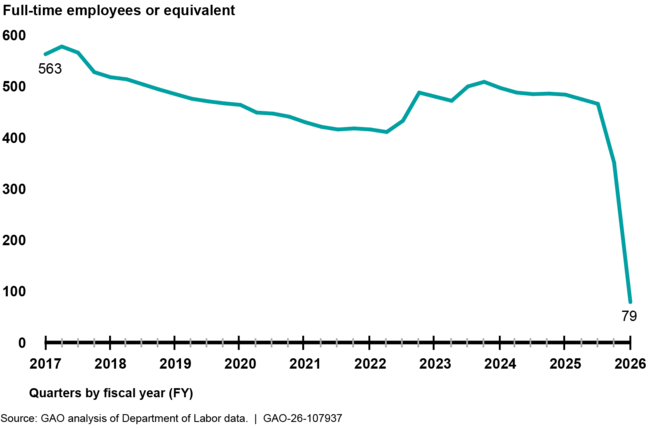
Section 503 of the Rehabilitation Act of 1973 (Section 503) requires certain federal contractors to take proactive steps to employ people with disabilities. The Office of Federal Contract Compliance Programs (OFCCP) within the Department of Labor (DOL) oversees contractors’ compliance with Section 503. Since January 2025, DOL has reduced its oversight activities. For example, DOL has suspended audits of selected contractors, which were a key tool for monitoring compliance. From fiscal years 2017 through 2025, 532 audits found Section 503 violations. Without resuming audits, DOL has less assurance that contractors are supporting employment of people with disabilities. Further, DOL has reduced OFCCP’s workforce in response to changes in its activities (see fig.). However, these changes were not informed by strategic workforce planning consistent with key principles for such efforts. DOL has made changes to Section 503 regulations that could further impact OFCCP’s activities. Engaging in strategic workforce planning would help DOL ensure that OFCCP’s workforce composition meets its needs.
Office of Federal Contract Compliance Programs Workforce, FY 2017–2026
Federal contractors face a range of challenges complying with Section 503. Selected stakeholders identified challenges in three key areas:
- conducting outreach to and recruiting people with disabilities,
- retaining and advancing people with disabilities, and
- demonstrating compliance with Section 503.
Stakeholders also said that DOL could provide additional guidance to help contactors comply with the law. For example, information on how to provide reasonable accommodations and a list of best practices for Section 503 compliance could help contractors better understand how to support employees with disabilities.
Why GAO Did This Study
In fiscal year 2025, the federal government spent about $793 billion on contracts with federal contractors—which employ over 1 million U.S. workers. Section 503 prohibits federal contractors from discriminating in employment against people with disabilities. It also requires certain contractors to take proactive steps to employ and advance in employment people with disabilities.
GAO was asked to review the implementation and oversight of Section 503. This report addresses (1) the extent to which DOL monitors Section 503 compliance and plans for its workforce needs, and (2) what challenges, if any, contractors face in complying with Section 503 and the extent to which DOL has provided resources to assist contractors.
GAO analyzed OFCCP enforcement data and DOL human resources data, and reviewed DOL documents. GAO conducted interviews and discussion groups with DOL officials as well as representatives of contractors, consultants who assist contractors with compliance, academic researchers, and other stakeholders who were familiar with Section 503 compliance or supporting employment of people with disabilities. GAO also conducted a nongeneralizable survey of representatives of contractors.
Recommendations
GAO is making eight recommendations, including that DOL resume compliance audits, conduct strategic workforce planning for OFCCP, and provide additional information to help contractors provide reasonable accommodations to employees with disabilities and comply with Section 503. DOL agreed with six of the recommendations and neither agreed nor disagreed with the other two.
Recommendations for Executive Action
| Agency Affected | Recommendation | Status |
|---|---|---|
| Department of Labor | The Secretary of Labor should ensure that OFCCP resumes collecting certification of AAPs from contractors through its Contractor Portal or other mechanism. (Recommendation 1) |
When we confirm what actions the agency has taken in response to this recommendation, we will provide updated information.
|
| Department of Labor | The Secretary of Labor should ensure that OFCCP resumes audits related to Section 503 compliance. (Recommendation 2) |
When we confirm what actions the agency has taken in response to this recommendation, we will provide updated information.
|
| Department of Labor | The Secretary of Labor should ensure that OFCCP analyzes trends in reasons for closing or referring Section 503 complaints that are not appropriate for it to investigate, and uses the results to identify and implement any identified actions to strengthen the complaints process, as appropriate. (Recommendation 3) |
When we confirm what actions the agency has taken in response to this recommendation, we will provide updated information.
|
| Department of Labor | The Secretary of Labor should carry out strategic workforce planning for OFCCP, consistent with key principles, to align its workforce with its current responsibilities and future needs. (Recommendation 4) |
When we confirm what actions the agency has taken in response to this recommendation, we will provide updated information.
|
| Department of Labor | The Secretary of Labor should ensure that OFCCP provides resources on its website with potential partner organizations, including regional organizations, that can help contractors recruit employees with disabilities. (Recommendation 5) |
When we confirm what actions the agency has taken in response to this recommendation, we will provide updated information.
|
| Department of Labor | The Secretary of Labor should ensure that OFCCP adds a reasonable accommodations section to its website with links to resources explaining how employers can provide reasonable accommodations. (Recommendation 6) |
When we confirm what actions the agency has taken in response to this recommendation, we will provide updated information.
|
| Department of Labor | The Secretary of Labor should ensure that OFCCP develops resources with information on how to assess outreach and recruitment efforts required by Section 503 regulations, and publishes those resources on its website. (Recommendation 7) |
When we confirm what actions the agency has taken in response to this recommendation, we will provide updated information.
|
| Department of Labor | The Secretary of Labor should ensure that OFCCP provides a list of best practices for Section 503 compliance on its website. (Recommendation 8) |
When we confirm what actions the agency has taken in response to this recommendation, we will provide updated information.
|